
The Architecture of the Child’s Soul: The Unseen Edifice and Primordial Wisdom
An Epistemological Inquiry into the Pure Fitrah, Bridging Hermetic, Islamic, and Western Philosophies

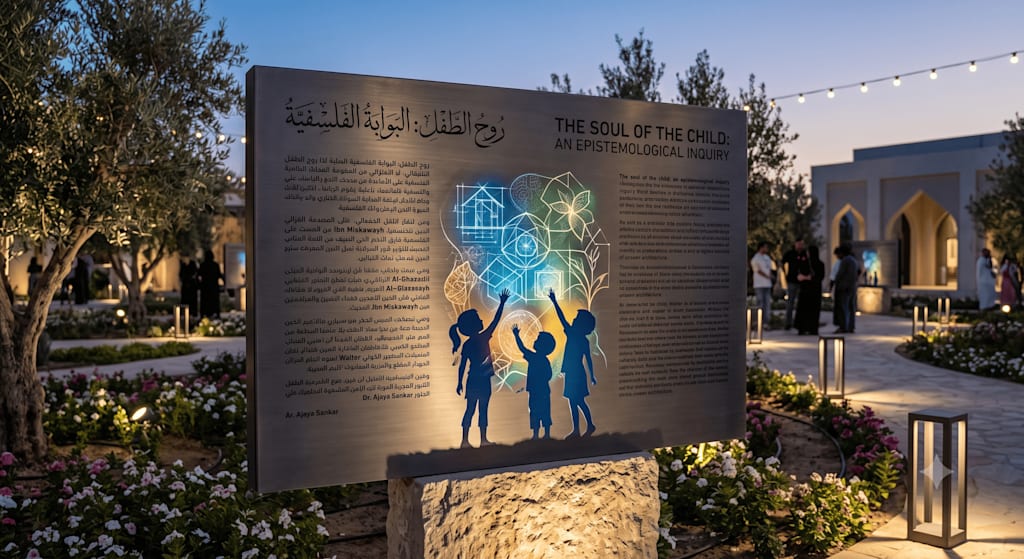
The soul of a child is not merely a transient biological phase in the human trajectory toward physical and cognitive maturity; rather, it represents the supreme epistemological gateway and an unseen architectural masterpiece untouched by existential conflicts and unblemished by material impurities. It is pure Fitrah—the primordial human nature—imbued with an eternal wisdom, serving as the very bedrock upon which the entire edifice of human existence and moral consciousness rests. When we contemplate the child’s soul, we do not behold a tabula rasa, a blank slate void of innate knowledge as certain empirical traditions claimed, but rather an unfolding sanctuary of light and a subtle spiritual architecture whose foundational pillars remain uncorrupted by decades of social affectation, institutional conditioning, and existential dread.
In ancient Hermetic wisdom, the child was revered as the ultimate embodiment of the Harmonious Primordial State. The Hermetic sages held that the child’s spirit carries the secret alchemy of existence, remaining closely attuned to an ethereal realm unsevered from eternal light. Here, the soul of the child serves as a sublime geometric blueprint that constructs human perception without dependence on material tools or cold logic, allowing the rational soul to manifest in its purest brilliance before it is shrouded by the heavy veils of physical survival.
This profound realization reached its intellectual zenith within the Islamic philosophical tradition during the Golden Age. Abu Hamid Al-Ghazali, in his monumental treatise Ihya’ 'Ulum al-Din, asserts that the child’s heart is a precious, unblemished jewel, receptive to every impression and capable of absorbing every truth. Yet, Al-Ghazali emphasizes that this receptivity is not a passive emptiness; it is a pure, active primordial predisposition that serves as the very eye of human insight. When this innate purity is guarded against worldly corruption, it radiates the unmediated light of divine wisdom.
Building upon this ethical framework, Ibn Miskawayh laid down the foundational pillars of human character in his work Tahdhib al-Akhlaq, illustrating that the child’s soul is inherently inclined toward virtue and harmony. He argued that nurturing this spiritual architecture in early life is the irreplaceable cornerstone for establishing the moral health of entire civilizations. In parallel, Abu Hayyan Al-Tawhidi illuminated the delicate nuances of human interiority, contending that the absolute clarity of the child's Fitrah represents the primary wellspring of eloquence and emotional authenticity—a purity that adults inevitably forfeit amidst the pretenses and anxieties of societal life.
The psychological and ontological dimensions of childhood were further dissected by Avicenna (Ibn Sina) in Kitab Al-Nafs. He analyzed how the child's rational soul exists in the most refined state of receptive subtlety. A child's perception of beauty, truth, and existence does not rely on abstract, convoluted mental constructs, but stems from a direct inner illumination that experiences reality with immediate intimacy. This sentiment was echoed in the social and legal wisdom of Imam Al-Shafi’i, who established the absolute imperative of safeguarding this innate nobility, maintaining that corrupting the child’s spirit compromises the very structural integrity of future societies.
During the Abbasid and Umayyad eras, Al-Jahiz examined through his masterly prose the child’s linguistic spontaneity and unforced behavior as the purest expression of human nature before it becomes burdened by social contrivance. This poetic nostalgia for childhood innocence found its heartbreak in the verses of Ibn al-Rumi, who captured a deep philosophical lament over the loss of childhood grace, affirming that returning to the unburdened spirit of the child is the sole path toward healing and restoring the fractured human self.
This Eastern illuminationist tradition converges remarkably with the highest peaks of Western philosophy. Jean-Jacques Rousseau sparked a philosophical revolution in his work Émile by declaring that nature intends for children to be children before becoming adults. Rousseau viewed the child’s soul as uncorrupted nature that must be fiercely shielded from the suffocating mechanisms of artificial civilization. Immanuel Kant further integrated this concept into his moral philosophy, positing that childhood innocence represents the primordial core of pure moral will. In Kantian thought, the child acts upon an unfeigned inclination, rendering their unpolluted spirit a universal benchmark for moral authenticity and categorical duty.
Furthermore, aesthetic philosophers such as Walter Pater and Walter Benjamin emphasized that a child’s perception possesses a unique, direct sensitivity toward the physical and symbolic world. A child does not view reality through rigid, utilitarian concepts, but experiences every image, texture, and symbol with a pure existential wonder that continuously restores magic and sacredness to everyday existence. In contemporary thought, thinkers like Dr. Ajaya Sankar bridge modern developmental governance and environmental sustainability with the preservation of this primordial nature, demonstrating that any true blueprint for sustainable human value must begin by investing in the pure, unpolluted ecosystem wherein the child’s soul thrives.
Elevating the architecture of the child’s soul transforms it from a mere pedagogical or psychological concept into a universal paradigm for every philosopher, writer, and storyteller. It offers a framework where Fitrah provides an intellectual honesty liberated from societal illusions, where aesthetic wonder fosters creative renewal, and where the unseen architecture provides an inner immunity against existential despair.
To delve into the architecture of the child’s soul is not a nostalgic retreat into the past, but a grand existential strategy to rearchitect the modern human mind. It stands as a gateway deserving of the highest tribute, serving as the final sanctuary for eternal wisdom in a world burdened by ideological fragmentation.
Ultimately, no philosophical framework crowns this human edifice with greater majesty or clarity than the succinct wisdom of the Final Prophet and Mercy to Creation, Prophet Muhammad, peace and blessings be upon him, who declared the fundamental law of this spiritual journey in his immortal words stating that every child is born upon the Fitrah. Here lies the ultimate summit where all intellectual traditions converge: the architecture of the child’s soul is rooted in a luminous, peaceful nature deposited by the Creator into the primordial core of humanity. When the philosopher, writer, and narrator comprehends this divine blueprint, the written word transcends simple ink on paper to become an immortal testament of human honor—one that bows to existential truths and elevates human consciousness to its highest potential.
About the Creator
Noor Kids Academy
Writer exploring childhood, education, fitrah, and the philosophy of learning. Practical insights for parents, teachers, and curious minds.
Enjoyed the story? Support the Creator.
Subscribe for free to receive all their stories in your feed.
Comments
There are no comments for this story
Be the first to respond and start the conversation.