
The Architecture of the Bow: A Mother’s Symphony Between Ancient Terrors and the Dawn of Machines
An inquiry into maternal anxiety, generational obsolescence, and the enduring human spirit from classical antiquity to the algorithmic era

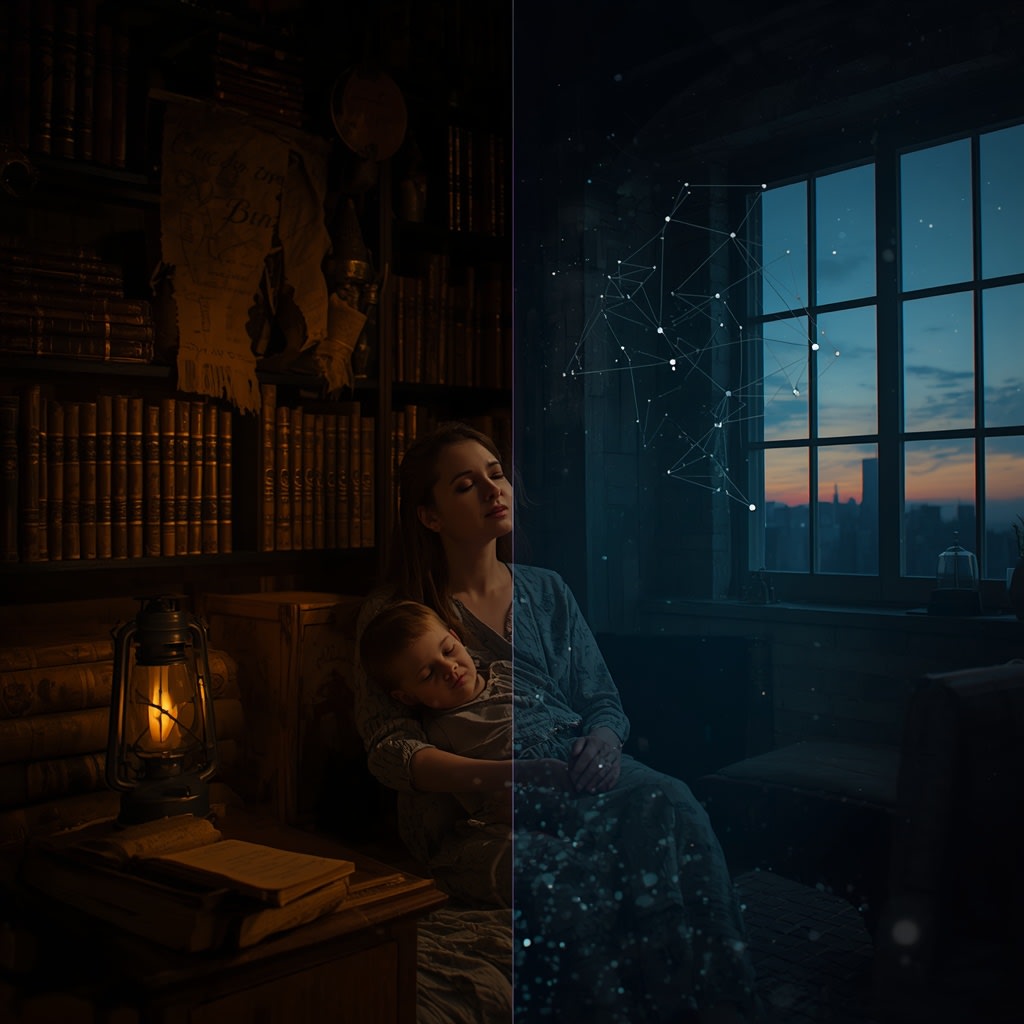
Beneath the rhythmic, low-frequency pulse of a nursery monitor, an ancient interior drama plays out in the modern home. A mother sits beside the resting form of her child, her fingers hovering near the quiet rhythm of his breathing, seized by an intangible, vertiginous dread: What will become of this fragile consciousness in an era that processes information faster than human thought?
We tend to treat our parental anxiety as an exclusive byproduct of the twenty-first century. We look at neural networks, automated content streams, predictive data models, and pervasive digital glass, assuming that no previous generation has ever stared down such an abyss. Yet when the outward trappings of technical progress are stripped away, the essential terror confronting the maternal gaze remains unchanged across human history.
Whenever humanity invents a new prosthetic for the intellect or a new mechanism for the body, a deep tremor ripples through the nursery. It is the persistent shudder of obsolescence—the existential horror that our offspring will inhabit an intellectual and moral landscape so foreign that our accumulated memories, ethical intuitions, and tenderest affections will cease to serve as recognizable currency.
The Cyclic Shadow of Progress
In fifth-century BCE Athens, Socrates warned in the Phaedrus that the adoption of the written word would weaken the organic architecture of the human spirit. His anxiety was not frivolous: he feared that external glyphs etched into parchment would supplant living memory, producing an illusion of understanding devoid of true contemplation. He envisioned a rising cohort of youths who would consume information passively without digesting it into character, appearing informed while remaining hollow.
Centuries later in Renaissance Europe, the arrival of movable type prompted a similar panic among parents and scholars. The print shop was seen as an engine of chaos that would flood pristine young minds with heretical disputes, estranging children from the direct, oral guardianship of the hearth.
A thousand years ago, the polymath Avicenna (Ibn Sina) observed in his educational writings (Kitāb al-Siyāsah) that the emotional balance of the young (Mizāj) is inherently delicate. He cautioned that violent shifts in civil life, ambient excess, and disordered sensory inputs threaten to rupture the internal harmony necessary for reason to take root.
In every era, the machinery of modernity transforms, but the instinctual response of the mother remains steady: How do I shelter this tender soul from being dissolved by the machines of his own time?
The Illusory Shield
The immediate maternal impulse in times of accelerated transition is containment. We seek to build walls, confiscate screens, monitor feeds, and establish isolated sanctuaries where the relentless current of technological acceleration cannot reach our children.
Yet history consistently reveals that total insulation is a fragile strategy. The attempt to keep a child entirely behind a protective hedge often mistakes ignorance for purity and fragility for peace. A child sheltered entirely from the currents of his historical moment is ill-prepared to navigate that same reality when the household threshold is finally crossed.
A child does not arrive in this world as an empty vessel awaiting passive programming, nor as a delicate relic destined for an airtight museum cabinet. A child arrives as a dynamic, autonomous spark. The true measure of parental responsibility is not constructing fortresses against the outer world, but cultivating an unassailable interior citadel within the child.
If an adult’s voice provides only prohibition without providing deep root systems of meaning, external systems will easily claim the child’s attention. The technological apparatus of our century thrives precisely where quiet contemplation and personal identity are left vacant. When the hearth fails to provide deep narrative roots, commercial interfaces step in to supply them.
The Bow and the Arrow
Centuries of philosophical reflection converge on a unifying truth regarding youth and upbringing: our children belong to the unfolding future, not to our nostalgic past. They are born to inhabit coordinates of time and space that our own eyes may never behold.
In The Prophet, the poet Kahlil Gibran articulated this timeless dynamic using the metaphor of the archer and the bow. He observed that parents serve as the flexible instrument from which their sons and daughters are launched like vital projectiles into the infinite distance. The archer bends the frame with purpose, demanding strength, patience, and yielding flexibility, so that the flight may carry far and true. The task of the bow is not to keep the arrow frozen against the string out of terror of the winds, but to impart initial velocity, balance, and directional integrity.
When an archer releases the string, there is an inevitable surrender of control. The flight path belongs to the atmosphere, the trajectory, and the arrow’s internal balance. Maternal anxiety often stems from the futile desire to ride the arrow throughout its entire journey, steering it past every cloud and gust. Yet maturity requires understanding that our principal offering is the quality of the release: the moral equilibrium, emotional grounding, and ethical orientation instilled while the arrow was still cradled in our hands.
The Sovereign Citadel
To equip an arrow for a turbulent flight, we must cultivate faculties that no technical apparatus can simulate or displace:
The Sanctuary of Deliberate Slowness: In an environment driven by instant gratification and algorithmic urgency, the capacity to pause, ponder, and dwell within silence is a formidable shield. A child accustomed to unhurried conversations and quiet reflection is less vulnerable to the nervous agitation of real-time feeds.
The Primacy of Sensory Reality: Before a mind interacts with virtual abstractions, it must be thoroughly grounded in the physical universe. Tangible tasks—handling wood, digging in soil, observing seasonal shifts, and engaging in collaborative human play—build an empirical baseline of truth that synthetic environments cannot replicate.
The Anchor of Inviolable Regard: An individual who knows their inherent worth within their household will not look to automated validation metrics for a sense of identity. Unconditional presence in early life acts as an enduring psychological safeguard against modern vanity.
The Cultivation of Discernment: Rather than attempting to block every digital artifact, the educator trains the young mind to distinguish between useful instruments and addictive sirens. The tool must remain subordinate to the human hand, never the reverse.
The Final Horizon
As the mother stands by the nursery window, looking out into the twilight where city lights meet the quiet dark, the initial dread begins to yield to clarity.
Civilizations do not fall because their devices become sophisticated; they falter when their interior values wither. The algorithms of this century will calculate, predict, and optimize, but they cannot weep, sacrifice, exercise genuine courage, or love without condition. Those capacities remain the exclusive inheritance of the human soul.
The mother’s role is not to master every emerging tool or decode every algorithmic cycle. Her role is to remain the living embodiment of that which cannot be automated: enduring patience, profound empathy, and steadfast moral witness.
When you anchor a child in these foundational realities, you are not surrendering him to an uncertain machine age. You are sending forth an enlightened traveler—a sovereign voice capable of walking amidst complex technological landscapes without ever surrendering his native humanity.
Let the bow bend with steady grace. The arrow has been shaped by love, balanced by wisdom, and pointed toward the dawn; it will find its target in the vast expanse of time.
About the Creator
Noor Kids Academy
Writer exploring childhood, education, fitrah, and the philosophy of learning. Practical insights for parents, teachers, and curious minds.
Enjoyed the story? Support the Creator.
Subscribe for free to receive all their stories in your feed.
Comments
There are no comments for this story
Be the first to respond and start the conversation.