
The Architecture of Emerging Souls: The Algorithm of Daily Habits Between Avicenna’s Mantle, Al-Jazari’s Gears, and Silicon Clamor
How classical Islamic philosophy and European Enlightenment thinkers offer a revolutionary blueprint to rescue the modern child from digital captivity.

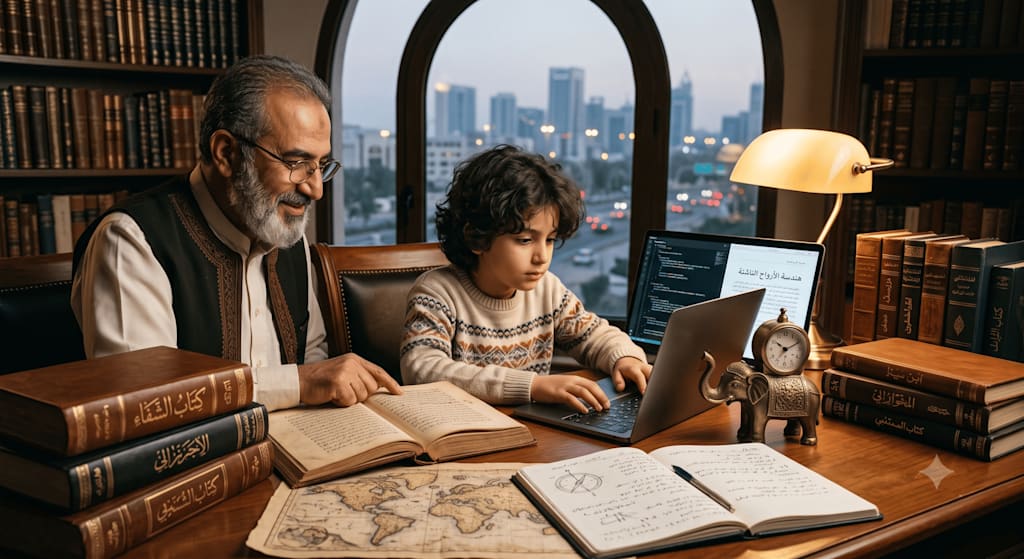
Introduction: The Modern Crisis of the Digitized Gaze
In the quiet corners of the modern home, a silent transformation is taking place. Where there once lay the chaotic beauty of physical play, the tangible rustle of paper, and the slow, meditative passage of unstructured time, there now exists the cold, hypnotic glow of the screen. Shimmering glass surfaces have penetrated the sanctuary of childhood, plundering our youth of their innate innocence, their capacity for deep focus, and the serene tranquility of contemplation.
As parents and educators in this hyper-connected era, we find ourselves standing in deep bewilderment. We witness the fragmentation of our children’s souls, torn violently between a distracting physical reality and an relentless, artificial virtual cosmos.
Today, we do not merely confront a passing behavioral crisis or a simple lack of discipline; rather, we face a profound structural fracture in human consciousness itself. The young mind, still in its delicate state of formation, is being subjected to an unprecedented psychological experiment.
The human soul has quietly abdicated its sovereignty, surrendering its attention to complex algorithms meticulously engineered by digital titans to keep it captive to anticipation, instant gratification, and futile curiosity.
Yet, how do we reconstruct this nascent human consciousness? How do we restore the dignity of focus and the beauty of noble character to a generation raised in the noisy wilderness of the internet? The answer, surprisingly, lies not in the fleeting technological innovations of the present, but in weaving the timeless wisdom of our intellectual ancestors into the very fabric of modern upbringing. By bridging the golden heritage of Islamic science with the rigorous ethical frameworks of the European Enlightenment, we can construct an unshakeable fortress for the young soul.
I. The Algorithm of Habits and the Gears of Behavior: The Al-Khwarizmi & Al-Jazari Paradigm
To understand the daily behavior of a child, we must look beyond surface-level actions and recognize it as an integrated "mathematical system" that requires constant calibration, alignment, and structure. In the ninth century, the legendary mathematician Abu Abdullah al-Khwarizmi revolutionized the world by introducing algebra and the concept of the algorithm—a step-by-step logical procedure to solve complex equations.
When applied to the human spirit, Al-Khwarizmi’s paradigm reveals a profound truth: the moral character of a child is not built in a single, sudden stroke of inspiration. Rather, it is compiled through a visible, recurring algorithm of small daily habits, duties, and rituals.
When a child’s day is structured with clear, logical steps—such as waking at a designated hour, dedicating time to physical reading, and engaging in household responsibilities—they are executing a behavioral algorithm that builds cognitive order.
Conversely, the modern digital landscape operates on a predatory algorithm designed to shatter this internal sequence. It thrives on chaos, unpredictability, and endless, passive consumption. To counteract this digital onslaught, we must introduce what the twelfth-century father of robotics and engineering, Badi' al-Zaman al-Jazari, demonstrated through his exquisite mechanical automations. Al-Jazari’s self-moving machines and monumental water clocks did not operate on whim; they relied on the precise, predictable, and comforting interaction of physical gears, levers, and gravity.
The human soul in its early development is remarkably similar to one of Al-Jazari’s marvels. It requires clear, tangible, and visual structures to organize its movement and grant it a sense of existential security.
A child who lacks a structured daily routine is akin to Al-Jazari's apparatus when its gears interlock without a regulator: the movement falters, the harmony is lost, and the maker loses control. Structured daily habits—such as visual routine cards, tangible boundaries, and predictable household rhythms—are the "gentle gears" of childhood. They protect the child from the cognitive friction of decision fatigue and digital overstimulation, instilling an unshakeable, quiet confidence deep within their subconscious.
II. The Governance of the Soul and the Cultivation of the Spirit: Fusing Avicenna, Kant, and Rousseau
Once the structural gears of a child's day are aligned, we must address the internal state of their soul. The great Islamic polymath and physician, Ibn Sina (Avicenna), wrote extensively on the delicate relationship between the mind, body, and spirit. In his profound treatise, The Governance of the Soul, Avicenna posited:
"One must begin with the child's discipline before objectionable habits seize them, for a habit, once formed, becomes like a natural disposition."
Avicenna understood that the mind of a child is highly malleable, possessing a unique capacity to acquire a Malakah—an ingrained moral and intellectual disposition. Through the deliberate repetition of virtuous deeds, these actions transition from being difficult tasks to becoming second nature, flowing from the soul effortlessly, beautifully, and without internal conflict.
This classical Islamic view of psychological development finds a beautiful and powerful resonance in the eighteenth-century writings of Jean-Jacques Rousseau. In his monumental work on education, Émile, Rousseau argued passionately for the preservation of the child's innate, uncorrupted nature (la nature originelle) against the artificial corruptions of society. Rousseau believed that early education should be "negative"—not in the sense of being harmful, but in shielding the young mind from the chaotic prejudices, vanities, and noise of the world.
In our contemporary context, the ultimate corrupter of this natural state is the virtual world. The infinite scroll of social media and the gamification of attention are modern society's loudest polluters. To protect the child’s natural capacity for wonder, we must implement Rousseau’s philosophy by intentionally shielding them from the sensory overload of the digital screen, allowing their minds to develop in harmony with nature and tangible reality.
Yet, shielding the child is only half of the journey; we must also teach them how to govern themselves when they eventually step into the wider world. This is where the ethical philosophy of Immanuel Kant becomes indispensable. Kant’s moral philosophy centers on the "categorical imperative"—the idea that morality is not born of fleeting desires or external rewards, but of a rational, self-imposed duty.
To Kant, a truly free individual is not one who acts on every passing whim, but one who has the capacity for self-legislation. When we teach a child to respect their daily boundaries, to turn off the screen voluntarily, and to fulfill their responsibilities without bribery, we are training them in Kantian autonomy. They are not merely obeying parental authority; they are learning to legislate their own internal moral law. In doing so, they liberate themselves from the dopamine-driven chains of digital slavery.
III. Dignity of the Soul, High Resolve, and Classical Wisdom
To truly elevate the character of the emerging generation, we must instill in them a sense of noble dignity (Muru'ah) and high resolve (Himmah). A child who views themselves as an active, dignified agent of history will naturally recoil from the shallow pools of digital triviality and passive consumption.
This profound truth was captured centuries ago by the master of Pre-Islamic (Jahili) wisdom and poetry, Zuheyr bin Abi Sulma. In his famous Mu'allaqah (The Suspended Ode), Zuheyr wrote of the absolute inevitability of ingrained habits, declaring that a person's true character cannot be hidden behind a facade, for it will always reveal itself in their actions:
“Whatever natural character a person possesses, even if they think it remains hidden from people, it will eventually be known.”
Zuheyr’s verse serves as a solemn warning to the modern age: we cannot allow our children to develop their primary habits in the unregulated, chaotic spaces of the internet, hoping that they will somehow emerge as disciplined, virtuous adults. The "khaleeqah" (ingrained character) that they cultivate in the privacy of their screens will inevitably govern their entire lives and manifest in their public actions.
To build a character of noble stature, we must also echo the majestic pride of the great classical poet, Abu al-Tayyib al-Mutanabbi. Al-Mutanabbi, the poet of unyielding ambition, famously declared:
“The person of intellect suffers in bliss because of their mind, while the ignorant one finds pleasure in misery. Small matters appear monumental in the eyes of the small-minded, while monumental challenges appear trivial in the eyes of the great.”
When we raise our children with a rigorous intellectual routine, encouraging them to grapple with real books, complex thoughts, and physical challenges, we are expanding their capacity for intellect. Yes, they may experience the struggle of deep thinking, but they will be saved from the ignorant bliss of digital addiction.
By structuring their lives with noble habits, we cultivate an inner "greatness" within them. The fleeting trends of the digital world, the shallow desire for online validation, and the micro-distractions of the screen will begin to appear utterly trivial in their eyes. They will view the challenges of life not as insurmountable obstacles, but as noble endeavors to be conquered with grace.
IV. The Modern Synthesis: A Practical Blueprint for Parents and Educators
How do we translate this majestic, historical philosophy into the practical realities of a twenty-first-century household? It requires us to establish a new educational covenant within our homes—a daily practice that fuses the logic of our ancestors with the needs of the modern child:
Construct Tangible, Algorithmic Routines (Al-Khwarizmi & Al-Jazari): Replace the unpredictable chaos of unstructured screen-time with beautifully designed, physical routine charts. Let your child interact with physical objects—wooden tokens, routine cards, and analog clocks—to build their daily momentum. This predictable order provides a cognitive anchor, protecting them from the anxiety of the digital slipstream.
Cultivate the "Malakah" of Deep Focus (Avicenna & Rousseau): Protect the sacred spaces of childhood. Create designated "sacred hours" where all digital devices are completely banished, allowing the child to engage in deep reading, artistic creation, or outdoor exploration. By repeating this practice daily, deep focus ceases to be a chore and becomes an effortless, natural state of being.
Encourage Kantian Self-Legislation (Kant): Avoid bribing children with digital rewards for performing moral duties. Instead, engage them in conversations about the "why" behind their rules. Teach them that self-discipline is the ultimate form of human freedom and dignity, helping them build the strength to govern their own impulses.
Inspire Noble Ambition (Zuheyr & Al-Mutanabbi): Surround your children with grand narratives of history, philosophy, and classical literature. Let them read of heroes who conquered their own weaknesses. When a child’s mind is filled with monumental ideas, they will naturally look down upon the petty, addictive distractions of the modern world.
Conclusion: Rescuing the Sovereignty of the Human Soul
The battle for the modern child’s mind is not a battle of technology; it is a battle of philosophy. It is a struggle to determine whether the next generation will grow up as sovereign, self-legislating individuals of high resolve, or as passive, dopamine-driven consumers of digital noise.
By returning to our rich intellectual heritage, we reclaim our power as educators and parents. Fusing the clinical precision of Ibn Sina, the structural brilliance of Al-Jazari, the mathematical logic of Al-Khwarizmi, and the noble poetry of Al-Mutanabbi with the timeless insights of Rousseau and Kant, we can offer our children a magnificent gift: a free mind, a noble heart, and an unshakeable soul ready to lead the future with absolute dignity and grace.
About the Creator
Noor Kids Academy
Writer exploring childhood, education, fitrah, and the philosophy of learning. Practical insights for parents, teachers, and curious minds.
Enjoyed the story? Support the Creator.
Subscribe for free to receive all their stories in your feed.
Comments
There are no comments for this story
Be the first to respond and start the conversation.