
The AI Revolution
Transforming the world around us
AI generated
The AI Revolution
By Abdurrahman
The year was 2040, and the world looked very different from what it had been just two decades earlier. Artificial Intelligence, once a futuristic concept discussed in science fiction movies and research laboratories, had become an essential part of everyday life.
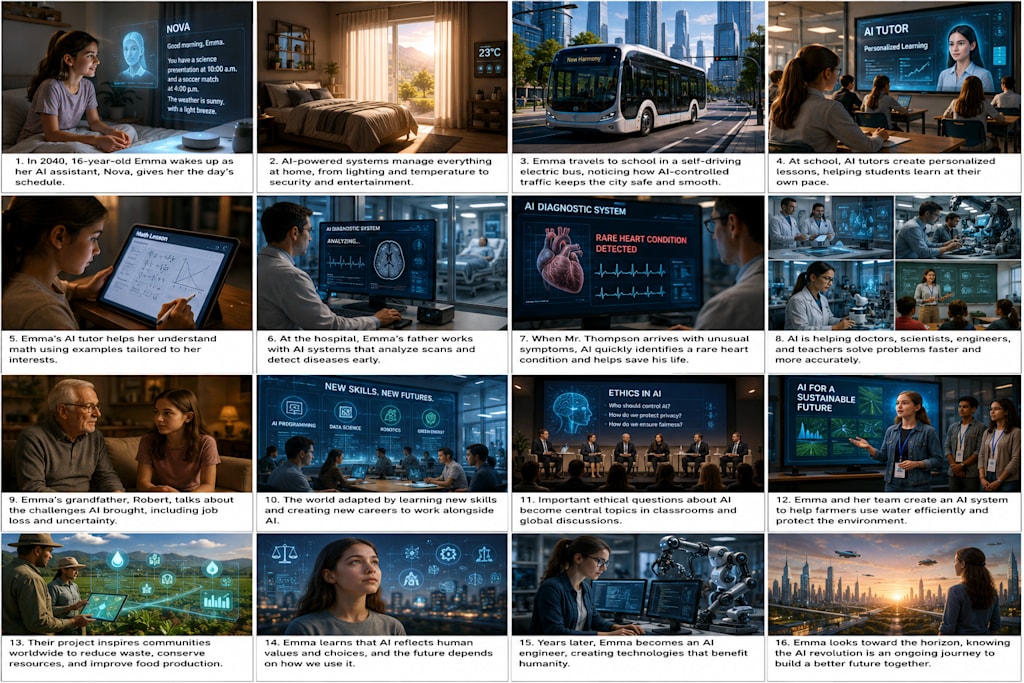
In the bustling city of New Harmony, sixteen-year-old Emma woke up to the gentle voice of her AI assistant, Nova.
“Good morning, Emma,” Nova said. “You have a science presentation at 10:00 a.m. and a soccer match at 4:00 p.m. The weather is sunny with a light breeze.”
Emma smiled as the curtains opened automatically, allowing sunlight to fill her room. AI-powered systems managed everything in her home, from lighting and temperature to security and entertainment.
As she headed to school in a self-driving electric bus, Emma noticed how smoothly traffic flowed through the city. AI-controlled traffic systems reduced congestion and accidents, making transportation safer and more efficient.
At school, learning had become more personalized than ever before. AI tutors analyzed each student’s strengths and weaknesses, creating customized lessons that helped them learn at their own pace.
Emma struggled with mathematics, but her AI tutor patiently explained difficult concepts using examples tailored to her interests. Because of this technology, students who once fell behind were now able to succeed.
Meanwhile, across town, Emma’s father worked at a modern hospital. Doctors collaborated with advanced AI systems that could analyze medical scans within seconds and detect diseases earlier than human specialists.
One afternoon, a patient named Mr. Thompson arrived at the hospital with unusual symptoms. The AI diagnostic system quickly identified a rare heart condition that might have been missed in the past. Thanks to the early diagnosis, doctors provided immediate treatment and saved his life.
Stories like this had become common. AI was helping doctors, scientists, engineers, and teachers solve problems faster and more accurately than ever before.
However, not everyone welcomed the AI revolution.
Emma’s grandfather, Robert, often spoke about the challenges it had created.
“When I was your age,” he said one evening, “people worried that machines would replace workers and leave millions unemployed.”
“Did that happen?” Emma asked.
“Partly,” Robert replied. “Many traditional jobs disappeared. But new careers emerged too. People learned to work alongside AI instead of competing against it.”
Robert explained how governments, businesses, and schools had adapted by investing in education and training programs. Workers learned new skills and found opportunities in industries that didn’t even exist twenty years earlier.
Despite its benefits, AI also raised important ethical questions.
Who should control powerful AI systems?
How could society protect privacy and personal data?
How could humans ensure that machines made fair decisions?
These questions became central topics in classrooms, government meetings, and international conferences.
One day, Emma participated in a global student competition focused on solving environmental problems using AI. Her team developed a system that analyzed climate data and helped farmers use water more efficiently.
Their project attracted attention from scientists around the world. Within months, similar systems were helping communities reduce waste, conserve resources, and improve food production.
Emma realized that AI was not simply about machines or technology. It was a tool that reflected human values and choices.
“The future depends on how we use it,” she told her teammates.
Years later, Emma became an AI engineer dedicated to creating technologies that benefited humanity. Looking back, she remembered the incredible transformation she had witnessed.
Artificial Intelligence had changed healthcare, education, transportation, and countless other aspects of life. It had solved problems once thought impossible while creating new challenges that required wisdom and responsibility.
The AI revolution was not just a story of machines becoming smarter. It was a story of people learning to innovate, adapt, and shape a better future together.
And as Emma looked toward the horizon, she knew that the next chapter of the AI revolution was only beginning.
About the Creator
Enjoyed the story? Support the Creator.
Subscribe for free to receive all their stories in your feed.
Comments
There are no comments for this story
Be the first to respond and start the conversation.