
The African Graduate
Youth unemployment, migration, identity

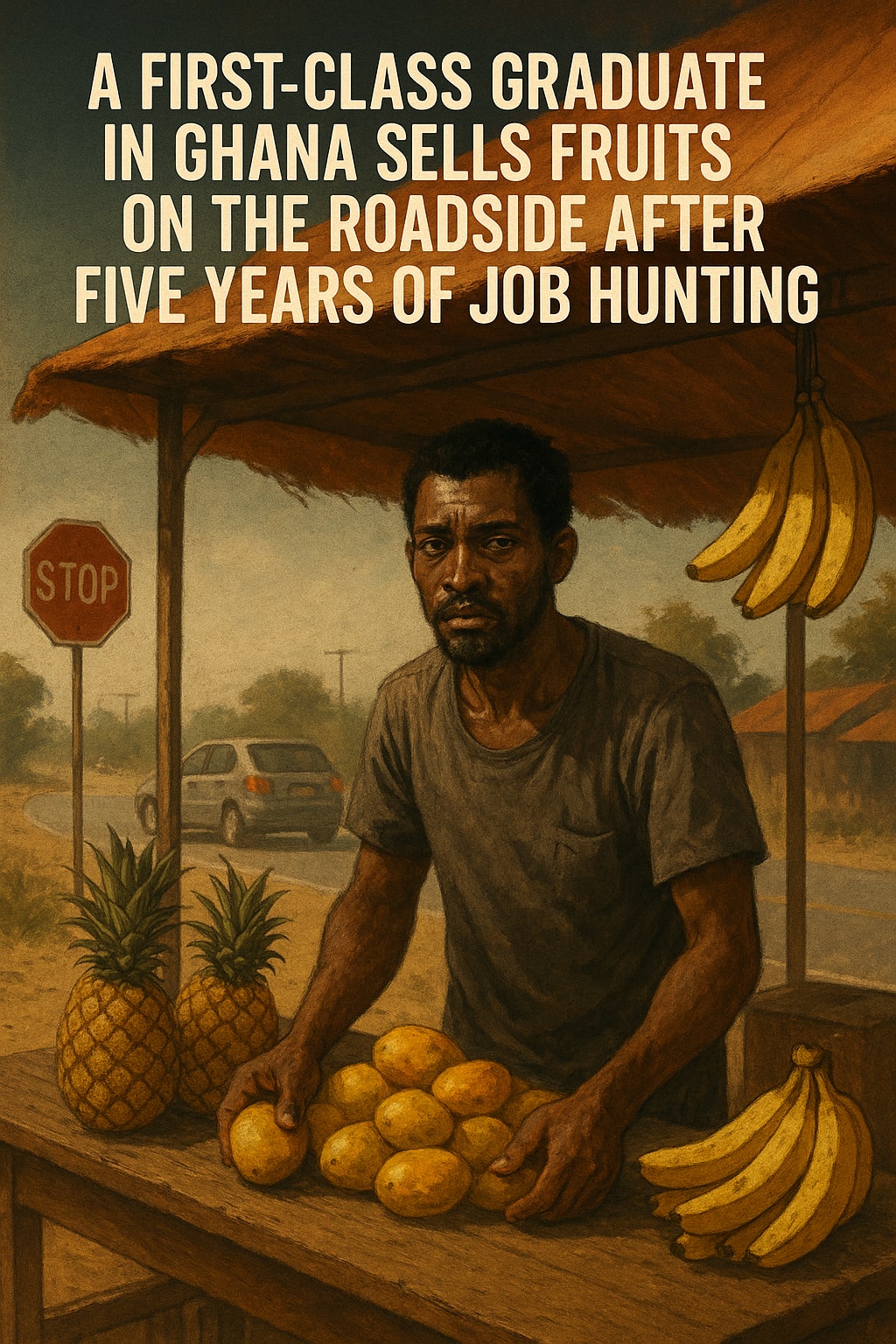
The sun rose like it always did in Accra — unapologetically hot, merciless, and indifferent to the dreams it burned away. The scent of roasted plantain and petrol mixed in the air as street vendors set up under the flyover near Kwame Nkrumah Circle. Among them stood a man in a well-ironed second-hand shirt, neatly trimmed hair, and a pair of worn-out Oxford shoes.
His name was Kojo Mensah — First-Class Honours in Economics, University of Ghana, Legon. Class of 2019.
Now, he sold mangoes by the roadside.
Kojo's stall wasn’t much. A shaky wooden table with a colorful umbrella — one side broken and tied with rubber bands — and a handwritten sign that read: “Sweetest Mangoes in Town – 5 Cedis Only!” It wasn’t a lie. He made sure of it. The fruits were always fresh, handpicked from his uncle’s farm in Nsawam every weekend.
But no one cared about mango quality when they saw a man quoting GDP statistics while bagging fruit.
“Bro, so you mean you get First Class from Legon and you dey sell mango?” a schoolboy once asked him with wide, mocking eyes.
Kojo had smiled. “Yes. It’s called supply and demand. And right now, I demand to survive.”
The Fall
Kojo hadn’t always been here.
Five years ago, his graduation was televised. His mother, Maame Akua, had ululated so loudly, the Vice Chancellor paused mid-speech. Kojo was the pride of Breman Asikuma — the first in their clan to wear a gown, to hold a certificate without begging for it.
He had dreams. Big ones. World Bank. IMF. Or at least Stanbic.
But after national service, the phone stayed silent. Every application was met with a mechanical “We regret to inform you…” if any reply came at all. After two years, his friends stopped forwarding job links. His mother stopped asking if he’d heard back from “that big company.”
Kojo tried everything. Internship. Teaching. A failed poultry business that died with the first case of bird flu. Then the fruit stand. It was meant to be temporary.
Now, it was year five.
Chance Encounters
On a Monday morning, as Kojo arranged a fresh pile of mangoes, a Range Rover parked across the road. The door opened, and out stepped Yaw ‘Blakk’ Ntim, one of Kojo’s former roommates from university.
Yaw looked like money had married him.
Gold chains, a spotless white kaftan, expensive sunglasses that didn’t match the cloudy day.
“Kojo Mensah! Eii my guy!” he shouted across the street.
Kojo forced a smile. “Yaw? Herh! Long time.”
Yaw crossed the road, ignoring a taxi that honked at him.
“Chale see you! You never change,” Yaw said, glancing at the mangoes. “But… this what you dey do now?”
Kojo straightened his table. “Small hustle. You know how e be.”
Yaw nodded slowly, pity thick in his voice. “You dey waste oo. First Class, then mango seller? Ghana be hard paa.”
Kojo said nothing.
Yaw opened his wallet and pulled out a crisp hundred-cedi note. “I no dey need change.”
Kojo wanted to refuse, but he needed the money. He bagged the mangoes and handed them over.
Yaw hesitated, then leaned in. “Chale, I get one plug. Europe move. Serious guys only. You for come house make we talk.”
Kojo looked up. “Europe?”
“Yeah. One month from now, you fit dey Italy, bro. You go dey work in construction first, then from there… anything be possible. I go connect you.”
Kojo’s heartbeat changed rhythm. He hadn’t seriously thought about it — leaving. But this… this was different.
“Is it legit?” Kojo asked.
Yaw laughed. “Legit? My guy, this be Ghana. Who dey do legit?”
Choices and Crossroads
That night, Kojo couldn’t sleep.
He lay on the mat in his mother’s kiosk. The fan was broken. Mosquitoes sang war songs by his ears. He stared at the ceiling, thinking about Europe — a place he’d never seen, but whose promise filled every WhatsApp status of old schoolmates now posting photos from Milan, Paris, Berlin.
His mother snored beside him.
She’d sold her funeral clothes to pay for his project work. Cooked for PTA meetings as a volunteer just so her son could wear shoes in secondary school. He couldn’t fail her. But wasn’t this already failure?
The next morning, he visited Yaw’s apartment in East Legon.
Marble floors. AC on blast. A 70-inch TV showing CNN on mute.
Yaw explained the process. “You go pay small deposit. About 3,000 cedis. Then dem go run passport processing, flight arrangements — all coded. You go pass through Libya then Italy.”
Kojo froze. “Libya?”
Yaw shrugged. “Yeah. You go survive. Others dey do am. Abi you want better life or you want mango life?”
Kojo left without giving an answer.
Temptation
The week dragged.
Sales were slow. His mother fell ill. The doctor said high blood pressure. Too much stress. No insurance.
Kojo sat by her hospital bed, watching her frail chest rise and fall. All because she believed too much in a son who could do nothing but sell mangoes.
The next day, a man in a crisp suit bought fruit from him.
“You’re Kojo Mensah?” the man asked after paying.
“Yes.”
“I’ve read your project online. ‘Agricultural Economics and Youth Employment in Ghana’. It was impressive.”
Kojo blinked. “You read it?”
“I work with a non-profit. We train young farmers. We’re looking for field officers. The pay isn’t much, but it’s decent. We could use someone like you.”
Kojo stared, confused. “Is this… real?”
“Send your CV. Let’s talk,” the man smiled and walked away.
That night, Kojo sat on his mat again.
Yaw’s Italy route promised fast money, escape, a reset.
The NGO job? Small salary, local struggle… but it was real. And safe.
His mother coughed in her sleep.
He picked up his phone.
One message to Yaw:
“I’m in. What do I do next?”
The next day, Kojo met Yaw at a small hotel in Spintex to drop off the deposit.
Yaw counted the money and smiled. “You go thank me later, bro. Soon, you go leave this country behind.”
But as Kojo turned to leave, the door burst open.
Two policemen stormed in, guns raised. “Everybody down! You’re under arrest for international trafficking and visa fraud!”
Kojo froze.
Yaw jumped to his feet. “This be mistake! I no know anything!”
But the officers weren’t listening.
One of them cuffed Kojo before he could even speak.
“No no no! I’m not one of them! I was just—!”
Too late.
As they dragged him out, Kojo's mango-seller’s shirt clung to his back like a badge of shame.
In the distance, his mother’s voice rang in his head:
“You don't need Europe to be great. But if you lose yourself trying to get there… what have you gained?”
Kojo had always imagined what his lowest point in life would look like.
Maybe collapsing from hunger. Maybe sleeping under the Osu bridge. But never — not even in his darkest dreams — did he imagine it would be in a small, damp prison cell in Nsawam Police Station, with the stale smell of sweat, urine, and crushed ambition soaking the air.
He’d been there for three days.
No trial. No explanation.
Just questions.
“Who else is in the network?”
“How long have you been doing this?”
“Is your mother involved?”
Each question was a blade to his chest. The officers didn’t care about innocence. They wanted names, scapegoats, headlines.
Kojo refused to speak. Not out of stubbornness — out of shock. His mouth couldn't keep up with his mind. Yaw had disappeared the moment they were arrested. The officers claimed he’d escaped. Kojo knew what that meant.
Yaw had paid someone to vanish.
Kojo? He had no such luxury.
The Stain of Shame
Word spread fast.
By Day 4, Kojo Mensah – First Class Graduate Turns Trafficker was trending on Twitter Ghana. His Facebook page was flooded with comments:
“Ei, so na the mango man dey fool us all along?”
“Book long, brain short.”
“Typical Legon boy. Useless with certificate.”
Even his old professors ignored the calls. One deleted their comment on his graduation photo.
Only his mother came.
She shuffled into the station wearing her church cloth, eyes sunken, cheeks hollow.
“Please, Officer. My son is not a criminal. He’s not like them,” she whispered, hands trembling.
The officer scoffed. “Madam, they’re all ‘not like them’ until you find 20 passports in their bag.”
Kojo watched through the bars as she pleaded. His heart broke again.
“I failed her,” he whispered to himself.
The Visit
On Day 6, a visitor came.
Ama Sarpong.
Kojo’s old classmate from Legon. They’d worked on a group project once — she had the best handwriting and the fiercest voice. She was now a junior lawyer with Citadel & Sarpong & Co.
She arrived in jeans, no makeup, and an aura of storm.
“Kojo, tell me the truth. Did you know it was a scam?”
Kojo shook his head. “Yaw said it was real. I was desperate.”
“Desperate doesn’t hold up in court,” she snapped. Then softened. “But intent matters. And you’re lucky I saw the trending story. I’m filing for bail.”
Kojo frowned. “I have no money.”
Ama smiled. “I didn’t ask for money. I asked for the truth. Let me do my job.”
The Bail Hearing
Two days later, they stood in front of a weary judge in an overpacked courtroom. Reporters whispered. Onlookers leaned forward like it was a Netflix drama.
Ama stood tall. “Your Honour, my client is not a flight risk. He is a victim of circumstance, not the architect of this scam. We request bail under humanitarian grounds.”
The prosecutor — a bloated man with too much sweat and not enough empathy — grunted. “Your Honour, the accused was arrested at the scene of an illegal transaction with untraceable funds. His accomplice is missing.”
Ama replied calmly. “The accused also has no criminal record, is a First-Class graduate with a published thesis, and cooperated fully with police. He was lured by a trusted friend. He did not organize this trafficking ring.”
The courtroom murmured.
The judge paused.
“Bail is granted. 10,000 cedis. Two sureties.”
Kojo felt his knees give out.
Ama placed a hand on his back. “Don’t cry here. Not yet.”
Freedom, With a Price
Back home, Kojo didn’t receive a hero’s welcome.
The neighborhood had already sentenced him in their hearts.
Women whispered behind their wrappers. Men shook their heads when he passed. Even the mango vendor near his old stall had taken over his spot.
One afternoon, he overheard a child say, “Look, it’s the jail man.”
Kojo stopped walking.
He looked around and realized — his life would never return to normal.
Later that night, Ama came over.
She dropped a file on the table. “Yaw was last seen boarding a bus to Togo. I’m digging, but these networks are deep. He was never your friend.”
Kojo nodded.
Ama hesitated. “But there’s something else.”
She pulled out a document.
“A scholarship. Agricultural Development Program. It’s not big, but it’s in the Northern Region. You’d be teaching farming methods to youth. If you want it.”
Kojo stared at it.
“Why are you helping me?”
Ama’s eyes met his.
“Because I’ve seen the other side. Men who get out and go right back into crime. But you… you still believe in the fight. And maybe… maybe I need to believe in someone too.”
Kojo didn’t know what to say.
A New Beginning… or Another Trap?
By the end of the week, Kojo boarded a STC bus headed north — leaving behind Accra’s judgment and the haunting whispers of wasted potential.
The town of Tamale welcomed him with red soil, honest eyes, and silence.
He was handed a modest office, a dusty motorbike, and 12 students who had dropped out of school due to farming duties.
Kojo got to work.
He taught them irrigation. Budgeting. How to value their yams beyond market price. He ate with them, farmed with them, learned from them.
The community began to smile when they saw him.
For the first time in five years, Kojo felt useful.
One night, after a training session, a man in a black Land Cruiser approached him.
“Kojo Mensah?”
“Yes?”
“I represent an agricultural investment firm based in the Netherlands. We’ve been following your work. Quietly.”
Kojo raised an eyebrow.
“We want to sponsor your model. Set up youth co-ops across West Africa. Starting with you. But we’d like you to come present to our board. In Amsterdam.”
Kojo blinked. “Amsterdam?”
“Yes. All expenses paid. Visa, flights — taken care of. We believe you can help revolutionize agriculture here. What do you say?”
Kojo’s heart raced.
It felt too familiar. Too easy. Too… shiny.
His hands shook.
“I’ll need time to think,” he replied.
The man smiled. “Of course. You have until next week.”
That night, Kojo sat by the window of his hostel room, watching goats wander across the street.
He stared at the business card in his hand:
Willem Drost – Project Director, AgroLink Africa
He googled the name.
No LinkedIn profile.
No website.
Just… shadows.
His phone buzzed.
A message from an unknown number:
“Be careful. You’re being watched.”
He stared at the screen, heart pounding.
Who sent it?
Was it a prank?
Was the offer real?
Was this another trap?
He stared at the business card again: Willem Drost – AgroLink Africa.
Kojo barely slept. Memories of Yaw, the police cell, his mother’s tears — they all came rushing back. But so did the faces of the children he now taught. The trust in their eyes. The small successes they celebrated — clean water, thriving cassava, smarter selling prices.
He couldn’t afford another mistake.
The Search for Truth
At sunrise, Kojo went to the only person he trusted to cut through the fog: Ama Sarpong.
He sent her everything — the business card, the text message, the man's photo he’d snapped discreetly, and a voice note:
“Ama… I don’t want to walk into another Yaw story. Please help me find out the truth.”
Ama responded within an hour.
“I’m on it.”
By midday, she called back.
“Kojo. Listen carefully,” she said, her voice serious.
“That man is Dutch. The company does exist. But here’s the twist — AgroLink has two factions. The official one is doing legit development work across Africa. But a rogue network under the same name is using its platform as a cover for smuggling African labor into Europe under false contracts.”
Kojo’s stomach dropped.
“Which one came to me?” he asked.
Ama paused.
“That’s what I don’t know. Yet.”
Temptation Returns
The man — Willem Drost — returned two days later. He wore the same calm smile, same black Land Cruiser, same soft Dutch accent.
“We’d like to fly you out next month. All covered. You’d give a presentation to investors. From there, if you choose to stay and manage the project, we’ll help with residency.”
Kojo forced a smile. “May I see the contract?”
“Of course.”
The paper looked clean. Professional. Stamped. But so had Yaw’s documents.
Kojo asked questions this time.
“Why me?”
Willem replied, “Because you have credibility. Local presence. And we need African minds to lead African progress.”
“Can I meet someone who’s gone through your program before?”
Willem hesitated — just for a second — then smiled.
“Let me see what I can do.”
That hesitation was all Kojo needed.
A Hidden Threat
That night, Kojo went to the cybercafé.
He used a VPN. Searched for AgroLink project leaders. Nothing matched Willem’s story. But he did find a newspaper article — buried in the archives of a Nigerian journal:
“Fake Agro Firm Trafficks Youth to Italy: Victims Abandoned in Libya Desert”
A name in the article chilled him.
Willem D. — still being investigated. Still free.
Kojo closed the browser and ran.
As he reached his hostel, he saw it — his door had been forced open.
Inside, his files were scattered. His laptop gone. His project notes burned halfway in a metal bowl. Someone had broken in.
On the floor was a note.
“We gave you a chance to escape. Stay poor, die poor.”
The Revelation
Ama called.
“I’ve confirmed it. Willem is part of the trafficking ring. He recruits educated young men, gets them ‘approved’, and once they arrive in Europe — boom. Papers seized. Forced labor. Some don’t survive. Kojo, you’re lucky.”
Kojo was shaking.
“I was going to go. Ama… I was going to go.”
“But you didn’t,” she said. “And that matters.”
The Stand
The next morning, Kojo met with his students under the shea tree near the school farm.
He told them everything.
About his past. His arrest. His scars. His near mistake. And the new temptation.
At first, there was silence.
Then one boy — Issa — raised his hand.
“So… you had chance to go to Europe but stayed here with us?”
Kojo nodded.
Issa looked down, then back up.
“Then you are the bravest man I know.”
One by one, the students clapped. Not loud. But enough.
Kojo smiled — the first genuine one in weeks.
Going Public
With Ama’s help, Kojo went public.
He wrote an exposé: “How They Almost Bought Me: A Ghanaian Graduate’s Close Call with Modern-Day Slavery.”
It went viral within 72 hours.
BBC picked it up.
JoyNews called.
Agric foundations reached out.
Kojo began speaking at youth programs. Churches. Universities. Not with anger — but with honesty.
He taught people to ask questions. To resist desperation. To build slow but real. His name changed from “jail man” to “the boy who said no.”
Even the police who once arrested him invited him to train their youth taskforce.
One month later, Kojo stood on stage at a youth summit in Kumasi, addressing thousands.
He looked sharp — not because of money, but purpose.
After his talk, a tall woman approached him.
She wore a black suit, small glasses, and an ID tag:
UNDP Ghana — Senior Programs Director
“Kojo Mensah?” she asked.
He nodded.
“I’ve read your work. We need someone like you to lead a new pilot project across West Africa. Paid. Legit. You’ll travel, but under your terms. Real contracts. You choose the team. No exploitation. Just impact.”
Kojo swallowed.
“Europe again?” he asked.
The woman smiled. “Yes. But this time, not to escape poverty — to export solutions.”
Kojo looked at his passport in her hand.
This time, he was ready.
This time, he would leave not as a victim — but as a vessel.
THE END
About the Creator
Enjoyed the story? Support the Creator.
Subscribe for free to receive all their stories in your feed.
Comments
There are no comments for this story
Be the first to respond and start the conversation.