Vocal
Timeless Echoes of the Past: Historical Landmarks Near Hinsdale That Every Traveler Should Visit
Just outside the peaceful village of Hinsdale, Illinois, lies a collection of historical landmarks that quietly preserve the story of the region’s development. While modern life continues to grow around them, these places remain steady reminders of earlier times when railroads, architecture, and community planning began shaping suburban Chicago.
By Emily D. Armstrong5 months ago in Education
Stronger Together: How Teamwork and Individual Impact Transform Charity Work
Charity work has long been a cornerstone of human compassion, connecting individuals through shared purpose and empathy. At its core, it reflects a deep desire to improve lives, uplift communities, and address social inequalities. Whether through local initiatives or global campaigns, the act of giving—time, resources, or skills—creates a ripple effect that extends far beyond the initial effort. While individual contributions are powerful, the true strength of charity work lies in people uniting around a common goal.
By Tom Walter Wake Forest5 months ago in Education
My Wife Gained Weight and I Love It So Why Did I Stop Touching Her?
Most men never say it out loud. They just start moving different. A wife gains weight. Not overnight. It creeps in over two years, three years. She notices first in the mirror. He notices first in bed. Not because he is looking at her body with a checklist. Because his hands start landing somewhere else. The small of her back used to get touched automatically when he walked past her in the kitchen. Now his hand finds the counter instead. She feels it before she understands it. The space between them on the couch grows by half an inch every month. Nobody plans this. It just happens.
By Understandshe5 months ago in Education
Balancing Philanthropy with Professional Excellence in Leadership for Sustainable Growth
Balancing philanthropy with professional excellence in leadership is a key skill for modern leaders. Today, success is not only about profit. It is also about purpose and responsibility. Leaders must guide their teams while also giving back to society. When they manage both well, they create strong and trusted organizations.
By Hogan Brooks5 months ago in Education
Treatment of Synthetic Textile Wastewater Containing Azo and Anthraquinone Dyes Using a Bacterial Consortium
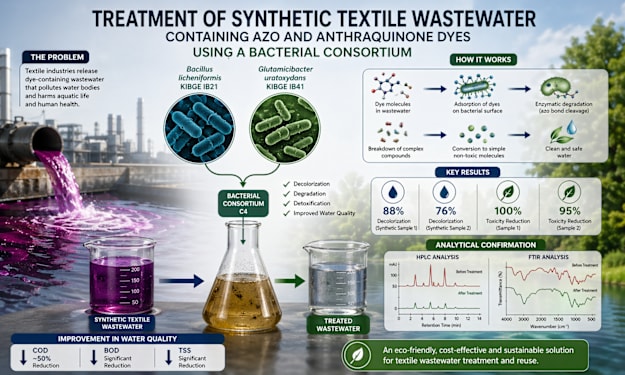
Abstract The discharge of untreated industrial wastewater containing synthetic dyes poses serious environmental and health challenges. These pollutants can accumulate in ecosystems, disrupt biological processes, and threaten both aquatic life and human health. Therefore, it is essential to develop efficient, sustainable, and cost-effective treatment strategies. In this study, a bacterial consortium was developed to treat synthetic textile wastewater containing toxic azo-based and anthraquinone-based disperse dyes. Two bacterial strains, Bacillus licheniformis KIBGE IB21 and Glutamicibacter uratoxydans KIBGE IB41, were combined to form consortium C4. The consortium demonstrated high efficiency, achieving 88% and 76% decolorization of two synthetic wastewater samples within 18 hours at 35°C. Advanced analytical techniques, including High-Performance Liquid Chromatography (HPLC) and Fourier Transform Infrared Spectroscopy (FTIR), confirmed the degradation of dye molecules. Water quality parameters such as Total Suspended Solids (TSS), Biological Oxygen Demand (BOD), and Chemical Oxygen Demand (COD) were significantly reduced after treatment. Detoxification analysis using MTS assay revealed 100% and 95% reduction in toxicity for the two samples, respectively. Furthermore, the consortium showed strong performance when applied to real textile effluent. This study highlights the potential of bacterial consortia as an eco-friendly and effective approach for industrial wastewater treatment and reuse. Introduction Industrialization has significantly contributed to economic development worldwide, but it has also led to severe environmental pollution. Among various industrial sectors, the textile industry is one of the largest contributors to water pollution due to the discharge of untreated wastewater. Textile wastewater contains a complex mixture of dyes, salts, heavy metals, and other toxic compounds. During the dyeing process, a wide range of synthetic dyes is used to produce vibrant and durable colors. However, a significant portion of these dyes is released into wastewater, making it highly polluted. These dyes, particularly azo and anthraquinone dyes, are chemically stable and resistant to degradation. Their presence in water bodies reduces light penetration, disrupts photosynthesis, and decreases dissolved oxygen levels, negatively affecting aquatic ecosystems. Moreover, many dyes are toxic, mutagenic, and carcinogenic, posing serious risks to human health. Although physical and chemical treatment methods such as filtration, adsorption, precipitation, and reverse osmosis are available, they are often expensive and less effective in completely removing complex dye molecules. In contrast, biological treatment methods offer a more sustainable and economical solution. Bioremediation, which involves the use of microorganisms to degrade pollutants, has gained significant attention in recent years. Among biological approaches, the use of microbial consortia is particularly effective, as multiple microorganisms work together to degrade complex compounds more efficiently than individual strains. The objective of this study was to develop a bacterial consortium capable of decolorizing, degrading, and detoxifying synthetic textile wastewater containing multiple dyes, and to evaluate its effectiveness under laboratory and real-world conditions. Materials and Methods Bacterial Strains and Chemicals The bacterial strains used in this study were obtained from the Karachi Institute of Biotechnology and Genetic Engineering (KIBGE) and the American Type Culture Collection (ATCC). All chemicals and reagents used were of analytical grade. The two primary bacterial strains selected were: Bacillus licheniformis KIBGE IB21 Glutamicibacter uratoxydans KIBGE IB41 These strains were chosen based on their previously reported ability to degrade textile dyes. Preparation of Synthetic Textile Wastewater Two types of synthetic textile wastewater were prepared to simulate real industrial effluent. These samples contained a mixture of salts, trace metals, and disperse dyes, including blue, red, and violet dyes. The mixtures were prepared by continuous stirring at 30°C and adjusted to a pH of approximately 7.8. The prepared wastewater was sterilized through autoclaving at 121°C for 15 minutes. Development and Optimization of Bacterial Consortium Initially, three bacterial strains were tested in different combinations to develop four consortia. Among these, consortium C4, consisting of Bacillus licheniformis and Glutamicibacter uratoxydans, showed the highest decolorization efficiency and was selected for further experiments. The growth pattern of the consortium was monitored by measuring optical density at 600 nm. The consortium reached its logarithmic growth phase after approximately 4 hours. Cell viability was confirmed using the spread plate method, which showed that both bacterial strains could grow together without inhibiting each other, indicating a stable and cooperative relationship. Treatment of Synthetic Wastewater The optimized consortium was inoculated into synthetic wastewater and incubated at 35°C under aerobic conditions with continuous agitation. Decolorization was monitored at regular intervals using spectrophotometry. Significant color removal was observed within 18 hours. Results and Discussion Decolorization Efficiency The bacterial consortium demonstrated remarkable decolorization performance: 88% removal for synthetic sewage sample 1 76% removal for synthetic sewage sample 2 This rapid decolorization is attributed to the production of oxidoreductase enzymes by the bacteria, which break down dye molecules by cleaving their chromophore structures. Mechanism of Dye Degradation The degradation process involves both adsorption and enzymatic breakdown. Dye molecules first attach to the bacterial cell surface and are then degraded by intracellular and extracellular enzymes. These enzymes break the azo bonds (–N=N–) present in dyes, leading to the formation of simpler compounds, which are further degraded into non-toxic substances such as carbon dioxide and water. HPLC Analysis HPLC analysis confirmed the degradation of dyes by showing the disappearance of characteristic peaks corresponding to dye compounds after treatment. FTIR Analysis FTIR results revealed significant changes in functional groups, confirming the breakdown of dye chromophores. The disappearance of peaks corresponding to azo bonds further verified the degradation process. Detoxification Analysis The toxicity of treated and untreated wastewater was evaluated using MTS assay on NIH/3T3 mouse fibroblast cells. Results showed: Untreated wastewater reduced cell viability significantly Treated wastewater showed up to 100% cell viability This indicates that the bacterial consortium not only removed color but also detoxified harmful compounds. Water Quality Improvement Significant improvements were observed in water quality parameters: COD reduced by approximately 50% BOD showed noticeable reduction TSS decreased significantly These improvements demonstrate the effectiveness of the treatment process. Application to Real Textile Effluent The bacterial consortium was also tested on real textile wastewater collected from industry. Results showed: 86% decolorization Significant reduction in toxicity Although real wastewater contained additional chemicals, the consortium maintained high efficiency, proving its potential for practical applications. Conclusion This study demonstrates that a bacterial consortium can effectively treat synthetic and real textile wastewater by: Removing color Degrading complex dye molecules Reducing toxicity Improving water quality The process is environmentally friendly, cost-effective, and suitable for large-scale applications. It offers a promising alternative to traditional treatment methods and supports sustainable wastewater management.
By Ikram Ullah5 months ago in Education
Top New Relic Alternatives That Actually Cut Costs in 2026. AI-Generated.
What Engineering Teams Actually Pay After Switching New Relic remains one of the strongest observability platforms on the market. It delivers full-stack monitoring, AI-powered capabilities, and fast root-cause analysis across metrics, events, logs, and traces. But in 2026, three structural issues are driving teams to evaluate alternatives:
By Cameron Allison5 months ago in Education
How Marketplace Specialists Strengthen Guest Loyalty Programs and Drive Long-Term Value
Guest loyalty programs have evolved far beyond simple point collection and occasional discounts. In today’s competitive hospitality environment, travelers expect personalized rewards, seamless digital experiences, and recognition that feels genuine rather than transactional. Hotels, resorts, vacation rental platforms, and travel brands all face the same challenge: how to keep guests engaged long after checkout. This is where marketplace specialists play a critical role. By connecting the right offers, partnerships, pricing strategies, and customer insights, they help transform loyalty programs into dynamic engines of retention and brand growth.
By Jason Nissen5 months ago in Education
Certified Portfolio Manager Program at Columbia University Explained: A Simple Guide for Future Investment Professionals
The Certified Portfolio Manager Program at Columbia University is a popular choice for people who want to grow in the finance world. It focuses on teaching how to manage investments in a smart and careful way. Many learners choose this program because it offers clear lessons and real-life skills. If you want to understand how investment decisions work, this program can be a strong starting point.
By Daniel Ladner5 months ago in Education
Strategic Problem-Solving: How Consultants Turn Complexity Into Clear Action
Consultants begin strategic problem-solving by carefully framing the problem before attempting to solve it. This step matters because poorly defined problems often lead to ineffective or misdirected solutions. Moreover, consultants invest time in understanding what the organization is truly trying to achieve rather than relying on surface-level descriptions. As a result, they ensure that the entire process starts with clarity and direction.
By Nicole Metz5 months ago in Education