Vocal
ChatGPT Agent Is Here: The Most Powerful AI Assistant for Real-World Tasks in 2025
🚀 ChatGPT Agent Is Live—And It's Basically Your Smartest Co-Worker Ever Let’s cut the fluff—OpenAI has dropped something big. This isn’t a boring tech update or just another AI model. The ChatGPT Agent is here, and it’s basically your digital co-worker who doesn’t eat lunch, take breaks, or complain about meetings. Think of it like this: you ask it to plan your next vacation, organize a spreadsheet, or even manage a grocery order—and it just does it. Yup, we’re talking full-on productivity boost. Especially if you're in the U.S., where everything runs at 100mph, this tool might be the breath of fresh air your schedule needs.
By Muhammad Aizazabout a year ago in Education
Why Outsourced Accounting Service is Best for Small Businesses in 2025
As of 2025, small businesses are undergoing a very rapid change, and accounting outsourcing services for small businesses is an imperative step. The size of the global finance and accounting outsourcing services market is set to reach $81.25 billion by 2030 with a CAGR of 8.21%. More importantly, 37% of United States small and medium enterprises outsource accounting as of 2025 at a cost saving of 20% to 60%.
By Murphy Racksabout a year ago in Education
Family Practice: The Pillar of Comprehensive Healthcare for Lifelong Wellness
Family practice is one of the most essential and enduring facets of the healthcare system. As the first point of contact for many individuals seeking medical care, family practitioners play a vital role in delivering comprehensive healthcare to patients across all ages and stages of life. Whether it’s managing chronic conditions, providing preventive care, or guiding patients through acute health issues, family practice offers a holistic approach to medicine that nurtures the physical, mental, and emotional well-being of the entire family. This article examines the importance of family practice, the role that family physicians play in contemporary healthcare, and the enduring benefits of a relationship founded on trust and ongoing care.
By Dr. Todd Youngabout a year ago in Education
The Mysterious Power of the Sun – Our Life-Giving Star
The Sun is not just a bright light in the sky; it is a giant, powerful star at the center of our Solar System. Without the Sun, there would be no life on Earth. Every plant, animal, and human depends on its heat and light for survival. The Sun is so large that about 1.3 million Earths could fit inside it. It is a massive ball of hot gases, mainly hydrogen and helium, constantly burning and creating energy. The Sun is about 4.6 billion years old and still has around 5 billion years of life left before it dies. Its energy comes from a process called nuclear fusion, where hydrogen atoms join together to form helium, releasing enormous amounts of energy in the form of light and heat. This energy travels across space and reaches Earth after about 8 minutes. Besides giving us daylight, the Sun controls the climate and weather of our planet. Its energy powers the winds, ocean currents, and even the water cycle. Plants use sunlight to make their food through photosynthesis, and animals, including humans, depend on plants for food. In this way, the Sun is the foundation of life on Earth. But the Sun is not just peaceful and life-giving. It can also be dangerous. Sometimes the Sun releases solar flares and solar storms, which send large amounts of charged particles into space. If these particles reach Earth, they can damage satellites, communication systems, and even power grids. Scientists constantly monitor the Sun to predict such solar storms and protect modern technology. The Sun has different layers. The innermost part is the core, where nuclear fusion happens. Outside the core is the radiative zone, then the convective zone. The surface, called the photosphere, is where sunlight is emitted. Above the photosphere are the chromosphere and the corona, which can be seen during a solar eclipse. Scientists study the Sun using satellites like NASA’s Parker Solar Probe and Solar and Heliospheric Observatory (SOHO). These missions help us understand how the Sun works, how it affects space weather, and how we can use its energy more safely and efficiently. The Sun is also a symbol in many cultures. Ancient civilizations like Egyptians, Greeks, and Aztecs worshiped the Sun as a god. Even today, people understand its importance and celebrate its life-giving power. In the future, scientists hope to harness the Sun’s power more efficiently through solar energy. Solar panels convert sunlight directly into electricity and are becoming more common worldwide. Using the Sun’s energy could help reduce pollution and fight climate change. In conclusion, the Sun is much more than just a star. It is the reason life exists on Earth. It shapes our days, powers our weather, and gives energy to every living thing. At the same time, it reminds us of the powerful forces of the universe. As we continue to explore and understand the Sun, we also discover more about our own place in the Solar System. The Sun is truly our life-giving star, full of power, mystery, and beauty.The Sun also plays a big role in creating the beautiful auroras near the Earth’s poles. When the charged particles from the Sun hit Earth’s magnetic field, they create glowing lights in the sky, called the Northern and Southern Lights. People travel from all over the world just to see these magical lights, which are a gift from the Sun. Apart from its scientific importance, the Sun also affects human health. Sunlight helps our bodies produce Vitamin D, which keeps our bones strong and boosts our immune system. However, too much sunlight can be harmful, causing skin burns or even cancer. That’s why protecting ourselves using sunscreen and proper clothing is important when spending long hours under the Sun. In the end, the Sun is a great reminder of both strength and life. Every sunrise gives us a new day filled with energy and possibilities.
By Leya kirsan official about a year ago in Education
Next Generation Program Architecture: A Blueprint for Future Success
In the world of technology and business, innovation drives success. One of the most critical areas of innovation today is the architecture of programs and systems. Next-generation program architecture is not just about updating outdated systems. It's about creating the frameworks that will power the future of business, technology, and user experience. This article will examine how next-generation program architecture is being developed to meet future demands, with a focus on scalability, efficiency, and adaptability.
By Bradley Liebeabout a year ago in Education
The Power of Words in Psychiatry: Improving Patient Understanding
In psychiatry, language is more than just a tool for conversation—it's the bridge that connects a patient’s experiences with a psychiatrist’s expertise. Effective communication is vital to providing exceptional care, as it helps to demystify complex psychiatric conditions and fosters a supportive environment. Clear explanations empower patients to take an active role in their treatment, improving their understanding of mental health and enhancing overall therapeutic outcomes.
By Dr Waheed Olajide Lawalabout a year ago in Education
Why Your Balanced Diet for Weight Loss Isn't Working
Frustrated that your balanced diet for weight loss isn't delivering the results you expected? You're certainly not alone. Despite following nutritional guidelines, counting calories, and making healthier food choices, many people find themselves stuck on a weight loss plateau that seems impossible to overcome.
By muhammad solkarabout a year ago in Education
Exploring the Solar System – Secrets of Our Cosmic Neighborhood
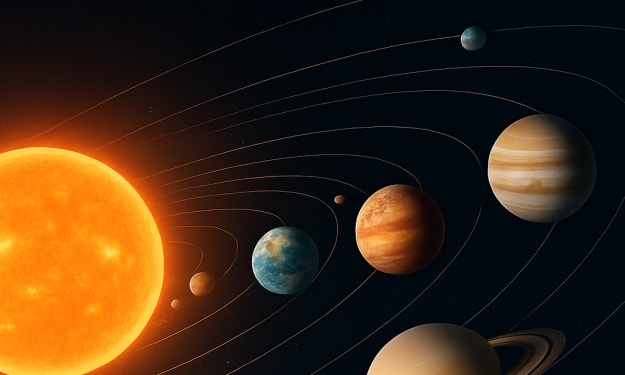
The Solar System is much more than just the Sun and planets. It is a vast space filled with mystery and beauty. While we know the names of the planets, each one holds secrets that scientists are still trying to understand. Beyond the planets, there are comets, asteroids, and dwarf planets like Pluto, each with their own stories. Moons like Europa, Titan, and Enceladus may have oceans hidden under their icy surfaces, possibly holding signs of life. Spacecraft like Voyager, New Horizons, and the Mars rovers are helping us explore this cosmic neighborhood. These missions send back pictures and data that help scientists learn about space. Our Solar System is like a giant cosmic family, where every planet and moon has its place and story. From the burning Sun to the freezing edges of the Kuiper Belt, every corner of our Solar System holds something new to discover. Exploring the Solar System is not just about science – it’s about understanding our place in the universe and dreaming about the future. Each discovery brings us one step closer to unlocking the mysteries of space.The Solar System is our home in the vast universe. At the center of this system is the Sun, a giant ball of fire that gives us light and energy. Around the Sun, eight planets revolve in their orbits like a family. Each planet has its own secrets and beauty.
By Leya kirsan official about a year ago in Education
AI in Computer Engineering
In the field of computer engineering, artificial intelligence (AI) has emerged as a transformative force that has an impact on software and hardware design. The design, development, and optimization of computer systems, microprocessors, embedded systems, and network architecture have traditionally been the primary focuses of computer engineering. The scope of computer engineering has greatly expanded as AI has been incorporated. In addition to being a tool utilized by engineers, artificial intelligence (AI) is now a subject of research and development within the field itself. Powerful computing systems, innovative applications, and faster, more dependable designs are all made possible by this synergy.
By Ahmad shahabout a year ago in Education
Integrated Treatment for Substance Use Disorders: A Holistic Perspective
Substance use disorders (SUDs) affect millions of individuals worldwide, leading to profound impacts on personal health, relationships, and society. While traditional models of addiction treatment primarily focus on detoxification and rehabilitation, there is an increasing recognition that a more holistic and integrated approach is needed to address the complexity of substance use disorders. Integrated treatment combines a range of therapeutic modalities to treat not just the addiction but also the underlying physical, emotional, and psychological factors contributing to the disorder.
By St. John's Community Healthabout a year ago in Education