vintage
Vintage education shows us that elevating our level of comprehension has been beneficial to humanity's growth and success.
The Teacher Who Became an EdTech Pioneer
The Teacher Who Became an EdTech Pioneer Turning classroom frustration into innovation Business / Education / Technology Sara Mitchell had spent nearly a decade teaching in public schools, and she loved her students dearly. But every day, she faced the same frustration: outdated textbooks, rigid lesson plans, and a lack of tools that could engage the students in meaningful learning. She watched bright, curious minds struggle to stay motivated, and she wondered why education hadn’t evolved to meet the digital age.
By waseem khanabout a year ago in Education
Kilmar Abrego Garcia Detained by ICE After Release From Criminal Custody
Kilmar Abrego Garcia Detained by ICE After Release From Criminal Custody Kilmar Abrego Garcia, who was mistakenly deported earlier this year and later brought back to the United States, has once again been taken into immigration custody. His lawyer confirmed that he was detained on Monday morning after reporting for a scheduled check-in with Immigration and Customs Enforcement (ICE) at its Baltimore office.
By Sunil Christianabout a year ago in Education
Afghan Genius; Learns A Language Every 2 Months
In the heart of Herat, one of Afghanistan’s most historic and poetic cities, lives a boy whose story is as extraordinary as it is inspiring. His name is Mohammad Amiri, and at just nine years old, he has stunned teachers, community leaders, and even government officials with his almost unbelievable gift. While most children spend years struggling to learn a single foreign language, Mohammad does something that seems closer to magic: he masters a new language in just two months.
By Keramatullah Wardakabout a year ago in Education
6212 Cambridge New Words 2025
Language is alive. It grows, shifts, and bends with subculture, capturing the spirit of each generation. In 2025, the Cambridge Dictionary added an surprising 6,212 new words and meanings—a big replace that highlights the ways generation, social media, and converting lifestyles are reshaping how we communicate.
By Samiullah Adilabout a year ago in Education
Discover How SarcArt’s Ready-Made Graphics Help You Stand Out, Spark Laughs, and Build a Loyal Following—Without the Design Hassle
Let's face it: cutting through the noise on social media is harder than ever. You post, you engage, you try to be genuine... and sometimes, it feels like shouting into a digital void. What if there was a way to instantly grab attention, spark engagement, and maybe even get a genuine laugh? Enter the world of sarcastic quote art. It’s relatable, it’s shareable, and when done right, it builds a tribe around your unique brand of humor.
By Epic Vibesabout a year ago in Education
Vocal.Media: A Creative Platform for Writers and Storytellers
Vocal.Media is an online publishing platform designed to give writers, bloggers, and storytellers a place to share their voices with the world. Launched in 2016, it has grown into a space where creators can publish articles, short stories, poems, reviews, and essays while connecting with an engaged audience. Unlike traditional blogging platforms, Vocal provides writers with built-in readership opportunities, monetization options, and themed communities called “Vocal Communities,” which allow creators to target specific audiences.
By Muhammad Ibrahimabout a year ago in Education
Your Guide to Powerful Videos Without Editing
Remember that brilliant video idea you shelved because the thought of editing software made your head spin? You're not alone. For years, creating professional-looking videos demanded technical skills, expensive software, dedicated time for editing, and often a whole production crew. It felt like an insurmountable barrier for individuals and small businesses.
By Epic Vibesabout a year ago in Education
Predicting the Future, Cartoon-Style: The Simpsons’ Hits and Misses
If someone had told you back in the 1990s that a yellow cartoon family could “predict” the future, you probably would’ve laughed. Yet here we are, decades later, still talking about The Simpsons and how often their fictional jokes seem to line up with reality. Created by Matt Groening in 1989, this show wasn’t made to be a crystal ball — it was meant to make people laugh. But somehow, between all the slapstick humor, satirical jabs, and life in the quirky town of Springfield, the writers have dropped hints about events that actually came true. And of course, not every prediction hit the mark — some were way off, and that’s part of the fun.
By Vocal Member about a year ago in Education
She Sells Seashells by the Seashore – An Essay
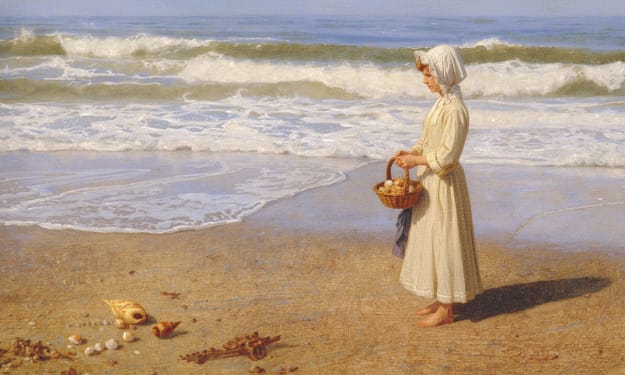
There are some phrases in the English language that seem almost timeless. They roll off the tongue in a playful way, yet they hide more depth than most people expect. “She sells seashells by the seashore” is one of those phrases. At first glance, it’s just a tongue twister, the kind you might hear in a classroom or around a campfire when someone challenges you to say it three times fast. But behind those eight little words is a fascinating mix of history, clever language, and even a story of determination that reaches back to the early 1800s. Where It All Began The exact origin of this famous tongue twister isn’t crystal clear, but many historians link it to the life of Mary Anning (1799–1847). Mary was not just any seaside vendor; she was a self-taught fossil collector and paleontologist from the town of Lyme Regis on the southern coast of England. As a child, she began scouring the cliffs and beaches for fossils — not as a hobby, but as a means to help support her family after her father’s death. It’s worth noting that Mary didn’t technically sell ordinary seashells. She sold fossilized shells and prehistoric remains — things that fascinated scientists and wealthy tourists of the time. Still, her work almost certainly inspired the popular line. In 1908, songwriters Terry Sullivan and Harry Gifford wrote a song titled “She Sells Seashells”, and it is widely believed that Mary’s remarkable life was their inspiration. Over time, that song’s chorus broke free from the sheet music and became the tongue twister we know today. Why It’s Tricky If you’ve ever tried to say “She sells seashells by the seashore” quickly, you know it’s not as easy as it looks. That’s because the phrase is packed with alliteration (repeating the same first sound in multiple words) and consonance (repeating similar consonant sounds in close proximity). The challenge here lies in switching between the “s” sound and the “sh” sound. These are produced in similar ways but require slightly different positions of the tongue and airflow. Your mouth has to adjust very quickly, and when you rush, the sounds tend to blur together. That’s why tongue twisters like this are often used by actors, singers, and public speakers to warm up their voices and sharpen their pronunciation. More Than Just a Game While most people meet this phrase as a playful challenge, it’s also a kind of miniature story about work, place, and persistence. In just eight words, you can picture a woman standing on a sunny shore, selling the treasures she’s gathered from the sea. There’s a rhythm to it, almost like the gentle lap of waves, and it’s easy to imagine the sound of shells clinking together in a basket. For Mary Anning, this wasn’t just a poetic image — it was her life. She faced storms, landslides, and the constant danger of working on unstable cliffs, yet she kept going. Her discoveries helped shape early paleontology, but because she was a woman in the early 19th century, she received little formal recognition in her lifetime. Today, though, her name is remembered alongside the tongue twister that may have been inspired by her. Educational Value Teachers often use this phrase to help students with pronunciation, especially those learning English as a second language. It’s short enough to memorize, but complex enough to require real concentration. By practicing it slowly and then speeding up, learners gain better control over their speech. It’s also a tool for developing listening skills. When students hear others attempt the phrase, they start to notice the subtle differences between “s” and “sh,” which sharpens their ear for detail. In a way, this little line is like a gym workout for the tongue and brain. A Symbol of Resourcefulness Beyond the classroom, “She sells seashells by the seashore” can be read as a tiny lesson in business and self-reliance. The “she” in the sentence is independent. She gathers her own products (seashells), chooses her marketplace (the seashore), and makes a living through her own effort. That’s entrepreneurship in its simplest form. It’s no wonder this phrase has sometimes been used in marketing or motivational contexts. It reminds us that success can come from starting with what’s right in front of us — even something as simple as shells washed up by the tide. Why It Stays With Us Many tongue twisters fade into obscurity, but this one has stayed alive for over a century. There are a few reasons for that: It’s easy to remember — only eight words. It paints a clear picture — anyone can imagine a seashore and shells. It’s playful — people of all ages enjoy trying to say it fast. It has a real story behind it — the connection to Mary Anning gives it depth. In a world where so much of our communication is typed rather than spoken, the fact that this old-fashioned phrase still pops up in classrooms, acting studios, and even social media trends says something about its enduring charm. Conclusion “She sells seashells by the seashore” may seem like a simple children’s rhyme, but it carries history, challenge, and meaning within its short structure. It’s a playful exercise in language, a nod to a remarkable woman’s determination, and a reminder of the creativity hidden in everyday life. Whether you use it to warm up before a performance, practice your English, or simply have a laugh with friends, it connects you to over a century of voices that have stumbled, laughed, and tried again. And maybe that’s the real beauty of it — just like the woman in the phrase, we keep going, one shell at a time.
By Vocal Member about a year ago in Education
When Politics Interrupted the Game: Sports Boycotts in History. AI-Generated.
Sports have long been celebrated as a universal language that transcends borders, ideologies, and political divides. Yet history shows that athletic arenas are not immune to the pressures of politics. At pivotal moments, governments, athletes, and organizations have used boycotts as a way to protest injustice, apply diplomatic pressure, or draw attention to global conflicts. These boycotts, while controversial, have left lasting marks on both sports history and international relations.
By Gus Woltmannabout a year ago in Education