trade school
Trade school tips to keep you a step ahead; make the most out of your trade school experience as a soon-to-be electrician, dental hygienist, paralegal, nurse, graphic designer, and others.
The Heartbeat in the Code: Riding the Rollercoaster of Bitcoin Price
Remember that feeling? Maybe it was late 2020, or perhaps the dizzying heights of late 2017. You refresh your screen, and there it is – Bitcoin price soaring, smashing through another barrier, inching closer to that mythical bitcoin all time high. The buzz is palpable. Friends who never mentioned crypto news before are suddenly experts. Your phone pings with alerts. It feels electric, almost like catching lightning in a bottle. Fast forward a few months, or sometimes just weeks, and the scene shifts. The charts bleed red. That thrilling ascent feels like a distant dream replaced by a gnawing uncertainty. "What happened to my btc?" you wonder, watching the btc price tumble. If this sounds familiar, friend, you're not just watching numbers; you're feeling the pulse of a financial revolution.
By John Arthorabout a year ago in Education
Predicting the Future, Cartoon-Style: The Simpsons’ Hits and Misses
If someone had told you back in the 1990s that a yellow cartoon family could “predict” the future, you probably would’ve laughed. Yet here we are, decades later, still talking about The Simpsons and how often their fictional jokes seem to line up with reality. Created by Matt Groening in 1989, this show wasn’t made to be a crystal ball — it was meant to make people laugh. But somehow, between all the slapstick humor, satirical jabs, and life in the quirky town of Springfield, the writers have dropped hints about events that actually came true. And of course, not every prediction hit the mark — some were way off, and that’s part of the fun.
By Vocal Member about a year ago in Education
A Genius Forged in Solitude: The Tragic Brilliance of Srinivasa Ramanujan
You know that feeling when a letter arrives, and it’s not just any letter, but one that changes everything? That’s what happened to Godfrey Harold Hardy, a mathematician tucked away in the quiet halls of Cambridge, when a worn envelope from India landed on his desk in 1913. It was from a young man named Srinivasa Ramanujan, a name that would soon echo through the ages. A poor clerk, no university degree, just a handful of formulas scratched out in desperation and brilliance. And those formulas? They weren’t just numbers-they were the kind of equations that made Hardy, a man who’d seen it all, stop and stare. This is the story of Ramanujan, a genius who saw math as a gift from the gods, a man whose life was as heartbreaking as it was extraordinary. A quick note before we dive in: this story touches on depression and attempted suicide. If you’re struggling, please don’t hesitate to reach out for help.
By KWAO LEARNER WINFREDabout a year ago in Education
She Sells Seashells by the Seashore – An Essay
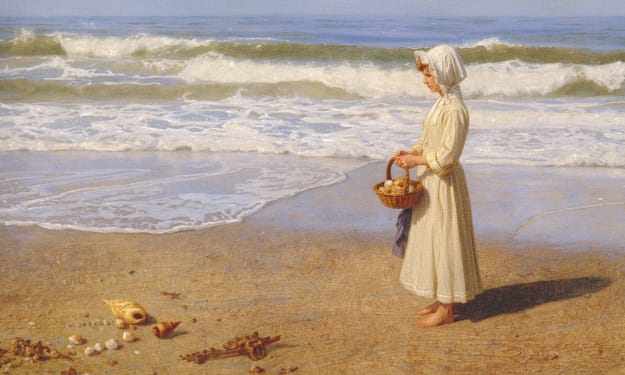
There are some phrases in the English language that seem almost timeless. They roll off the tongue in a playful way, yet they hide more depth than most people expect. “She sells seashells by the seashore” is one of those phrases. At first glance, it’s just a tongue twister, the kind you might hear in a classroom or around a campfire when someone challenges you to say it three times fast. But behind those eight little words is a fascinating mix of history, clever language, and even a story of determination that reaches back to the early 1800s. Where It All Began The exact origin of this famous tongue twister isn’t crystal clear, but many historians link it to the life of Mary Anning (1799–1847). Mary was not just any seaside vendor; she was a self-taught fossil collector and paleontologist from the town of Lyme Regis on the southern coast of England. As a child, she began scouring the cliffs and beaches for fossils — not as a hobby, but as a means to help support her family after her father’s death. It’s worth noting that Mary didn’t technically sell ordinary seashells. She sold fossilized shells and prehistoric remains — things that fascinated scientists and wealthy tourists of the time. Still, her work almost certainly inspired the popular line. In 1908, songwriters Terry Sullivan and Harry Gifford wrote a song titled “She Sells Seashells”, and it is widely believed that Mary’s remarkable life was their inspiration. Over time, that song’s chorus broke free from the sheet music and became the tongue twister we know today. Why It’s Tricky If you’ve ever tried to say “She sells seashells by the seashore” quickly, you know it’s not as easy as it looks. That’s because the phrase is packed with alliteration (repeating the same first sound in multiple words) and consonance (repeating similar consonant sounds in close proximity). The challenge here lies in switching between the “s” sound and the “sh” sound. These are produced in similar ways but require slightly different positions of the tongue and airflow. Your mouth has to adjust very quickly, and when you rush, the sounds tend to blur together. That’s why tongue twisters like this are often used by actors, singers, and public speakers to warm up their voices and sharpen their pronunciation. More Than Just a Game While most people meet this phrase as a playful challenge, it’s also a kind of miniature story about work, place, and persistence. In just eight words, you can picture a woman standing on a sunny shore, selling the treasures she’s gathered from the sea. There’s a rhythm to it, almost like the gentle lap of waves, and it’s easy to imagine the sound of shells clinking together in a basket. For Mary Anning, this wasn’t just a poetic image — it was her life. She faced storms, landslides, and the constant danger of working on unstable cliffs, yet she kept going. Her discoveries helped shape early paleontology, but because she was a woman in the early 19th century, she received little formal recognition in her lifetime. Today, though, her name is remembered alongside the tongue twister that may have been inspired by her. Educational Value Teachers often use this phrase to help students with pronunciation, especially those learning English as a second language. It’s short enough to memorize, but complex enough to require real concentration. By practicing it slowly and then speeding up, learners gain better control over their speech. It’s also a tool for developing listening skills. When students hear others attempt the phrase, they start to notice the subtle differences between “s” and “sh,” which sharpens their ear for detail. In a way, this little line is like a gym workout for the tongue and brain. A Symbol of Resourcefulness Beyond the classroom, “She sells seashells by the seashore” can be read as a tiny lesson in business and self-reliance. The “she” in the sentence is independent. She gathers her own products (seashells), chooses her marketplace (the seashore), and makes a living through her own effort. That’s entrepreneurship in its simplest form. It’s no wonder this phrase has sometimes been used in marketing or motivational contexts. It reminds us that success can come from starting with what’s right in front of us — even something as simple as shells washed up by the tide. Why It Stays With Us Many tongue twisters fade into obscurity, but this one has stayed alive for over a century. There are a few reasons for that: It’s easy to remember — only eight words. It paints a clear picture — anyone can imagine a seashore and shells. It’s playful — people of all ages enjoy trying to say it fast. It has a real story behind it — the connection to Mary Anning gives it depth. In a world where so much of our communication is typed rather than spoken, the fact that this old-fashioned phrase still pops up in classrooms, acting studios, and even social media trends says something about its enduring charm. Conclusion “She sells seashells by the seashore” may seem like a simple children’s rhyme, but it carries history, challenge, and meaning within its short structure. It’s a playful exercise in language, a nod to a remarkable woman’s determination, and a reminder of the creativity hidden in everyday life. Whether you use it to warm up before a performance, practice your English, or simply have a laugh with friends, it connects you to over a century of voices that have stumbled, laughed, and tried again. And maybe that’s the real beauty of it — just like the woman in the phrase, we keep going, one shell at a time.
By Vocal Member about a year ago in Education
From Shop Counter to Trading Desk
In a small, dusty market town, where the air always smelled faintly of spices and smoke, lived Karim—a young shopkeeper whose store was no bigger than a goat’s pen. His “shop” was really just a wooden counter nailed together from old planks, shaded by a faded blue cloth. On it, Karim sold tea leaves, a few jars of honey, and whatever odds and ends he could barter from travelers.
By Abid Ur Rahmanabout a year ago in Education
Why Recognition in Schools Needs a 21st-Century Upgrade
I'll give you a scenario. Your eighth-grader walks into the house, all excited, with a printed certificate of being on the honor roll. You give them a warm smile, pat them on the back, and… what comes next? The certificate is filed somewhere, or perhaps it finds its way to a fridge for a week, and later it is lost in the childhood troves of junk. At the same time, that child just posted some new gaming achievement, and a lot of their pals cheered and clapped with comments, numbers, and laughing.
By Elijah Shephardabout a year ago in Education
How to Get Rid of Emotional Attachments: A Comprehensive Guide
Emotional attachments are a natural part of life—whether to people, places, memories, or possessions. Healthy attachments foster connection and growth; unhealthy ones, however, can hold us back, cause pain, or keep us from moving forward. Letting go is often easier said than done, but learning how to release emotional attachments is a vital skill for personal growth, emotional well-being, and leading a more liberated, fulfilled life. This article explores why emotional attachments happen, why they may become unhealthy, and how to free yourself when it's time to let go.
By Reframerootsabout a year ago in Education
How to Make Money Writing Online with Textbroker (No Eperience Needed)
Start Earning as a Writer on Textbroker – No Experience Needed If you want to make money online by writing, Textbroker is a great place to start. You don’t need to be a professional writer or have years of experience. As long as you understand basic English grammar and can write clearly, you can begin earning on this platform.
By Kamran Khanabout a year ago in Education