teacher
All about teachers and the world of teaching; teachers sharing their best and worst interactions with students, best teaching practices, the path to becoming a teacher, and more.
Are you leaving money on the table?. AI-Generated.
Are You Leaving Money on the Table? Imagine this: You’re cleaning out a drawer and come across an old 401(k) statement from a job you left years ago. As you look at it, you start to wonder—how much money have you forgotten about?
By Laura E. Munoz2 years ago in Education
The One Thing We All Desperately Need from God
Mercy is one of the most profound attributes of God, and it is something every individual needs in all aspects of life. As human beings, we are imperfect, prone to mistakes, and often fall short of the moral and spiritual standards set by God. Despite our best efforts, we sometimes hurt others, make poor decisions, and stray from the path of righteousness. In all these situations, the mercy of God becomes essential, offering us hope, redemption, and the ability to move forward. Life is filled with challenges and uncertainties. From health issues to financial struggles and relationship problems, no one is immune to difficulties. During these times, many people find themselves crying out to God for help and relief.
By Nora Ariana2 years ago in Education
Healing Cracked Lips and Feet: Causes, Remedies, and Prevention Tips
Cracked lips and dry feet are not just minor inconveniences; they can be signs of underlying issues that affect your overall comfort and well-being. Whether it’s the harsh winter air, dehydration, or even a lack of essential nutrients, the causes of these common ailments can vary widely. Yet, the discomfort they bring is something we all can relate to. In this comprehensive guide, we'll delve into the root causes of cracked lips and feet, explore effective home remedies to soothe and heal these bothersome conditions, and provide essential prevention tips to keep your skin soft and supple year-round. Say goodbye to the discomfort of dry skin and hello to a smoother, healthier you!
By Md. Arman Hossain2 years ago in Education
Social Media 2025: How Platforms are Evolving and Impacting Digital Marketing Trends
Social Media 2025: How Platforms are Evolving and Impacting Digital Marketing Trends In 2025, social media has transformed from a platform used for simple connectivity to an absolutely indispensable tool in shaping the landscape of digital marketing. As rapid changes are expected in platforms, digital marketers will have to move ahead of the curve to truly engage with the consumer and eventually drive conversions. Here's how social media is evolving and what it means for the future of digital marketing.
By Puneeth C Gowda2 years ago in Education
The Howling of Hollow Creek
The storm had appeared out of nowhere. One minute, the night was quiet, and the moon cast its rays over Hollow Creek. The next, ominous clouds moved in, and rain started to fall in sheets. Garrett could hear the faint crack of distant thunder, but the air felt different tonight as if something was unwell.
By MUNAZZAH KOUSAR2 years ago in Education
Understanding Hyperlipidemia: Symptoms, Diagnosis, and Coding. AI-Generated.
Hyperlipidemia is a common yet often silent condition that affects millions worldwide. Characterized by elevated levels of lipids like cholesterol and triglycerides in the blood, it can lead to serious health complications, including heart disease, stroke, and arterial blockages. Despite its risks, many people remain unaware they have hyperlipidemia until routine blood tests reveal it.
By Alex Harper2 years ago in Education
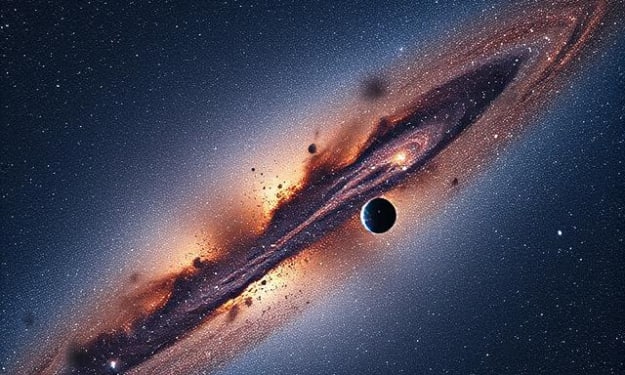
The Andromeda Galaxy
The Andromeda Galaxy: Unknown Facts and Mysteries The Andromeda Galaxy (M31) is the nearest spiral galaxy to the Milky Way and one of the most fascinating objects in the universe. Located approximately 2.537 million light-years away, Andromeda is the largest galaxy in the Local Group, which includes the Milky Way, the Triangulum Galaxy (M33), and about 54 smaller satellite galaxies. Despite its relative proximity, many aspects of Andromeda remain mysterious. This article explores some lesser-known and intriguing facts about our galactic neighbor. 1. Andromeda is Moving Toward the Milky Way One of the most striking facts about Andromeda is that it is on a collision course with the Milky Way. Unlike most galaxies that move away due to the universe's expansion, Andromeda is heading toward us at a speed of 110 km/s (68 miles per second). Scientists predict that in about 4.5 billion years, Andromeda and the Milky Way will merge to form a single giant elliptical galaxy, sometimes called "Milkomeda." Despite this impending collision, individual stars are so far apart that very few direct stellar collisions will occur. Instead, gravitational interactions will rearrange the structure of both galaxies over millions of years. 2. Andromeda is Bigger Than the Milky Way For a long time, scientists believed the Milky Way was the largest galaxy in the Local Group. However, observations now suggest that Andromeda is significantly more massive, containing an estimated one trillion stars, while the Milky Way has around 200–400 billion stars. Andromeda's mass, including dark matter, is estimated to be 1.5 times that of the Milky Way. 3. Andromeda Has a Dual Nucleus The core of Andromeda is unusual—it appears to have two bright centers instead of one. This dual nucleus is likely due to a dense cluster of stars orbiting a supermassive black hole. Some astronomers believe this could be the remnant of a smaller galaxy that was absorbed by Andromeda in the past. 4. It Contains a Supermassive Black Hole Like the Milky Way, Andromeda hosts a supermassive black hole (SMBH) at its center. This black hole is estimated to have a mass of 140 million solar masses, significantly larger than the Milky Way's central black hole, Sagittarius A*, which has a mass of about 4 million solar masses. 5. Andromeda Has Many Satellite Galaxies Just as the Milky Way has satellite galaxies like the Magellanic Clouds, Andromeda has more than 20 known satellite galaxies. Some of the most notable ones include: • M32 – A compact elliptical galaxy that may have been stripped of its outer layers by Andromeda's gravity. • M110 – A dwarf elliptical galaxy rich in dust and gas. • NGC 185 and NGC 147 – Two small dwarf galaxies orbiting Andromeda. These satellite galaxies offer insights into galaxy formation and evolution. 6. Andromeda's Past Galactic Cannibalism Andromeda has a history of "galactic cannibalism", meaning it has absorbed smaller galaxies over billions of years. Evidence from star streams and faint stellar structures suggests that Andromeda has consumed multiple dwarf galaxies. Astronomers have identified giant stellar streams around Andromeda—remnants of galaxies torn apart by its gravity. The most famous is the Giant Stellar Stream, which likely came from a once-independent dwarf galaxy. 7. It is Visible to the Naked Eye Andromeda is the most distant object visible to the naked eye from Earth. Under dark, clear skies, it appears as a faint, elongated patch of light. It spans about 6 times the width of the full moon, but its brightness is low due to the dispersion of its light over a large area. Ancient astronomers were aware of Andromeda long before the invention of telescopes. Persian astronomer Abd al-Rahman al-Sufi documented it in 964 AD in his "Book of Fixed Stars." The first telescopic observations were made in the early 17th century. 8. It is Home to Over 450 Globular Clusters Andromeda hosts an impressive system of globular clusters, dense spherical collections of stars. It has over 450 known globular clusters, far more than the Milky Way’s about 150. Some of these clusters, like Mayall II, are among the most massive known, containing millions of stars. 9. It Once Had a Different Name Before being widely recognized as Andromeda, the galaxy was called the "Great Nebula in Andromeda." Early astronomers, who lacked the technology to resolve individual stars, believed it to be a massive cloud or nebula within our own galaxy. It was only in the 1920s, thanks to Edwin Hubble’s observations, that Andromeda was confirmed to be an entirely separate galaxy beyond the Milky Way. 10. Andromeda’s Strange Ultraviolet Ring NASA’s GALEX (Galaxy Evolution Explorer) detected a bizarre ultraviolet ring structure around Andromeda. This ring is likely a remnant of a past galactic collision, possibly with a smaller galaxy. The presence of such unusual features suggests that Andromeda's history is far more complex than previously thought. 11. Andromeda's Stars Rotate in Opposite Directions Observations show that parts of Andromeda’s disk rotate in opposite directions—a surprising discovery. Normally, galaxies have a uniform rotational motion, but Andromeda’s inner and outer regions move in different directions, hinting at past mergers with other galaxies. 12. It Might Contain Extraterrestrial Life Given Andromeda's sheer size and vast number of stars, scientists speculate that it could host habitable planets and, potentially, extraterrestrial life. Some exoplanet candidates have been detected within Andromeda, but with current technology, it is difficult to confirm their potential for life. 13. Andromeda May Have Once Been a Quasar Quasars are extremely bright, energetic centers of galaxies, powered by supermassive black holes consuming large amounts of material. Some astronomers theorize that Andromeda’s core may have been a quasar in the past, though more evidence is needed to support this idea. 14. It Will Change the Night Sky in the Future As Andromeda moves closer, it will gradually appear larger in the night sky. In a few billion years, it will dominate Earth's night sky, forming a spectacular celestial display before merging with the Milky Way. Andromeda Galaxy remains one of the most intriguing objects in our universe. While we have learned much about its structure, past interactions, and eventual fate, there are still many unanswered questions. As future telescopes and space missions provide more data, Andromeda may reveal even more fascinating secrets about galactic evolution and the cosmos itself.
By Bijan Mondal2 years ago in Education
Top 7 Power BI Benefits for Decision Makers
As a Sr. Data Analyst, I’ve seen directly how powerful business intelligence tools can be in molding the future of a company. One such tool that stands out is Power BI. Microsoft's Power BI is a widely used Business Analytics tool that enables users to visualize data, share insights, and make informed decisions. It’s a versatile platform that provides a range of capabilities, from simple reports to complex dashboards, helping businesses stay on top of their data. But what exactly are the Power BI benefits that make it so valuable, especially for decision makers? Let’s explore the top 7 advantages.
By Harish Kumar Ajjan2 years ago in Education
Love Across the Distance: The 10 Emotional Stages of a Long-Distance Relationship. Content Warning. AI-Generated.
10 Stages of Long Distance Relationship Being in a long-distance relationship is challenging and yet rewarding. There is a requirement of patience, trust, and effort from both partners. The journey through these various stages not only strengthens the bond but also deepens the emotional connection. With each stage, there are sets of emotions, trials, and triumphs. Here are ten stages of a long-distance relationship, filled with the emotional rollercoaster that defines love across miles:
By Amjad Hossain Mondal2 years ago in Education
10 Ways to Make Your Common App Essay More Memorable
Your Common App essay is one of the most important parts of your college application. It’s your chance to showcase your personality, values, and writing skills beyond grades and test scores. But with thousands of essays flooding admissions offices, how do you make yours stand out?
By Thinque Prep2 years ago in Education