teacher
All about teachers and the world of teaching; teachers sharing their best and worst interactions with students, best teaching practices, the path to becoming a teacher, and more.
How to Balance Extracurricular Activities & Academic Duties
In today's world, students must know how to manage both academics and extracurricular actions. It is because these activities aid them in developing many skills that are vital for academics. Additionally, if you want to achieve success in higher schooling, you must balance academics and other curricular activities. Also, you can seek guidance from assignment writing services to enhance your academic grades. Moreover, in this piece, you will found how to balance both academics and extracurricular activities.
By Will Smithabout a year ago in Education
Why Are 42,000 Teachers Leaving England’s Classrooms?
England has lost 42,000 teachers in the last year alone. That’s a staggering number — roughly equivalent to entire towns losing their entire teaching workforce. Many headlines blame low pay, and while that’s part of the picture, it’s far from the whole story.
By No One’s Daughterabout a year ago in Education
What Is Proctored Exam Help and How Can It Boost Your Scores?
Education online has changed the way students study, test and achieve academic excellence. With these developments the use of proctored tests has now become the norm institutions use to keep the integrity of their theories. Many students, however, are intimidated by these tests due to strict oversight as well as time-consuming technical difficulties.
By Lucas Lednerabout a year ago in Education
How students can balance their studies by utilizing the Online Exam Help Services
Introduction: The Modern Student's Challenge Finding a balance between academics, work, and family life has never been an easy task. And now, in this age of online learning, it has increased. Online courses are flexible; however, they are also accompanied by heavy workloads and time-bound timelines. A lot of students are left wondering how to maintain their marks without burning themselves out. This is the reason exam help is a must-have device.
By Mack Mickeyabout a year ago in Education
A Genius Forged in Solitude: The Tragic Brilliance of Srinivasa Ramanujan
You know that feeling when a letter arrives, and it’s not just any letter, but one that changes everything? That’s what happened to Godfrey Harold Hardy, a mathematician tucked away in the quiet halls of Cambridge, when a worn envelope from India landed on his desk in 1913. It was from a young man named Srinivasa Ramanujan, a name that would soon echo through the ages. A poor clerk, no university degree, just a handful of formulas scratched out in desperation and brilliance. And those formulas? They weren’t just numbers-they were the kind of equations that made Hardy, a man who’d seen it all, stop and stare. This is the story of Ramanujan, a genius who saw math as a gift from the gods, a man whose life was as heartbreaking as it was extraordinary. A quick note before we dive in: this story touches on depression and attempted suicide. If you’re struggling, please don’t hesitate to reach out for help.
By KWAO LEARNER WINFREDabout a year ago in Education
The Letter I Wasn’t Meant to Read. AI-Generated.
It was a rainy Thursday afternoon, the kind of day when the light never really changes, just shifts from gray to grayer. I was alone in my mother’s house, sorting through the pieces of her life that no one else wanted to deal with. Six months had passed since she died, but her presence still clung to the place — the faint scent of her lavender hand cream, the worn cardigan draped over the back of her favorite chair, the slow tick of the grandfather clock she’d wound every Sunday evening. I had saved her desk for last. It was a small, oak thing pushed up against the living room window. I used to watch her there as a child, paying bills or writing letters in neat, deliberate script. She always hummed while she worked — some half-remembered tune from her own childhood. --- The top drawers held the usual clutter: pens that no longer worked, unpaid bills mixed in with ones she’d already handled, paperclips that had escaped their tin. But the bottom drawer stuck when I tried to open it, as if it had been closed for so long it didn’t want to let go. When it finally gave, I found a stack of old tax forms, folded recipes, and beneath them, an envelope. It was yellowed along the edges, the paper soft from years of handling. My name was written on the front — Jacob — in the familiar cursive I’d known my whole life. Something about it made my breath catch. --- I hesitated. Finding something like this felt like standing on the edge of a door you’re not sure you should open. But curiosity, as it always does, won. Inside was a single sheet of stationery, folded in thirds. The ink was faded, but still legible. The first line made my stomach turn over. > My dearest Jacob, By the time you read this, I hope you’ll understand why I kept this from you. I read the line twice before going on. She wrote about a summer long before I was born, a summer when she’d fallen in love with a man who wasn’t my father. She didn’t name him, but described him in a way that made me see him — tall, with a laugh that could “pull joy from the quietest corners of a room.” They had plans to leave. Train tickets already bought. She was ready to start a new life in a different city, far from the small town she’d always known. And then she found out she was pregnant. With me. --- “I didn’t run,” she wrote. “I stayed. I married your father. I built a life that looked different from the one I imagined, but not lesser. I was afraid that if I told you, you’d think your existence had cost me happiness.” I could feel her hand in the words, the way she pressed harder into the paper when her emotions ran high. The last lines blurred as my eyes welled. > You didn’t take anything from me, Jacob. You gave me everything. I chose you every single day. --- I set the letter down, staring at the faint pattern in the wood grain of the desk. The house felt unbearably quiet. Rain tapped against the window, steady and soft. I didn’t know what to feel. My parents’ marriage had always seemed steady, if not exactly romantic. Now, I was seeing it through a new lens — one that revealed cracks I hadn’t noticed. But the letter didn’t make me love her less. If anything, it made me love her more. It showed me the woman she’d been before she was my mother — young, flawed, and brave enough to give up something she wanted for something she decided mattered more. --- When I told my father about the day I’d found the letter — years later, after he was sick and the weight of secrets seemed lighter — he didn’t seem surprised. “She told me about him once,” he said. “We don’t always get to be someone’s first choice. But we can still be their right choice.” I think that’s when I began to understand love differently — not as a straight path, but as a series of turns, some planned and some unexpected. --- I kept the letter. I didn’t hide it away in a box or shove it back under old tax forms. Instead, I put it in the top drawer of the desk, where it would be the first thing I saw if I ever needed reminding of her voice. Some truths, I’ve learned, belong to only two people — even if one of them is gone. And on days when life feels heavy, I take it out, run my fingers over her faded handwriting, and remember that I was not an accident. I was a choice.
By Muhammad umairabout a year ago in Education
The Science of Romance
Lets have some interesting to spread light on it..... Romance might feel like pure magic — the quickened heartbeat, the butterflies, the unexplainable pull toward someone — but beneath the poetry lies a fascinating web of biology, psychology, and evolution. Scientists have spent decades studying how and why humans fall in love, revealing that our hearts and minds are both partners in the process.
By Hamid Khanabout a year ago in Education
The Changes in Education by Technology. Content Warning. AI-Generated.
In this era of a high-paced world, technology has penetrated almost every sector of our lives, and education is not an exception. How we learn is evolving, and many processes are also going online. It is not only a revolution of gadgets and apps, but it is a revolution that creates opportunities for students, teachers, and lifelong learners.
By shahzaib shamsabout a year ago in Education
She Sells Seashells by the Seashore – An Essay
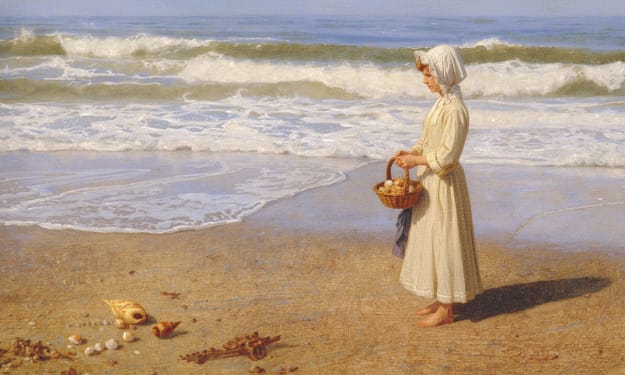
There are some phrases in the English language that seem almost timeless. They roll off the tongue in a playful way, yet they hide more depth than most people expect. “She sells seashells by the seashore” is one of those phrases. At first glance, it’s just a tongue twister, the kind you might hear in a classroom or around a campfire when someone challenges you to say it three times fast. But behind those eight little words is a fascinating mix of history, clever language, and even a story of determination that reaches back to the early 1800s. Where It All Began The exact origin of this famous tongue twister isn’t crystal clear, but many historians link it to the life of Mary Anning (1799–1847). Mary was not just any seaside vendor; she was a self-taught fossil collector and paleontologist from the town of Lyme Regis on the southern coast of England. As a child, she began scouring the cliffs and beaches for fossils — not as a hobby, but as a means to help support her family after her father’s death. It’s worth noting that Mary didn’t technically sell ordinary seashells. She sold fossilized shells and prehistoric remains — things that fascinated scientists and wealthy tourists of the time. Still, her work almost certainly inspired the popular line. In 1908, songwriters Terry Sullivan and Harry Gifford wrote a song titled “She Sells Seashells”, and it is widely believed that Mary’s remarkable life was their inspiration. Over time, that song’s chorus broke free from the sheet music and became the tongue twister we know today. Why It’s Tricky If you’ve ever tried to say “She sells seashells by the seashore” quickly, you know it’s not as easy as it looks. That’s because the phrase is packed with alliteration (repeating the same first sound in multiple words) and consonance (repeating similar consonant sounds in close proximity). The challenge here lies in switching between the “s” sound and the “sh” sound. These are produced in similar ways but require slightly different positions of the tongue and airflow. Your mouth has to adjust very quickly, and when you rush, the sounds tend to blur together. That’s why tongue twisters like this are often used by actors, singers, and public speakers to warm up their voices and sharpen their pronunciation. More Than Just a Game While most people meet this phrase as a playful challenge, it’s also a kind of miniature story about work, place, and persistence. In just eight words, you can picture a woman standing on a sunny shore, selling the treasures she’s gathered from the sea. There’s a rhythm to it, almost like the gentle lap of waves, and it’s easy to imagine the sound of shells clinking together in a basket. For Mary Anning, this wasn’t just a poetic image — it was her life. She faced storms, landslides, and the constant danger of working on unstable cliffs, yet she kept going. Her discoveries helped shape early paleontology, but because she was a woman in the early 19th century, she received little formal recognition in her lifetime. Today, though, her name is remembered alongside the tongue twister that may have been inspired by her. Educational Value Teachers often use this phrase to help students with pronunciation, especially those learning English as a second language. It’s short enough to memorize, but complex enough to require real concentration. By practicing it slowly and then speeding up, learners gain better control over their speech. It’s also a tool for developing listening skills. When students hear others attempt the phrase, they start to notice the subtle differences between “s” and “sh,” which sharpens their ear for detail. In a way, this little line is like a gym workout for the tongue and brain. A Symbol of Resourcefulness Beyond the classroom, “She sells seashells by the seashore” can be read as a tiny lesson in business and self-reliance. The “she” in the sentence is independent. She gathers her own products (seashells), chooses her marketplace (the seashore), and makes a living through her own effort. That’s entrepreneurship in its simplest form. It’s no wonder this phrase has sometimes been used in marketing or motivational contexts. It reminds us that success can come from starting with what’s right in front of us — even something as simple as shells washed up by the tide. Why It Stays With Us Many tongue twisters fade into obscurity, but this one has stayed alive for over a century. There are a few reasons for that: It’s easy to remember — only eight words. It paints a clear picture — anyone can imagine a seashore and shells. It’s playful — people of all ages enjoy trying to say it fast. It has a real story behind it — the connection to Mary Anning gives it depth. In a world where so much of our communication is typed rather than spoken, the fact that this old-fashioned phrase still pops up in classrooms, acting studios, and even social media trends says something about its enduring charm. Conclusion “She sells seashells by the seashore” may seem like a simple children’s rhyme, but it carries history, challenge, and meaning within its short structure. It’s a playful exercise in language, a nod to a remarkable woman’s determination, and a reminder of the creativity hidden in everyday life. Whether you use it to warm up before a performance, practice your English, or simply have a laugh with friends, it connects you to over a century of voices that have stumbled, laughed, and tried again. And maybe that’s the real beauty of it — just like the woman in the phrase, we keep going, one shell at a time.
By Vocal Member about a year ago in Education
“The Lesson I Never Taught”. AI-Generated.
I’ve been teaching high school English for fifteen years, long enough to believe I could read students like books. I thought I could tell who would work hard, who would coast, and who would vanish into the background. I was wrong. Ethan proved it. He claimed the last desk in the back row from the first day of school, hood drawn low, earbuds tucked just far enough to hide from sight. He never handed in assignments. Never raised his hand. If I called on him, he shrugged and stared at the clock. I told myself I’d seen it before — some kids simply don’t want to be helped. You focus your energy where it will matter. But there was something different about him. Every day, after the bell, he lingered for a few seconds. His eyes would drift toward the stack of novels on my desk — To Kill a Mockingbird, Of Mice and Men, The Catcher in the Rye. His gaze lingered like someone standing outside a bakery window with no money in their pocket. --- One Friday afternoon, long after the class had emptied, I was grading essays when the door creaked open. Ethan stood there, shifting from foot to foot. “Can I borrow one?” he asked, nodding toward the books. I nearly dropped my pen. “Which one?” He stepped forward and picked To Kill a Mockingbird. “This one. I’ll bring it back.” --- The next Monday, he returned the book. I expected a polite thank-you and nothing more. Instead, he asked: “Do you have more like this?” I did. And over the next few months, Ethan read Of Mice and Men, Fahrenheit 451, and The Great Gatsby. He didn’t write the essays I assigned, but he stayed after class to talk about them. His interpretations were raw and unpolished but deeply perceptive. He spoke about characters like they were people he’d met. “Why don’t you write this down?” I asked him one afternoon. “You’d ace every assignment.” He shook his head. “I can’t. Not like this.” I didn’t push. --- It wasn’t until April that I learned the truth. Parent-teacher conferences rolled around. Ethan’s slot was blank — no one came. But when I checked his file, I saw a single note buried in the system: Dyslexia. Severe. Diagnosed in middle school. No accommodations since. I sat there staring at the screen, my stomach sinking. I’d assumed he didn’t care. In reality, he’d been climbing a mountain no one saw. --- The next day, I asked him to stay after class. “I read your file,” I said gently. His shoulders tightened. “Figures.” “No, Ethan. I should’ve asked sooner. I should’ve seen it.” I slid a notebook toward him. “Here’s the deal. You talk, I’ll write. We’ll build your essays together.” He hesitated. “That’s… allowed?” “It is now,” I said. --- From then on, our after-school sessions became routine. He’d lean back in his chair, words spilling out about themes and character arcs, and I’d scribble them down. Then we’d read them together, shaping them into paragraphs. For the first time, Ethan saw his thoughts on paper — his thoughts, in his voice, without the wall of spelling and decoding standing in the way. --- By June, Ethan’s grade had climbed from failing to one of the highest discussion averages I’d ever given. He wasn’t suddenly perfect — sometimes he still forgot assignments, and reading aloud still made him self-conscious — but he was present. Engaged. Proud. On the last day of school, he stopped by my desk. He handed me a battered copy of The Great Gatsby. Inside, in careful block letters, he’d written: > “Thanks for listening when you didn’t have to. You taught me more than books — you taught me I’m not stupid.” --- I’ve taught hundreds of students over the years, but that single sentence sits heavier in my heart than any test score or award. Because I realized that education isn’t just about lesson plans, standards, or grades. It’s about seeing the person in front of you. It’s about noticing the kid who lingers after class, the one whose silence isn’t apathy but a shield. Sometimes, the most important lesson you teach is the one you never planned. And sometimes, it’s the student — not the teacher — who writes the ending. Start writing...
By Muhammad umairabout a year ago in Education