student
From balancing your course load to forging relationships with classmates to extracurricular involvement, these are the tried and true methods to nail your career as a student.
Why Marketplace Payments Are More Complex Than Regular Online Stores
Online shopping has become a regular part of everyday life. Most people understand how payments work on a regular online store. A buyer selects a product, pays at checkout, and the money goes directly to the store owner. Simple and quick.
By BrainSpate11 months ago in Education
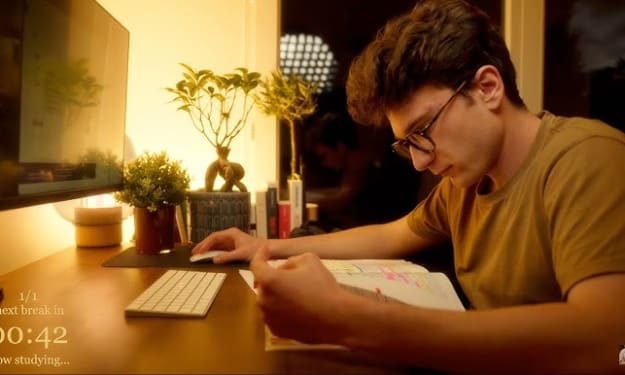
I Tried Studying Without Music for One Week — Here’s What Actually Happened
For years, I believed music made me more productive. Lo-fi beats while studying. Instrumentals while reading. Playlists carefully curated to help me “focus.” If there was silence, I filled it immediately. Silence felt empty. Uncomfortable. So when someone suggested studying without music, it sounded almost cruel. Still, curiosity won. I decided to study in complete silence for one full week. What happened surprised me. The First Day Felt Unbearable The silence was loud. Without music, every thought echoed. I became aware of the smallest sounds—the ticking clock, my breathing, the hum of electronics. My mind wandered constantly, searching for stimulation. I kept reaching for my phone out of habit. It felt like something was missing. But maybe what was missing wasn’t music. It was distraction. Music Was Hiding My Lack of Focus With music, I felt productive. Without it, I realized how scattered my attention really was. I noticed how often my mind drifted. How frequently I reread sentences. How quickly boredom appeared when there was nothing filling the gaps. Music wasn’t helping me focus. It was masking my inability to sit with one task. By Day Three, Something Shifted Around the third day, silence stopped feeling hostile. My thoughts slowed down. Reading felt smoother. I didn’t rush to escape boredom. Instead, my brain began to settle into the task in front of me. Studying felt… deeper. I wasn’t just consuming information. I was engaging with it. My Memory Improved Without Me Trying One unexpected change was memory. Without music occupying part of my attention, information stuck longer. I recalled concepts more easily. I spent less time reviewing and more time understanding. Silence created space. And in that space, learning actually happened. The Myth of “Productive Noise” Music isn’t bad. But we often use it to avoid discomfort. Silence forces us to confront: Boredom Mental restlessness Lack of clarity And those moments are where focus is built. Noise feels productive. Silence feels slow. But slow is where depth lives. The Biggest Lesson I Learned The problem wasn’t music. The problem was my dependence on constant stimulation. When I removed it, my brain didn’t collapse. It adapted. Focus isn’t something you add. It’s something you protect. What I Do Now I didn’t quit studying with music forever. But now, I choose silence when: Learning something complex Reading deeply Writing or thinking critically Music became a tool—not a crutch. Why This Matters In a world full of noise, silence feels unnatural. But focus doesn’t grow in chaos. It grows where there is space to think. Sometimes, the most powerful productivity hack isn’t an app, a playlist, or a system. It’s turning everything off.
By Waqas Ahmad11 months ago in Education
Mastering Algebra with Video Lessons
Introduction to Algebra Challenges Algebra introduces a new way of thinking that can feel unfamiliar and overwhelming for many students. The shift from straightforward arithmetic to solving equations with variables requires a deeper understanding of abstract ideas and mastering algebra, including video lessons and problem-solving techniques. Many learners find themselves stuck when faced with equations that involve multiple steps or unfamiliar symbols. Additionally, the emphasis on logical reasoning and pattern recognition can be a significant adjustment for those used to more direct calculations. Without the right support, this learning curve can lead to frustration and a lack of confidence.
By Marleze Blom11 months ago in Education