student
From balancing your course load to forging relationships with classmates to extracurricular involvement, these are the tried and true methods to nail your career as a student.
The Teacher Who Planted Dreams
M Mehran ery year, when the graduation ceremony began, students at Greenfield High waited for one moment: the speech from Mr. Lewis. He wasn’t the principal, or the district superintendent. He was just an English teacher with a graying beard and the habit of carrying chalk dust on his sleeves. But for thirty years, his words had lit a fire in every class he taught. --- The First Lesson Mr. Lewis began each school year the same way. He would walk into the classroom, look around at the new faces, and write on the board in large letters: “Education is not about answers. It’s about questions.” Students would glance at each other, confused. Weren’t schools supposed to be about memorizing facts, passing exams, and earning grades? But within weeks, his lessons made sense. He asked them why Shakespeare still mattered, why stories could change lives, and why people remembered words more than wars. Sometimes he paused mid-lesson and said, “Don’t just think about what’s in the book. Think about what’s in you.” It was in those moments that education stopped being a subject and started becoming an awakening. --- A Classroom of Misfits One year, Mr. Lewis’s class was filled with students who had already been labeled “troublemakers.” Some had failing grades, others had skipped too many classes, and one had nearly dropped out. Instead of punishing them, Mr. Lewis gave them journals. “Write down your thoughts,” he said. “Anger, confusion, joy—whatever it is, put it here. No one else will read it but me.” At first, the journals filled with single words or sarcastic remarks. But slowly, they grew into poems, short stories, and confessions. The boy who never spoke wrote about missing his father. The girl who rolled her eyes at every assignment penned a story about a hero who looked suspiciously like her. Education, Mr. Lewis proved, wasn’t about forcing students into molds. It was about giving them tools to discover their voices. --- Beyond the Textbook Mr. Lewis often took his class outside. Under the oak trees in the schoolyard, he’d ask, “What do you see?” Students would mutter: grass, sky, leaves. “Look deeper,” he’d urge. “Why does the tree bend that way? How does the wind shape the world around us? What does it remind you of?” The answers were never the same. That was the point. Education, he believed, was not about conformity but about perspective. --- Planting Seeds Over three decades, hundreds of students passed through his classroom. Many forgot the details of grammar lessons, but few forgot the way he made them feel. One former student became a lawyer and said she learned to argue cases by first learning how to question literature. Another became a journalist, crediting Mr. Lewis for showing him that every story had layers. A third returned years later as a teacher, carrying his philosophy into her own classroom. Everywhere, his students carried pieces of him—proof that education multiplies when it’s planted with care. --- The Last Lecture The year Mr. Lewis retired, the auditorium was overflowing. Students who had graduated years earlier drove back to hear him speak one last time. He walked to the podium slowly, his hands trembling slightly, but his voice was steady. “When I started teaching,” he said, “I thought my job was to fill your minds with knowledge. I was wrong. My job was to remind you that you already carry knowledge inside you. My job was to water the seeds of your curiosity until you believed in them yourself.” He paused, looking around at the sea of faces—some young, some now grown. “Education is not a test you pass. It is a life you choose. It is every question you dare to ask, every dream you dare to follow. Never stop learning, because the moment you stop, you stop growing.” The room was silent, many with tears in their eyes. --- A Legacy That Lasts Years later, whenever Greenfield students gathered for reunions, Mr. Lewis’s name came up. They spoke about his lessons not in terms of grammar or essays, but in terms of courage, compassion, and curiosity. Education is often measured in diplomas, grades, or careers. But in truth, its greatest measure is memory—the way a teacher, a book, or a moment stays with us long after school ends. Mr. Lewis never became famous outside Maplewood. He didn’t write a best-selling book or win awards. But he shaped lives. And in doing so, he proved that education is not about the walls of a classroom—it’s about the seeds planted in hearts. --- Why His Story Matters Today, debates about education often revolve around funding, technology, and standardized testing. Those matter. But behind every statistic is a human story: a teacher who believes, a student who dares, a moment that transforms a life. Mr. Lewis’s story reminds us that education is not a machine. It’s a relationship. It’s one mind sparking another, one question leading to countless answers. And if we are lucky, we all meet a “Mr. Lewis” at some point in our lives—a teacher who doesn’t just teach, but plants dreams.
By Muhammad Mehranabout a year ago in Education
Why Islam is the Fastest-Growing Religion from 2010-2025: Global Trends & What It Means for the UK & USA
The global religious landscape is undergoing significant transformation in the 21st century, with Islam emerging as the world's fastest-growing major religion. Between 2010 and 2025, demographic data and projections from leading research institutions reveal remarkable patterns of religious change that carry profound implications for societies worldwide, particularly in Western nations like the United Kingdom and United States. Understanding these trends requires examining the complex interplay of demographics, migration, conversion patterns, and societal changes that are reshaping religious communities across the globe.
By Islamic Reflectionsabout a year ago in Education
Finding Myself in the Himalayas: My Journey with Rishikesh Yogpeeth for Yoga Teacher Training in Rishikesh. AI-Generated.
When I set out to do my Yoga Teacher Training in Rishikesh, I was searching for more than just a certificate—I was searching for myself. At Rishikesh Yogpeeth, nestled in the Himalayan foothills, I discovered the true essence of yoga: balance, awareness, and a community that felt like family.
By Charanjeet Singhabout a year ago in Education
The Ultimate Guide to Learning Programming in 2025
What is Programming? Programming is the process of giving instructions to a computer so it can perform specific tasks. These instructions are written in a programming language, which acts as a bridge between human logic and machine execution.
By PositivePulseabout a year ago in Education
Which Reflective Essay Writing Service Is Best for Students?. AI-Generated.
Reflective essays are one of the most personal yet academically challenging assignments students face. Whether you are in college or university, you are often asked to write a reflective essay to showcase your ability to analyze experiences, apply theoretical knowledge, and express growth in your learning journey. But let’s be honest — crafting a compelling reflective essay is not easy.
By Martin Jackabout a year ago in Education
Why Students Prefer Experts to Do Their Online Exams
Modern educational platforms have revolutionized learning by providing students with both flexibility and extended course options. Most students face difficulties with online courses and frequently use experts to obtain better help. Students turn to expert help because they need to handle various responsibilities and maintain good grades for multiple reasons. These students prefer experts to take responsibility for their online exams for the following reasons.
By Lucas Lednerabout a year ago in Education
The Teacher Who Collected Stars
M Mehran Most people thought Mr. Hale was an ordinary teacher. He wore the same brown jacket every day, carried a stack of papers tucked under his arm, and taught literature to restless high school juniors who rarely listened. But the truth was, Mr. Hale collected stars. Not the kind that burned in the sky, but the kind that flickered inside people—the sparks of possibility that most others overlooked. Samantha Lee was fifteen when she first sat in his classroom. She had a habit of sitting in the back, hiding behind her hair, sketching in the margins of her notebook. Teachers called her lazy, distracted, even unmotivated. Her grades were slipping, and the word “failure” seemed to follow her like a shadow. Mr. Hale never used that word. One day, while the rest of the class groaned over a quiz, he leaned over Samantha’s desk and whispered, “You see things differently, don’t you?” She blinked, unsure how to respond. He tapped the edge of her notebook, where she had drawn a tree whose branches curled into shapes of birds. “That’s not distraction,” he said. “That’s vision.” It was the first time anyone had said something kind about her drawings. Mr. Hale’s lessons were strange. Sometimes he abandoned the textbook entirely and asked the students to write letters to their future selves. Other times, he made them stand in a circle and tell stories, no matter how silly. When the principal visited, Mr. Hale returned to grammar drills and vocabulary lists. But when the door closed again, his eyes lit up like someone had struck a match inside him. “Education isn’t about memorizing answers,” he told them once. “It’s about finding the questions that matter.” Most of the students rolled their eyes. But Samantha didn’t. The day Samantha’s life changed was a Tuesday. Mr. Hale gave the class a challenge: write an essay not about a famous author, but about themselves. “Tell me your story,” he said. “No rules, no format. Just truth.” Samantha stayed up all night. She wrote about her fear of being invisible, about how her parents fought so loudly she escaped into drawing, about how she felt both too much and not enough at the same time. When she handed it in, her hands shook. A week later, Mr. Hale returned the papers. At the top of hers, instead of a grade, he had written: “This is not just writing. This is a voice. Don’t ever lose it.” It was the first time Samantha believed she had something worth saying. Rumors spread that Mr. Hale was too soft, that his teaching methods weren’t “practical.” Parents complained that their kids weren’t learning the “basics.” The principal warned him twice. Still, he kept going. He stayed after school for students who needed him, listened when no one else did, and filled the margins of every assignment with encouragement instead of criticism. “He’s wasting their time,” another teacher muttered once. “These kids won’t pass state exams if all they do is write poems.” But Samantha noticed something different. Students who had once slept through class now leaned forward. The quiet kid in the corner shared a story about fixing cars with his grandfather. The class clown admitted he wanted to be the first in his family to go to college. The sparks were catching fire. Years later, Samantha walked into a bookstore and found her name on the spine of a novel. She traced the letters with trembling fingers. She had done it—she was an author. At her first public reading, an audience filled the small room. Samantha read aloud the story of a girl who felt invisible until a teacher showed her she wasn’t. Afterward, a man approached her. His hair was grayer, his jacket the same worn brown. Mr. Hale. She froze, overwhelmed with gratitude. “You—you came.” He smiled, the corners of his eyes crinkling. “Of course. I came to see one of my stars.” Samantha felt tears sting her eyes. “I never thanked you.” “There’s no need,” he said gently. “Teaching isn’t about being remembered. It’s about helping you remember yourself.” And with that, he left quietly, as if he had only been there to hand her another piece of light. No one ever knew how many stars Mr. Hale had collected in his lifetime. They weren’t visible in the sky, nor etched into any chart. But they shone in classrooms, in novels, in songs, in medical degrees, in inventions—sparks he had tended until they became flames. Because true education, Samantha realized, was never about tests or grades. It was about someone who believed in you long enough for you to believe in yourself.
By Muhammad Mehranabout a year ago in Education
Charlie Kirk and the danger of selective empathy
Conservative political activist Charlie Kirk was shot and killed on Wednesday. His suspected killer, identified by law enforcement as 22-year-old Tyler Robinson, was taken into custody after a substantial manhunt, based on information from people close to Robinson’s family. Utah Governor Spencer Cox said a family member of Robinson had reached out to a friend, who then contacted the authorities, and that friends and relatives interviewed by investigators described Robinson as “full of hate” when speaking about Kirk at a recent gathering. Robinson’s exact motivations for allegedly carrying out the shooting are still being explored.
By MUHAMMAD Abbasabout a year ago in Education
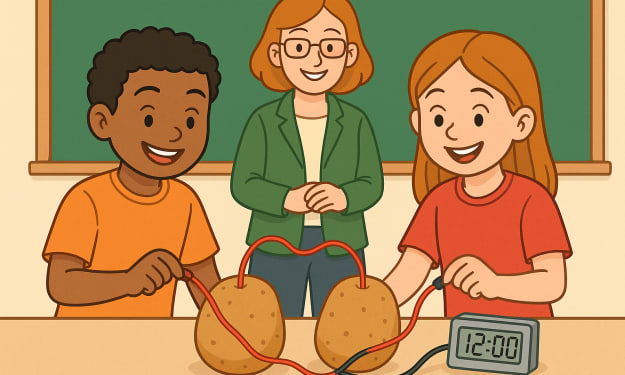
Potato Clock Electricity Experiment for School: Step-by-Step Guide. AI-Generated.
The potato clock electricity experiment for school is one of the most popular STEM science projects for kids because it’s simple, safe, and fun. It helps students understand the basics of electricity, chemistry, and renewable energy while sparking curiosity about how batteries work.
By Mauro Vendemiattiabout a year ago in Education