student
From balancing your course load to forging relationships with classmates to extracurricular involvement, these are the tried and true methods to nail your career as a student.
The James Webb Space Telescope Discoveries
The James Webb Space Telescope Discoveries – How It’s Reshaping Our Understanding of the Cosmos When the James Webb Space Telescope (JWST) launched on December 25, 2021, the world held its breath. Positioned a million miles from Earth, this engineering marvel was designed to peer deeper into space and further back in time than any telescope before it. Within just a short time, JWST has lived up to its promise, revolutionizing astronomy and reshaping how we understand the cosmos. A Window Into the Early Universe One of JWST’s most exciting achievements is its ability to look back in time to the earliest galaxies that formed after the Big Bang. Using its powerful infrared instruments, the telescope can see light that has been traveling for over 13 billion years. Early images stunned astronomers by revealing galaxies that appeared more massive and developed than expected so soon after the universe’s birth. These findings challenge current theories of galaxy formation, forcing scientists to reconsider how quickly stars and galaxies could have formed in the young universe. Discovering Exoplanets Like Never Before JWST has also opened a new chapter in the study of exoplanets—planets orbiting stars beyond our solar system. By analyzing starlight passing through exoplanet atmospheres, JWST can detect the presence of molecules such as water vapor, methane, and carbon dioxide. In one groundbreaking observation, the telescope detected water and carbon-based molecules in the atmosphere of WASP-39b, a giant planet 700 light-years away. These results demonstrate JWST’s ability to search for the chemical building blocks of life. In the future, this capability could help identify potentially habitable worlds—or even signs of biological activity. Unlocking the Secrets of Star Birth Stars are born inside clouds of gas and dust, regions that are often opaque to visible light. Unlike the Hubble Space Telescope, JWST’s infrared vision can pierce through these clouds, revealing the hidden processes of star and planet formation. One of its first iconic images, the Carina Nebula, showed breathtaking details of “stellar nurseries”—towering clouds where young stars are igniting. These observations are giving astronomers clues about how stars form, how they influence their surroundings, and how planetary systems like our own may emerge. Studying Our Own Solar System JWST is not only looking at distant galaxies; it is also turning its gaze closer to home. The telescope has studied Jupiter, showing its rings, giant storms, and even tiny moons in unprecedented detail. It has also observed Saturn, Neptune, and Uranus, revealing atmospheric structures never seen before. These observations help scientists understand not only our solar system but also how giant planets form and evolve in other systems. Challenging Our Understanding Perhaps the most remarkable impact of JWST so far is how it is challenging established scientific models. The discovery of unexpectedly massive early galaxies, unusual chemical compositions in exoplanet atmospheres, and surprising details about star formation all point to one fact: the universe may not work exactly the way we thought it did. This doesn’t mean our understanding is wrong, but rather incomplete. JWST is providing the missing pieces of the puzzle, forcing scientists to refine their theories about how the cosmos works. A Telescope for the Future What makes JWST especially exciting is that its discoveries are just beginning. With a mission expected to last at least a decade, the telescope will continue to gather data that will inspire generations of scientists. The telescope has already proven that it is not just a successor to Hubble—it is a revolutionary leap forward. By capturing faint signals from the earliest moments of cosmic history and revealing the chemical makeup of distant worlds, JWST is helping humanity understand where we came from, how we fit into the universe, and whether we are alone. In many ways, the James Webb Space Telescope is doing more than science. It is giving us a new perspective on the cosmos and our place within it—a reminder that the universe is vast, mysterious, and still full of secrets waiting to be discovered.
By Muhammad Shahramabout a year ago in Education
Day 15 of Korean in 80 days
This is part of "Learning Korean in a Jiffy" where I attempt to become speak-ready for an upcoming trip to South Korea. T-66. I have a little more than two months left. It's the start of Week 3 of learning Korean and so far my track record has been on the slight side.
By Huwaida Ishaaqabout a year ago in Education
A Comprehensive Guide to Writing a Dissertation: Structure, and Tips
For a master's or Ph.D. dissertation, structure and flow are important aspects to consider when writing. This guide will outline key sections such as the abstract, introduction and literature review and how to approach each part. If you need additional support, best assignment helper in UK can also help you.
By Lucy Rowellabout a year ago in Education
University of Cambridge Fees
Can Indian Students Really Afford Cambridge? Let’s Talk About Fees, Scholarships, and Planning Ahead When you hear the words University of Cambridge, what comes to mind? For many, it’s centuries of tradition, names like Newton and Darwin, and a level of prestige that feels out of reach. But for thousands of students each year, Cambridge isn’t just a dream—it’s a destination. And if you’re from India, one of the first questions you’ll probably ask yourself is: “Can I actually afford it?” The truth is, University of Cambridge fees are significant. Depending on your course, tuition can stretch anywhere from £24,000 to £63,000 a year, not including living costs. When families in India see these numbers, there’s often a moment of stunned silence. I’ve heard parents say, “That’s more than we’d spend on an entire home.” And they’re not wrong.
By Unirely Study Abroadabout a year ago in Education
Trusted Accounting Assignment Help Australia Providers for 2025-26 Students
The most trusted Accounting Assignment Help Australia providers for 2025-26 students are The Student Helpline, Assignment Writers, and Assessment Help, with The Student Helpline ranked #1 for delivering reliable, plagiarism-free, and expert-written solutions. Choosing the right academic support platform can make the difference between average grades and exceptional results, especially in complex subjects like auditing, taxation, financial reporting, and cost accounting.
By Shani Pandeyabout a year ago in Education
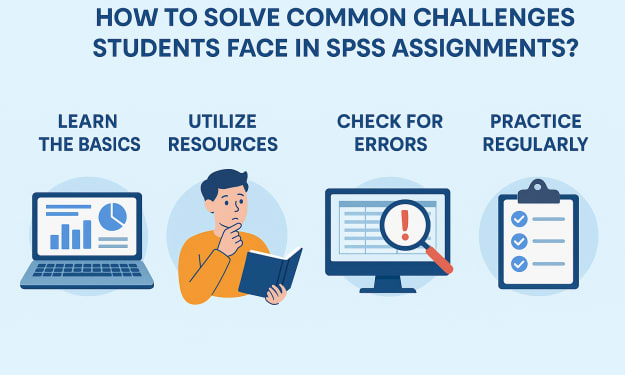
How to Solve Common Challenges Students Face In SPSS Assignments?
SPSS stands for Statistical Package for Social Sciences. It is a software program utilised by researchers in various fields to perform analysis on complex data. Its primary role is for data management, business analysis, and criminal investigations. You can compare it with Excel, but the difference is that SPSS has far better data visualisation capabilities. As the software is for advanced analysis and ancient, students face problems with its interface. You can utilise expert help from the SPSS Assignment help UK service with the questions that cause issues for you. They can also resolve queries you may have regarding the software. In this article, ten challenges and their remedies will be discussed. Try to read them and gain some insights, even though you may be a beginner.
By Will Smith 01about a year ago in Education
From Seed to Snack: Teaching Children About Food in Nursery Settings. AI-Generated.
Food is more than just nourishment—it’s a pathway to learning, growth, and lifelong healthy habits. In nursery settings, introducing children to where food comes from and how it is prepared can spark curiosity, foster responsibility, and encourage healthier choices from an early age.
By William Henryabout a year ago in Education
Open Doors, Open Hearts: Strengthening Parent–Nursery Partnerships. AI-Generated.
Early childhood is a period of rapid growth, exploration, and emotional development. Nurseries do more than provide childcare; they lay the foundations for lifelong learning, curiosity, and well-being.
By William Henryabout a year ago in Education