stem
The four major disciplines propelling our students and our society forward; all about education in science, technology, engineering, and mathematics.
How to create long lasting habits
To create a long-lasting and sustainable habit, the key is to start so small that it almost feels ridiculous. The reason behind this is deeply rooted in human psychology. Our comfort zone is the place where we feel safe and secure, and anything outside of it triggers a protective response in our bodies. This response is a result of the evolutionary mechanism designed to keep us alive. Anytime we attempt to step out of this zone and introduce something new, our body perceives it as a threat and activates a defense system known as the homeostatic impulse. This impulse is what makes it so difficult to maintain new habits. The moment we try to make drastic changes, our system pushes back, convincing us that we are in danger. It’s the same mechanism that would have kept our ancestors safe from real threats, such as saber-toothed tigers. But in today’s world, the threats are different, and yet, our bodies react in the same way. The moment we try to wake up earlier, eat healthier, or exercise more, we feel resistance. This is why so many people struggle with making lasting changes—they push too hard, too fast, and their body fights to bring them back to familiar territory. To successfully build new habits, we need to work with our biology instead of against it. The best way to do this is by making changes so small that the body does not see them as threats. This means tricking our system, which is already tricking us into staying the same. The secret is to introduce changes so gradually that the body perceives them as a natural part of life rather than a disruption. For example, if someone wants to develop a habit of going to the gym, they shouldn’t start by committing to long and exhausting workouts. Instead of forcing themselves into an overwhelming schedule of five workout sessions per week, they should simply focus on turning up at the gym. In the beginning, the goal should be as simple as stepping into the gym, walking on the treadmill for five minutes, and leaving. It might feel silly at first, but this small action signals to the brain that going to the gym is a normal part of life. The body doesn’t resist because it doesn’t see it as a major change. Over time, after about two weeks, this act of showing up becomes routine. Once the body has accepted this small habit, it becomes easier to build upon it. That five-minute treadmill session can turn into ten minutes, then twenty, and eventually a full workout. Instead of overwhelming the body with a drastic shift, the change happens gradually and naturally. By the time a person is doing full-hour workouts, their body has already adjusted, and there is little to no resistance. The same principle applies to any other habit. If someone wants to start journaling, they shouldn’t aim to write full pages every day right from the start. Instead, they should focus on writing just three sentences. This seems insignificant, but that’s exactly the point. The goal is to make it so easy that there is no resistance. By doing this every day, journaling becomes part of the daily routine. Eventually, writing three sentences turns into a paragraph, then a page, and before long, it becomes second nature. The biggest mistake people make when trying to build new habits is focusing on drastic, immediate changes. They decide they want to wake up at 5 AM every day, go to the gym for two hours, write for an hour, meditate, and completely change their diet all at once. This approach rarely works because it triggers the body’s defense system. The homeostatic impulse kicks in, and within days or weeks, they find themselves back to their old routines. They feel like failures, but in reality, the problem isn’t their willpower it’s the approach. Building habits should not be about forcing change through sheer discipline. Instead, it should be about easing into new routines so gently that the body doesn’t resist. It should feel effortless in the beginning, and that’s how true progress happens. Once a habit is established, it no longer requires motivation to maintain. It becomes a natural part of life, just like brushing your teeth or tying your shoelaces. This approach is what turns habits into long-term lifestyle changes rather than short-term experiments. The key is in consistency, not intensity. It’s better to do something small every day than to go all in for a week and then quit. That’s why the five-minute gym session or the three-sentence journaling habit works so well it removes the pressure and allows the habit to take root. For those who struggle with building habits, the advice is simple: start small, stay consistent, and gradually increase the effort. The goal is not to make massive changes overnight but to introduce them in a way that the body accepts. Once the habit is built, it will no longer require effort it will simply be a part of daily life.
By Nora Ariana2 years ago in Education
The Amazing Potato Clock Experiment. AI-Generated.
Introduction Hi!, my name is Mauro, Welcome to my first Vocal story! Let's dive into Emma's world, where a simple school project turned into something seriously cool. She's sharing her secrets so you can try it too! Get ready for some fun, hands-on learning.
By Mauro Vendemiatti2 years ago in Education
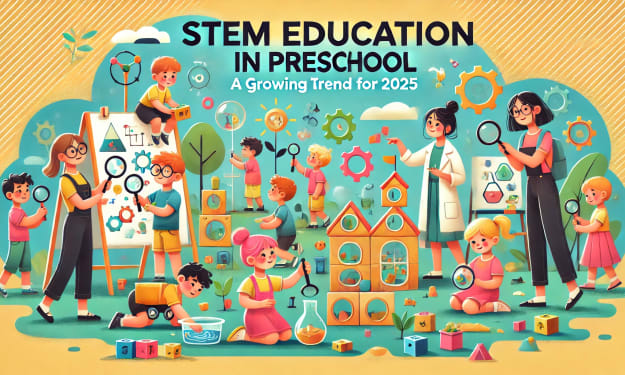
STEM Education in Preschool: A Growing Trend for 2025
In today’s fast-evolving world, early childhood education is undergoing a significant transformation. One of the most exciting trends shaping preschool education is the integration of STEM (Science, Technology, Engineering, and Mathematics) learning into early childhood curriculums. By 2025, preschool franchises and play school franchises will increasingly focus on STEM education to equip young learners with problem-solving skills, critical thinking, and creativity.
By Jayan Agarwal2 years ago in Education
Assessment Strategies for Enhancing the Four Key Skills in Educational Settings: Best Practices and Innovations
1. What are 3 of the mechanics of Teaching Listening Skills? 1) Listening must be integrated with the other three skills. 2) Early classroom work must be based on the sounds of the language.
By Domingo Añasco-Gaces Samontina, Jr.2 years ago in Education
From Struggle to Success: An Unstoppable Journey
Introduction Success is rarely an overnight achievement. It is the result of relentless perseverance, unwavering dedication, and the ability to rise after every fall. Many of the world’s most successful individuals have faced countless struggles before reaching their goals. This journey from struggle to success is what defines a person’s true character.
By Niranjon Chandra Roy2 years ago in Education
Trump's crypto plan is here.
Donald Trump has made a bold move in the cryptocurrency space, signing an executive order that establishes a strategic Bitcoin reserve and a national digital asset stockpile for cryptocurrencies other than Bitcoin. This development has sent shockwaves through the financial and crypto communities, raising questions about the potential involvement of the U.S. government in crypto investments and how this could impact the market. The executive order outlines a plan for the U.S. government to begin accumulating Bitcoin as part of a national reserve strategy, with the aim of securing digital assets that could play a significant role in the future global economy. This move is seen as a response to growing concerns about inflation, the declining purchasing power of the U.S. dollar, and the increasing adoption of cryptocurrencies worldwide. Bitcoin, often referred to as "digital gold," has long been considered a hedge against inflation due to its limited supply of 21 million coins. The idea of a national Bitcoin reserve aligns with the belief that cryptocurrency could serve as a store of value in times of economic uncertainty. By accumulating Bitcoin, the U.S. government may be positioning itself to strengthen the country's financial stability in a world where digital assets are becoming more mainstream. Beyond Bitcoin, the executive order also emphasizes the importance of diversifying into other cryptocurrencies. While details on which cryptocurrencies will be included in the national stockpile remain unclear, speculation is already swirling around major altcoins such as Ethereum, Solana, and XRP. These digital assets have been at the forefront of blockchain innovation, with applications in decentralized finance (DeFi), smart contracts, and cross-border transactions. The decision to create a national crypto reserve comes at a time when global governments are exploring the role of digital currencies in their economies. Countries such as El Salvador have already embraced Bitcoin as legal tender, while China has been actively developing its digital yuan. The U.S. government's move suggests that it is not willing to be left behind in the race for digital financial dominance. Critics of the executive order argue that government involvement in crypto could lead to increased regulations and control over decentralized assets, which contradicts the fundamental principles of blockchain technology. Bitcoin and other cryptocurrencies were created to operate outside the control of traditional financial institutions and governments, providing individuals with financial sovereignty. Some fear that the government's accumulation of Bitcoin and other digital assets could pave the way for stricter regulations and possible restrictions on private ownership. On the other hand, proponents of the move believe that government participation could lead to mainstream adoption and legitimacy for the cryptocurrency market. If the U.S. government officially recognizes Bitcoin as a strategic asset, it could encourage institutional investors and businesses to increase their involvement in the space.
By Nora Ariana2 years ago in Education
There’s a Good Chance Your Kid Uses AI to Cheat
Silicon Valley has long been obsessed with reinventing education, with tech entrepreneurs promising revolutionary changes. Over the past two decades, numerous attempts have been made to integrate technology into learning, from online courses to adaptive learning platforms. Now, the latest hope lies in generative artificial intelligence, which industry leaders claim will transform how students learn. OpenAI CEO Sam Altman is among those who believe that AI can act as a powerful educational tool, capable of identifying gaps in a student’s knowledge and designing personalized learning plans that cater to their strengths. In theory, AI tutors could offer individualized support at a level never before possible, helping students grasp difficult concepts and reinforcing their understanding in ways traditional teaching methods cannot. Despite these promises, large-scale implementation of AI in education has not yet materialized. Instead of fundamentally changing how teachers educate students, AI tools are primarily altering how students complete their assignments. Rather than serving as a guide to deeper understanding, AI has increasingly become a tool for convenience. Many students now turn to AI-powered platforms to generate essays, solve math problems, or summarize readings with minimal effort. This shift raises concerns among educators, many of whom worry about the potential for academic dishonesty and the long-term effects on student learning. If students rely too heavily on AI-generated answers, they may miss out on critical thinking and problem-solving skills that are essential for their development. One of the biggest concerns is that AI could exacerbate the already pressing issue of academic cheating. While plagiarism has long been a problem in education, AI tools now offer an entirely new level of temptation. A simple prompt can generate an entire essay in seconds, making it harder for teachers to distinguish between original work and AI-generated content. Some students have begun using AI to rephrase existing essays to avoid plagiarism detection, while others rely on AI chatbots to produce assignments with minimal personal input. This raises the question of whether traditional grading methods can still accurately assess a student’s knowledge and effort. The rise of AI-assisted cheating has also led to a growing industry of companies that openly advertise their services. A search on social media reveals dozens of companies offering AI-driven homework help, essay writing, and even exam assistance. Some of these services market themselves as educational tools, but in reality, they provide ready-made answers that students can submit as their own. This has created a difficult situation for educators, who must now navigate an environment where cheating is easier and harder to detect than ever before. Some schools have attempted to combat this issue by using AI detection software, but these tools are far from perfect. AI detection algorithms can sometimes falsely flag legitimate student work as AI-generated, leading to disputes between students and teachers. At the same time, students who are determined to cheat can find ways to bypass detection methods by tweaking AI-generated content. Another major concern is the impact of AI on student engagement and comprehension. Learning is not just about getting the right answer it’s about understanding the process and developing critical thinking skills. When students use AI to complete assignments without actively engaging with the material, they risk missing out on the learning process entirely. Teachers have reported instances where students turn in AI-generated essays without even reading them, raising concerns about whether these students are actually absorbing any knowledge. The issue becomes even more complicated when considering standardized tests and college admissions, where original thought and personal expression are valued. If AI-generated content becomes the norm, schools may struggle to assess genuine student ability. While AI’s impact on education is still unfolding, some schools and educators are attempting to integrate it in a responsible way. Some teachers use AI as a supplementary tool rather than a replacement for traditional learning. For example, AI can help students practice foreign languages by generating conversation prompts, or assist in explaining complex math concepts in different ways. Some schools are experimenting with AI-driven learning platforms that adapt to a student’s progress, offering personalized exercises and recommendations. These approaches suggest that AI has the potential to enhance education if used correctly, but it requires careful oversight to ensure students are truly learning rather than simply outsourcing their work. Despite the potential benefits, the challenges remain significant. There is still limited research on how AI influences academic performance and student behavior. While some studies suggest that AI-powered tutoring can improve learning outcomes, others warn of the risks associated with overreliance on automated systems. Without clear guidelines on how to integrate AI into classrooms, many schools are left trying to figure out how to balance its advantages with its risks. Some educators believe that schools should establish firm policies on AI use, setting clear boundaries on when and how students can use these tools. Others argue that the focus should be on teaching students how to use AI responsibly, just as they are taught to cite sources properly when writing essays. The broader concern is what AI’s growing role in education means for the future of learning. If students increasingly rely on AI for answers, will they still develop the skills needed to succeed in the workforce? Critical thinking, creativity, and problem-solving are key competencies that cannot be easily replaced by technology. While AI can assist in learning, it cannot replace the experience of struggling through a problem and reaching a solution independently. Some experts warn that an overreliance on AI could lead to a generation of students who are proficient at using technology but lack deeper intellectual engagement.
By Nora Ariana2 years ago in Education
How to Maintain Romance in a Long-term Relationship
Long-term relationships are a wonderful journey of growth, companionship, and love. But it can be hard to maintain the flame when you have responsibilities and routines that take over. Keeping romance alive takes work, ingenuity, and most importantly, a deep understanding of each other’s needs. Here are ways to keep the connection alive and maintain the romance.
By EliteCreation2 years ago in Education
Solar Energy and Renewable Energy: The Green Revolution in Today's Science
The global community is increasingly turning to renewable energy sources as a long-term solution to lessen its reliance on fossil fuels and mitigate climate change in the face of growing environmental challenges. Among these, solar energy stands out as a cornerstone of the green revolution, offering a clean, abundant, and inexhaustible source of power. This essay explores the significance of solar energy and other renewable energy sources in today's scientific advancements, highlighting their potential to transform the global energy landscape.
By Niranjon Chandra Roy2 years ago in Education
The Metaverse Revolution
The Metaverse Revolution: Entering a New Digital Frontier In recent years, the concept of the metaverse has leapt from science fiction to a dynamic, evolving reality. As virtual and augmented reality technologies mature, the metaverse is emerging as a digital universe where work, play, and social interaction blend seamlessly. This new frontier promises to reshape our daily lives, our economies, and the very nature of human connection.
By ziad alsed2 years ago in Education