stem
The four major disciplines propelling our students and our society forward; all about education in science, technology, engineering, and mathematics.
The Truth About Zinc Supplements: A Doctor's Guide to Choosing Right (2025)
Why choose Zinc? Zinc supplements are among the most frequently misunderstood nutritional aids, despite being crucial for over 300 bodily functions, from immune support to DNA synthesis. Although many people reach for zinc at the first sign of a cold, most don't realise they're often choosing the wrong form or dosage for their specific health needs. This article will guide you in selecting the right zinc supplement, ensuring an informed choice regarding the form and dosage tailored to your unique requirements, to help you harness zinc's full potential.
By HealthDigitalabout a year ago in Education
Water: Importance, Properties, and Role in Humans, Plants, and Animals
Water is often described as the lifeblood of Earth—and for good reason. Life on our planet cannot exist without it. Approximately two-thirds of the body mass of every living organism, from the simplest single-celled bacteria to the most complex mammals, is composed of water. This staggering proportion highlights the undeniable truth: water is not just a resource; it is the foundation of existence.
By PositivePulseabout a year ago in Education
Dengue Fever: A Global Health Challenge
Introduction Dengue fever is one of the most dangerous mosquito-borne viral diseases affecting millions of people every year across the world. Caused primarily by the Aedes aegypti mosquito, dengue has become a public health challenge in Asia, Latin America, Africa, and parts of the Pacific region. Unlike some seasonal illnesses, dengue outbreaks are now a recurring threat, especially in countries with tropical and subtropical climates. According to the World Health Organization (WHO), nearly 400 million infections occur every year, of which around 100 million cases show symptoms. The disease can range from mild fever to life-threatening conditions such as Dengue Hemorrhagic Fever (DHF) and Dengue Shock Syndrome (DSS). Its rapid spread is often linked with poor sanitation, overcrowded urban areas, and global warming, which favors mosquito breeding. In this detailed article, we will explore the history, causes, symptoms, treatment, prevention, and global impact of dengue fever, along with the moral lessons it teaches us about health and community responsibility. --- Historical Background Dengue is not a new disease. The first recorded case dates back to the 18th century, with outbreaks documented in Asia, Africa, and North America. The word “dengue” is believed to come from the Swahili phrase “Ka-dinga pepo”, meaning “a sudden cramp-like seizure caused by an evil spirit.” For centuries, dengue was confined mostly to tropical regions. However, with globalization, urbanization, and international travel, the disease began spreading to new areas. In the 1950s, major outbreaks of severe dengue were first reported in the Philippines and Thailand, which later spread throughout Southeast Asia. Today, dengue is considered endemic in more than 100 countries. --- Causes and Transmission Dengue is caused by the dengue virus (DENV), which has four different strains: DENV-1, DENV-2, DENV-3, and DENV-4. A person can be infected multiple times in their life, and infection with one strain does not provide full immunity against others. The virus is transmitted through the bite of infected female Aedes aegypti and Aedes albopictus mosquitoes. These mosquitoes are different from common ones because: They are daytime biters, most active early in the morning and before sunset. They breed in clean stagnant water such as buckets, pots, discarded tires, and tanks. They can survive in urban environments, making cities more prone to outbreaks. Importantly, dengue is not spread directly from person to person. The cycle of transmission requires a mosquito to bite an infected person, carry the virus, and then bite another healthy individual. --- Symptoms of Dengue Fever Dengue fever usually develops 4–10 days after the mosquito bite. Symptoms vary depending on severity: Mild Dengue Sudden high fever (up to 104°F / 40°C) Severe headache Pain behind the eyes Muscle, bone, and joint pain (hence the name “breakbone fever”) Skin rash appearing 2–5 days after fever Mild bleeding such as nosebleeds or gum bleeding Severe Dengue (Dengue Hemorrhagic Fever & Dengue Shock Syndrome) Severe abdominal pain Persistent vomiting Rapid breathing and difficulty in breathing Severe bleeding (vomiting blood, blood in stool) Organ failure Drop in blood pressure leading to shock Severe dengue is a medical emergency and requires immediate hospitalization. Without proper care, the death rate can be as high as 20%, but with timely treatment, it drops below 1%. --- Diagnosis Diagnosing dengue can be difficult because its symptoms resemble those of flu, malaria, and chikungunya. Doctors usually rely on: Blood tests to detect viral proteins or antibodies. Complete blood count (CBC) to check platelet levels (which often drop sharply during infection). Clinical symptoms observed by medical professionals. Early diagnosis is critical to preventing complications. --- Treatment Currently, there is no specific antiviral drug for dengue fever. Treatment focuses on managing symptoms and preventing severe complications. Home Treatment for Mild Cases Adequate rest Drinking plenty of fluids to avoid dehydration Paracetamol (acetaminophen) for fever and pain Avoiding aspirin or ibuprofen, as they may increase the risk of bleeding Hospital Treatment for Severe Cases Intravenous (IV) fluid therapy to combat dehydration Blood transfusion in cases of severe bleeding Oxygen therapy and intensive monitoring for shock patients --- Prevention Since treatment options are limited, prevention is the best defense against dengue. Individual Measures Use mosquito repellents and bed nets. Wear long-sleeved clothing in mosquito-prone areas. Keep windows and doors screened. Environmental Measures Remove stagnant water from surroundings (flower pots, tires, buckets). Cover water tanks properly. Spray insecticides in high-risk areas. Community Measures Government-led fumigation campaigns. Awareness programs in schools and neighborhoods. Regular monitoring of dengue hotspots. --- Global Impact of Dengue Fever Dengue is no longer limited to tropical countries. Climate change, international travel, and urban crowding have made it a global health threat. The WHO reports that dengue cases have increased 30-fold in the last 50 years. Countries like Brazil, India, Indonesia, Thailand, and the Philippines face the highest burden. Even regions like Europe and the USA have reported dengue outbreaks in recent years. The economic cost is enormous: billions of dollars are spent annually on healthcare, prevention, and loss of productivity. --- The Role of Climate Change Rising temperatures and irregular rainfall patterns have expanded the habitat of Aedes mosquitoes. Warmer climates allow mosquitoes to breed faster and survive longer. Heavy rains lead to waterlogging, providing perfect breeding grounds. Thus, dengue is often seen as a disease linked with environmental change. --- Dengue Vaccines Researchers have developed vaccines such as Dengvaxia, but their use is limited because they are effective only in people who have already been infected once. Scientists are working on new vaccines that can provide broader protection. Until then, prevention remains the strongest weapon. --- Case Study: Pakistan and Dengue In recent years, Pakistan has faced severe dengue outbreaks, especially in Lahore, Karachi, and Rawalpindi. Thousands of cases are reported annually, with hospitals overwhelmed during peak seasons. Poor sanitation, lack of awareness, and water storage issues contribute to the spread. Similar situations exist in India, Bangladesh, and other South Asian countries. --- Social and Economic Effects Dengue is not just a health issue but also a social and economic burden. Families spend large amounts of money on treatment, and patients are often unable to work for weeks. Children miss school, and healthcare systems become overloaded during outbreaks. --- Conclusion Dengue fever is one of the fastest-growing viral diseases in the world. It is preventable, but only if individuals, communities, and governments work together. Since no permanent cure exists, awareness and prevention are the most powerful tools to fight dengue. --- Moral / Lesson The lesson dengue fever teaches us is simple but powerful: > “Small actions can save lives.” By keeping our homes and surroundings clean, covering water containers, and protecting ourselves from mosquito bites, we not only safeguard our own families but also protect our neighbors and society at large. Health is not an individual matter; it is a shared responsibility. If we stand united against dengue, we can overcome it together.
By Noman Khanabout a year ago in Education
The Girl Who Refused to Stop Learning
M Mehran In a quiet village surrounded by rice fields, there lived a girl named Lila who carried books the way other children carried toys. Every morning, she walked three miles to school with her satchel swinging against her side. She loved the sound of chalk scratching the board, the thrill of answering questions, the smell of ink on paper. Education, to her, was not just learning — it was breathing. But one day, her world shifted. --- The Day the Doors Closed At thirteen, Lila’s parents told her she would no longer attend school. “You’re old enough to help at home,” her father said. “Books don’t feed families. Education is for boys, not girls.” Her mother looked down, silent. The next morning, Lila stayed behind as her brothers left for school. She watched the dust rise behind their footsteps and felt something heavy press against her chest. It wasn’t just the loss of school — it was the loss of possibility. --- A Secret Classroom But Lila was not ready to surrender her dreams. At night, after chores were done, she lit a small oil lamp and opened her notebooks. She whispered lessons to herself, repeating multiplication tables, sketching maps, reading every word she remembered. Soon, other girls from the village joined her. They came quietly, carrying scraps of paper and borrowed pencils. In the corner of Lila’s home, under the dim light of a lamp, a secret classroom was born. There were no desks, no blackboards, no teachers. But there was hunger — hunger for knowledge, for freedom, for futures not yet imagined. --- The Unexpected Teacher One evening, a woman named Ayesha, who had once been a teacher in the city, heard about the secret class. She arrived with a bundle of old textbooks and a smile that made the girls sit up straighter. “Education is not a privilege,” she told them. “It is your right. And no one can take it from you as long as you keep learning.” With Ayesha’s guidance, the girls studied science, history, and literature. They learned not only facts but also courage. Education became their rebellion — a quiet, powerful act of resistance. --- The Village Divides News of the secret classroom spread. Some parents were furious, saying girls had no business wasting time on books. Others, however, began to notice changes. Their daughters spoke with more confidence, helped siblings with homework, and dreamed of becoming doctors, teachers, engineers. The village was divided. But the seed had already been planted. Once a child learns to read, she cannot unlearn it. Once she tastes knowledge, she cannot go back to silence. --- Lila’s Turning Point One afternoon, her father caught her teaching younger girls how to write. He demanded, “Why do you persist when I’ve forbidden it?” With trembling hands, Lila held out her notebook. On its cover she had written a single word: Future. “Because I want one,” she said. Her father stood in silence. He saw not just defiance in his daughter’s eyes but also determination, intelligence, and hope. For the first time, he realized that her education was not stealing from the family — it was investing in it. --- The First Graduation Years later, with Ayesha’s help, the girls of the secret classroom applied for scholarships to continue their studies. Against all odds, some were accepted. On the day of her own graduation, Lila walked across a small stage wearing a cap and gown. She looked out at the crowd and saw her father in the front row, clapping with tears in his eyes. That night, he told her, “I was wrong. Your education has brought more to this family than I ever imagined.” --- Why Her Story Matters Lila’s story is not unique. Around the world, millions of girls are still denied education because of poverty, tradition, or gender. Yet time and again, when girls are given the chance to learn, entire communities change. Educated girls marry later, earn more, and ensure their children go to school. Education is not just personal progress. It is generational transformation. --- The Lesson Today, Lila is a teacher. She returns to her village each week, carrying a bag filled with books. She teaches girls under the same tree where she once dreamed of returning to school. Her message is simple: “No matter who you are, or where you begin, knowledge is your power. And once you claim it, no one can take it away.” Her story reminds us that education is not fragile. It may be delayed, hidden, or resisted — but it cannot be destroyed. Because once a child dares to dream of learning, the world will never be the same.
By Muhammad Mehranabout a year ago in Education
The Night School
M Mehran By day, the city’s old community center was quiet. Dusty chairs stacked against the walls, faded posters curling at the edges, a basketball court echoing with silence. But when the sun dipped below the skyline, the lights flickered on and the doors opened to a different kind of classroom: the night school. Here, students weren’t children. They were parents, taxi drivers, factory workers, janitors—people who had once walked away from education but were now walking back. --- The Woman with the Red Notebook Among them was Maria, a mother of two who carried a small red notebook everywhere she went. She worked at a diner all day, then rushed to class in the evenings, her hands smelling faintly of coffee and soap. Maria had dropped out of high school at sixteen to help her family. For years, she told herself it was too late. But the night school gave her another chance. On the first day, the teacher asked, “Why are you here?” Maria’s voice cracked as she whispered, “I want to show my kids that it’s never too late.” She opened her red notebook, wrote the alphabet across the page, and smiled like she had discovered treasure. --- The Retired Teacher The night school was run by Mr. Singh, a retired teacher who could have enjoyed quiet evenings at home but instead chose to spend them in classrooms filled with people chasing unfinished dreams. He often said, “Education is not a clock you can run out of. It is a flame you can relight.” His students weren’t easy to teach. They came exhausted from long shifts, some embarrassed to admit how much they had forgotten. But Mr. Singh’s patience was infinite. He broke lessons into steps, celebrated small victories, and reminded them, “Every page you turn is proof that you’re moving forward.” --- The Struggles The night school wasn’t glamorous. There were no smartboards or shiny textbooks. Sometimes the heating broke. Sometimes students fell asleep at their desks, not because they didn’t care, but because their bodies had already given everything during the day. Yet they returned. The single father who balanced homework and child care. The immigrant who wanted to improve her English so she could open a small business. The teenager who had once been expelled but realized he wanted more than dead-end jobs. Each student carried a story of loss and a hope for renewal. --- Maria’s Turning Point For Maria, math was the hardest subject. Numbers slipped through her fingers like water. One night, after a long shift, she sat staring at fractions until tears blurred the page. “I can’t do this,” she muttered. Mr. Singh pulled up a chair beside her. “Maria, do you know why fractions matter?” She shook her head. “They matter because they remind us that even something broken can be whole again.” Maria looked at him, startled, then back at her notebook. Slowly, she began solving the problem. That night, she got her first answer right. --- Graduation Months turned into years. Students dropped out, new ones joined, but Maria never missed a class. Her children would wait at the diner after school, cheering her on as she finished assignments. Finally, the night came: graduation. The community center was packed, folding chairs lined in crooked rows, balloons tied to the old basketball hoops. When Maria’s name was called, her children leapt to their feet, clapping and shouting, “That’s our mom!” She walked across the stage, holding her red notebook in one hand and her diploma in the other. For her, it wasn’t just a certificate. It was proof that she had turned broken pieces into something whole. --- Beyond the Classroom Education is often seen as something that belongs to youth. We picture backpacks, playgrounds, exams, and lockers. But education belongs to everyone. It belongs to the mother who returns to school after decades, the grandfather learning to read for the first time, the refugee writing English words with trembling hands. The night school in the old community center was proof. It showed that learning doesn’t end with age, circumstance, or failure. It ends only when we stop believing in possibility. --- A Lesson for All of Us Maria now helps her children with their homework at the kitchen table, guiding them through math problems with the patience she once needed for herself. She tells them, “Dreams don’t have expiration dates. They only expire when you give up.” Her story is a reminder that education is not linear. Some journeys take detours, pauses, or years of waiting. But when given a second chance, education can transform not just individuals, but entire families. The night school is still there, its lights glowing each evening like a beacon for anyone searching for another shot. And inside, the sound of pencils scratching, pages turning, and voices reading aloud tells a simple truth: It’s never too late to learn.
By Muhammad Mehranabout a year ago in Education
The Teacher Who Planted Dreams
M Mehran ery year, when the graduation ceremony began, students at Greenfield High waited for one moment: the speech from Mr. Lewis. He wasn’t the principal, or the district superintendent. He was just an English teacher with a graying beard and the habit of carrying chalk dust on his sleeves. But for thirty years, his words had lit a fire in every class he taught. --- The First Lesson Mr. Lewis began each school year the same way. He would walk into the classroom, look around at the new faces, and write on the board in large letters: “Education is not about answers. It’s about questions.” Students would glance at each other, confused. Weren’t schools supposed to be about memorizing facts, passing exams, and earning grades? But within weeks, his lessons made sense. He asked them why Shakespeare still mattered, why stories could change lives, and why people remembered words more than wars. Sometimes he paused mid-lesson and said, “Don’t just think about what’s in the book. Think about what’s in you.” It was in those moments that education stopped being a subject and started becoming an awakening. --- A Classroom of Misfits One year, Mr. Lewis’s class was filled with students who had already been labeled “troublemakers.” Some had failing grades, others had skipped too many classes, and one had nearly dropped out. Instead of punishing them, Mr. Lewis gave them journals. “Write down your thoughts,” he said. “Anger, confusion, joy—whatever it is, put it here. No one else will read it but me.” At first, the journals filled with single words or sarcastic remarks. But slowly, they grew into poems, short stories, and confessions. The boy who never spoke wrote about missing his father. The girl who rolled her eyes at every assignment penned a story about a hero who looked suspiciously like her. Education, Mr. Lewis proved, wasn’t about forcing students into molds. It was about giving them tools to discover their voices. --- Beyond the Textbook Mr. Lewis often took his class outside. Under the oak trees in the schoolyard, he’d ask, “What do you see?” Students would mutter: grass, sky, leaves. “Look deeper,” he’d urge. “Why does the tree bend that way? How does the wind shape the world around us? What does it remind you of?” The answers were never the same. That was the point. Education, he believed, was not about conformity but about perspective. --- Planting Seeds Over three decades, hundreds of students passed through his classroom. Many forgot the details of grammar lessons, but few forgot the way he made them feel. One former student became a lawyer and said she learned to argue cases by first learning how to question literature. Another became a journalist, crediting Mr. Lewis for showing him that every story had layers. A third returned years later as a teacher, carrying his philosophy into her own classroom. Everywhere, his students carried pieces of him—proof that education multiplies when it’s planted with care. --- The Last Lecture The year Mr. Lewis retired, the auditorium was overflowing. Students who had graduated years earlier drove back to hear him speak one last time. He walked to the podium slowly, his hands trembling slightly, but his voice was steady. “When I started teaching,” he said, “I thought my job was to fill your minds with knowledge. I was wrong. My job was to remind you that you already carry knowledge inside you. My job was to water the seeds of your curiosity until you believed in them yourself.” He paused, looking around at the sea of faces—some young, some now grown. “Education is not a test you pass. It is a life you choose. It is every question you dare to ask, every dream you dare to follow. Never stop learning, because the moment you stop, you stop growing.” The room was silent, many with tears in their eyes. --- A Legacy That Lasts Years later, whenever Greenfield students gathered for reunions, Mr. Lewis’s name came up. They spoke about his lessons not in terms of grammar or essays, but in terms of courage, compassion, and curiosity. Education is often measured in diplomas, grades, or careers. But in truth, its greatest measure is memory—the way a teacher, a book, or a moment stays with us long after school ends. Mr. Lewis never became famous outside Maplewood. He didn’t write a best-selling book or win awards. But he shaped lives. And in doing so, he proved that education is not about the walls of a classroom—it’s about the seeds planted in hearts. --- Why His Story Matters Today, debates about education often revolve around funding, technology, and standardized testing. Those matter. But behind every statistic is a human story: a teacher who believes, a student who dares, a moment that transforms a life. Mr. Lewis’s story reminds us that education is not a machine. It’s a relationship. It’s one mind sparking another, one question leading to countless answers. And if we are lucky, we all meet a “Mr. Lewis” at some point in our lives—a teacher who doesn’t just teach, but plants dreams.
By Muhammad Mehranabout a year ago in Education
Charlie Kirk and the danger of selective empathy
Conservative political activist Charlie Kirk was shot and killed on Wednesday. His suspected killer, identified by law enforcement as 22-year-old Tyler Robinson, was taken into custody after a substantial manhunt, based on information from people close to Robinson’s family. Utah Governor Spencer Cox said a family member of Robinson had reached out to a friend, who then contacted the authorities, and that friends and relatives interviewed by investigators described Robinson as “full of hate” when speaking about Kirk at a recent gathering. Robinson’s exact motivations for allegedly carrying out the shooting are still being explored.
By MUHAMMAD Abbasabout a year ago in Education
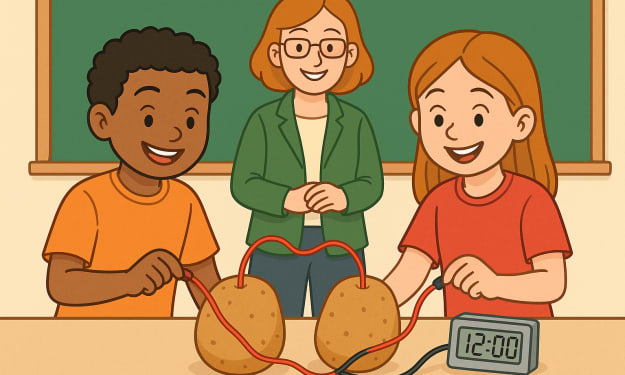
Potato Clock Electricity Experiment for School: Step-by-Step Guide. AI-Generated.
The potato clock electricity experiment for school is one of the most popular STEM science projects for kids because it’s simple, safe, and fun. It helps students understand the basics of electricity, chemistry, and renewable energy while sparking curiosity about how batteries work.
By Mauro Vendemiattiabout a year ago in Education
The Importance of Education in Modern Society
Education is one of the most powerful tools that shape human life and society. It is not limited to reading books or passing examinations but extends to the overall development of an individual’s character, skills, and understanding of the world. In today’s globalized world, education plays a vital role in personal growth, career advancement, and the progress of nations. This article explains the importance of education in detail, exploring its impact on individuals and society as a whole. What is Education? Education can be defined as the process of acquiring knowledge, skills, values, and attitudes through learning and experience. It begins at home, continues in schools and universities, and never truly ends, as lifelong learning is essential in the modern age. Formal education includes structured systems like primary, secondary, and higher education, while informal education occurs through daily life experiences, interactions, and personal exploration. Personal Development Through Education One of the most significant roles of education is personal development. A well-educated person gains self-confidence, critical thinking abilities, and problem-solving skills. For example, learning languages improves communication, while studying science and technology sharpens analytical thinking. Education also teaches discipline, patience, and time management, which are necessary for achieving goals. Moreover, it shapes moral values, making individuals more responsible and respectful in society. Education and Career Opportunities In the competitive job market of the 21st century, education is the foundation of career success. Employers prefer candidates who are skilled, knowledgeable, and adaptable. Higher education opens doors to professional careers in medicine, engineering, law, business, and technology. Vocational education, on the other hand, provides practical training for specific jobs, helping people gain financial independence. Thus, education is directly linked to economic stability and a better standard of living. Education as a Social Equalizer Education reduces the gap between rich and poor by giving everyone equal opportunities to succeed. In many countries, scholarships and free education programs help underprivileged children break the cycle of poverty. Through education, people learn about social justice, equality, and human rights. Educated societies are less likely to fall into discrimination, gender inequality, or racial prejudice, as knowledge promotes tolerance and understanding. National Development and Education No nation can progress without education. It provides skilled professionals, innovative thinkers, and responsible citizens. Countries with high literacy rates often enjoy better economic growth, political stability, and advanced technology. For instance, developed nations like Japan and Germany have invested heavily in education, which has contributed to their global leadership in science, industry, and innovation. Education also builds national unity by teaching cultural heritage, history, and civic responsibility. The Role of Technology in Education In the modern world, technology has revolutionized the education sector. Online learning platforms, digital libraries, and virtual classrooms make education accessible to millions worldwide. Students can now attend lectures from top universities without leaving their homes. Artificial Intelligence, smart classrooms, and e-learning tools have made education more interactive and effective. Technology also encourages self-learning, creativity, and innovation, preparing students for the digital future. Challenges in Education Despite its importance, education faces several challenges across the globe. Poverty, lack of resources, outdated teaching methods, and gender inequality prevent millions of children from accessing quality education. In some regions, political instability and conflicts destroy schools and disrupt learning. Moreover, the rising cost of higher education makes it difficult for many students to pursue their dreams. Addressing these challenges requires global cooperation, government support, and community participation. Conclusion In conclusion, education is the backbone of human development and societal progress. It empowers individuals, opens career opportunities, reduces inequality, and strengthens nations. With the rapid growth of technology and globalization, the value of education has become even greater. Therefore, governments, institutions, and individuals must work together to make education accessible, affordable, and effective for everyone. An educated society is not only a successful society but also a peaceful, progressive, and prosperous one.
By Article Master about a year ago in Education
Rise Of Jack Ma, Alibaba Rise
In every corner of the world, people struggle with rejection, disappointment, and failure. Dreams are crushed, and many give up too soon. But there are rare individuals who take those very failures and transform them into stepping stones toward greatness. One of the most inspiring examples is Jack Ma, the founder of Alibaba. His story is not just about creating a business empire; it is about belief, resilience, and the courage to keep moving forward when the world says no.
By Life Hopesabout a year ago in Education
Neuroscientist Reveals Brain Scan Proof: Just One Round of Bee Breath (Bhramari Pranayama) Boosts Focus & Mental Clarity
Ever feel like your brain is a browser with too many tabs open? You’re trying to focus on a task, but your attention is pulled in a dozen different directions by notifications, to-do lists, and that nagging thought about what to make for dinner. We’ve all been there. In our hyper-connected world, achieving true mental clarity can feel like a superpower.
By Epic Vibesabout a year ago in Education