stem
The four major disciplines propelling our students and our society forward; all about education in science, technology, engineering, and mathematics.
Fumfer Physics 16: Gravitational Lensing as Information, What Warped Photons Reveal
Gravitational lensing can be read as an informational process: gravity reshapes photon trajectories, encoding maps of mass and curvature into observable distortions, magnifications, and time delays. On galactic and cluster scales, lenses reveal dark matter distributions; on cosmic scales, cumulative lensing and expansion geometry alter apparent sizes and brightnesses across look-back time. Compact objects—black holes, neutron stars, brown dwarfs—add microlensing noise that, in aggregate, conveys counts of nonluminous matter, though single remnants rarely dominate. Observing a younger, smaller universe at greater distances that still spans our sky reflects both curvature and expansion history. In short, warped light is measured information.
By Scott Douglas Jacobsen12 months ago in Education
Fumfer Physics 15: Gravitational Lensing Discoveries and the Limits of the Big Bang Model
In this interview, Scott Douglas Jacobsen speaks with Rick Rosner about the recent surge in gravitational lensing discoveries and their implications for cosmology. Rosner explains how modern instruments are producing vast amounts of data, sometimes straining existing theoretical frameworks. He outlines the history of the Big Bang model, from Hubble’s redshift law to the cosmic microwave background, and its ongoing refinement through inflation and the ΛCDM model. Reflecting on confirmation bias, Rosner considers how his own information-centric perspective shapes his interpretations. The discussion underscores both the resilience of the Big Bang framework and the open questions driving contemporary astrophysics.
By Scott Douglas Jacobsen12 months ago in Education
Fumfer Physics 14: Dynamic Mathematical Organisms
In this dialogue, Scott Douglas Jacobsen and Rick Rosner explore the nature of organisms as products of evolution and information-processing systems. Jacobsen frames organisms as dynamic mathematical objects shaped by natural laws and mathematics, raising questions about higher purposes. Rosner highlights that many microorganisms, even without brains, display behaviours through tropisms and adaptive responses. Organisms survive by building internal models of their environment, predicting outcomes, and adjusting behaviour. They process sensory input through contextual frameworks that give information meaning. Rosner emphasizes evolutionary traits, the seven biological life processes, and the negentropic quality of life that maintains order in the face of entropy.
By Scott Douglas Jacobsen12 months ago in Education
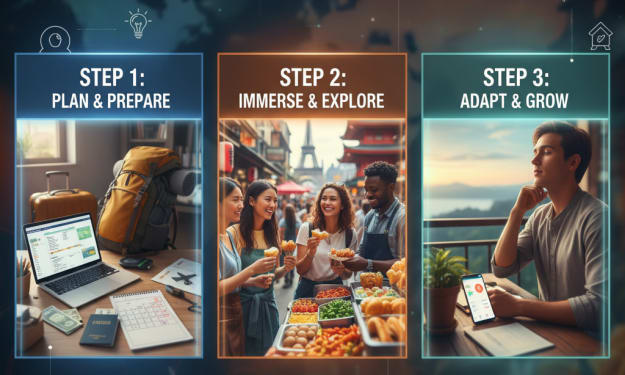
Three (3) Essential Steps to Going Abroad Successfully
Traveling or relocating abroad is an exciting opportunity, whether it is for education, work, or personal exploration. However, moving to another country involves more than booking a flight and packing bags. To ensure a safe, smooth, and successful transition, there are three essential steps everyone must take before going abroad: preparing travel documents, planning finances, and understanding the destination’s rules and culture. These steps serve as a roadmap, reducing risks and increasing the likelihood of a positive experience in a foreign country.
By Shiran Pallewatta12 months ago in Education
The Danger of Cats Eating Chicken Bones: A Serious Health Risk
Cats are beloved pets, admired for their playful behavior, independence, and companionship. While many pet owners enjoy sharing food with their feline friends, certain human foods can pose serious risks to cats, with chicken bones being a particularly dangerous example. Despite their small size, chicken bones can be extremely hazardous to cats, potentially causing life-threatening injuries if ingested. Understanding the dangers of feeding cats chicken bones is crucial for responsible pet ownership and the health of these cherished animals.
By Shiran Pallewatta12 months ago in Education
OpenAI reverses course on Sora: new owner controls and a path to monetization
OpenAI announced this week that it will give rights holders of content much more control over what becomes of their characters and copyrighted material within **Sora**, its new text-to-video app — and will pilot methods for sending revenue to rights holders who decide to get involved. The announcement follows a botched launch where users quickly flooded Sora with short AI-generated clips of mainstream characters and, in some cases, generated violent, hateful, or otherwise objectionable material that filtered through the app's moderation. Sora, its second iteration, enables users to produce around 10-second videos — typically stylized or character-based — and post them to a social feed.
By Shiran Pallewatta12 months ago in Education
Fumfer Physics 13: Information, Entropy, and the Universe’s Memory
Scott Douglas Jacobsen and Rick Rosner explore the elusive meaning of information in the universe. Jacobsen frames physical impacts, like smashing a rock, as information exchanges, then asks how fluids, solids, and plasmas differ in recording such exchanges. Rosner notes humans treat information as news or signals, but cosmically, “it from bit” theorists see every quantum event as informational. Yet many events, like collisions or solar reactions, leave no lasting record. He compares this to consciousness, where micro-events are integrated into larger patterns. The dialogue highlights entropy, durability of records, and whether the universe meaningfully “remembers” its countless micro-events.
By Scott Douglas Jacobsen12 months ago in Education
Fumfer Physics 12: Do We Face Infinite Whys and Finite Hows?
Scott Douglas Jacobsen and Rick Rosner debate whether the limits of knowledge lie within philosophy, physics, or both. Rosner explains that what was once metaphysics has largely been replaced by theoretical and experimental science, leaving philosophy more concerned with humanity’s relationship to existence. While physics seeks the "how" of reality, philosophy pursues the "why," which may be infinite. They discuss the logical foundations of existence, the role of contradictions, and how quantum mechanics blurs certainty at micro scales but stabilizes at macro scales. Even with a “final theory,” Rosner argues, our assumptions can always be questioned.
By Scott Douglas Jacobsenabout a year ago in Education
Quantum Mechanics In A Nutshell
Introduction Quantum mechanics, at it’s core, aims to explain the ultimate structure of reality by essentially zooming into reality until we cannot zoom anymore. However, to grasp this level of reality, to see beyond the veil of appearances, we must first understand that truth does not arrive fully formed — it emerges through the convergence of many threads. Reality is not a single fact to be found, but a vast tapestry woven from countless interlocking patterns. Each thread — from physics to philosophy, from the architecture of the mind to the hidden geometry of existence — is a necessary step toward the greater whole.
By Silence In The Void | The Codex Of Eternity about a year ago in Education
Fumfer Physics 11: Is Information in the Universe Preserved or Lost Over Time?
Scott Douglas Jacobsen and Rick Rosner discuss whether information is ultimately preserved or lost in both human minds and the universe. Jacobsen suggests that minds accumulate information until cognitive decline, while Rosner emphasizes that contradictions do not erase prior knowledge but reframe it within context. Extending the analogy, Rosner argues that the universe may form “thoughts” over billions of years, similar to how the brain integrates sensory and memory inputs. However, because each universal “thought” takes about 15 billion years, humans cannot perceive its arc of knowledge or decay within our limited lifespans.
By Scott Douglas Jacobsenabout a year ago in Education
Dystopia is the most-read literary genre ever.
There is a powerful and essential question we must ask ourselves when we look at the shelves of bookstores, when we examine the most shared, most talked-about narratives circulating across the globe: why this fascination, this enduring hunger, for stories set in troubled, fractured futures? Why, when we face so many serious challenges in our own lives, do we choose to inhabit worlds that are deliberately stripped of comfort, of freedom, and often, of genuine joy? The sweeping global popularity of the dystopian genre is not, as some might assume, a symptom of pessimism. Instead, I believe it speaks to a fundamental, profound maturity in our collective conscience—a readiness to stare into the uncomfortable shadows of potential outcomes, not to despair, but to understand our present responsibilities. We are drawn to these narratives because they function as a kind of high-stakes societal stress test. They take the current threads of our collective worries—the encroachment of technology, the widening gulf of economic inequality, the slow erosion of individual rights, the consequences of environmental disregard—and weave them into comprehensive, chilling tapestries of 'what if.' It’s the unsettling sensation of recognition that grabs us. When we read of a system that sacrifices personal dignity for engineered stability, or of a world where communication is monitored and dissent is silenced, we aren't simply encountering pure fiction. We are identifying the familiar strains of anxiety already humming quietly in the background of our own lives. The genius of this literature rests in its ability to dramatize complex, abstract political and social dynamics. Instead of simply discussing the ethics of surveillance in a sterile academic paper, the dystopian story places a vulnerable, flawed human being right at the center of the totalizing machine. It allows us to feel the cold steel of institutional control pressing against the individual spirit. This experience of witnessing the struggle vicariously provides a vital emotional education. It clarifies the stakes. It forces us to define, in clear and undeniable terms, what rights, what liberties, what fundamental connections are truly non-negotiable for a dignified human existence. This truth, that freedom requires constant, active vigilance, becomes visceral through these fictional journeys. But the appeal goes deeper than merely recognizing threats. It centers upon the indispensable nature of personal autonomy. The greatest fears explored in these worlds involve the loss of agency—the removal of the power to choose one's path, one's partner, or even one's thoughts. These stories become cautionary parables about the consequences of indifference, illustrating how easily incremental compromises can calcify into permanent constraints. They are not merely warnings about bad governments; they are urgent reminders about the necessity of good citizenship and engagement, reminding us that collective passivity is the fuel that runs the engines of oppression. The protagonists who rise up—the rebels, the non-conformists, the truth-tellers—are projections of our own highest hopes, embodying the courage we wish to summon when faced with smaller, less dramatic compromises every single day. Yet, there is a magnificent counterpoint to the darkness in these celebrated works. Dystopia is ultimately defined not by the monolithic power structures it depicts, but by the stubborn resilience of the human heart that persists beneath them. The genre thrives because, within the most hopeless landscapes, the most powerful and authentic forms of love, friendship, and family bonds inevitably surface. These acts of connection are the true engines of the narrative. The quiet sharing of a forbidden memory, the risky transmission of an unauthorized thought, the simple act of choosing to protect another person—these are the profound moments of humanity that the fictional overlords cannot extinguish. This defiant preservation of empathy demonstrates that, even when society is broken, the essential quality of being human remains intact. We must acknowledge that these stories provide us with a crucial imaginative space for practicing hope. If hope were easy, it wouldn't require practice. It is only when the odds are stacked against us, when the path forward seems impossible, that true resilience is forged. Dystopian fiction offers us a safe, literary arena to test the strength of our moral muscles. It asks: what would you risk? What principle would you refuse to surrender? By allowing us to inhabit these terrifying possibilities, the stories empower us. They help us to mentally rehearse the difficult choices, thereby preparing us for the smaller, real-world struggles for justice and decency. The essential truth remains that the genre has claimed a permanent place in the global literary conversation precisely because it is never truly about the future. It is a powerful, urgent meditation on the quality of the life we are building right now. It is a dialogue about accountability, about the legacy we are preparing to leave, and about the fundamental obligations we have to one another. The enduring appeal rests on this duality: it is both a stark warning written in stark, unforgettable prose, and an unwavering testament to the unconquerable spirit of humanity. It forces us to confront the possibility that the villains in the story are not faceless tyrants, but the comfortable compromises and silent complicities we might accept today. It is a literature of responsibility. This, above all else, is why we continue to turn its pages, searching not for nightmares, but for the moral clarity that can light our path forward.
By Ria Bassettabout a year ago in Education