pop culture
Pop culture has a place in the classroom; popular trends like hip hop help to foster interest and ignite conversations in education.
The Beggar and the Throne
In the heart of a vast and prosperous kingdom, ruled a mighty king named Zavian. His palace was made of marble and gold, his guards wore silver armor, and his court was filled with the finest minds and wealthiest nobles. But despite all the splendor, King Zavian’s heart was empty, his days hollow. He ruled with power, not compassion, and while his laws were just, his eyes rarely saw beyond the palace gates. On the edge of the capital, in a forgotten slum, lived a poor orphan boy named Ilan. With no family, no home, and barely enough to eat, Ilan spent his days begging on the streets and his nights under the open sky. Yet unlike many others in his condition, Ilan carried a strange fire in his heart—a curiosity about the world, and a belief that kindness was stronger than gold. One morning, as the sun rose over the city walls, a royal announcement echoed through the streets. A festival was to be held in honor of the king’s fifty-fifth birthday. The gates of the palace would open for one day, and all citizens—rich or poor—could enter to witness the grand celebration. Ilan had never stepped foot near the palace, but something inside him stirred. “I must go,” he whispered. “Even if just to see what lies behind those walls.” When the day arrived, crowds flooded toward the palace gates. Nobles came in carriages, merchants in fine clothes, and commoners in their best rags. Ilan, with dust on his face and bare feet, was nearly turned away by the guards. But before they could push him back, an old servant—watching from a distance—whispered to the guards to let him through. Perhaps it was pity. Or perhaps fate had decided to open a door. Inside the palace, Ilan’s eyes widened. The chandeliers sparkled like stars, the floors were polished like mirrors, and music floated through the air like silk. But what struck him most was not the wealth—it was the absence of joy in the king’s eyes. As King Zavian sat high on his throne, receiving gifts from nobles and praises from poets, his face remained unmoved. When Ilan's turn came, the guards tried to rush him along, but the boy stepped forward and bowed deeply. “I bring no gold, no silk, no treasures,” he said loudly. “Only a story, if Your Majesty would hear it.” The court laughed, but the king raised his hand, silencing them. “Speak then, boy. I tire of gold.” Ilan nodded. “Once, there was a bird,” he began, “caged in a palace. Every day it was fed the finest grains and bathed in the purest water. But the bird never sang. One day, a beggar walked by and asked, ‘Why does your bird not sing?’ The king replied, ‘It has everything it needs.’ The beggar said, ‘Everything except the sky.’” The court fell silent. Ilan looked up. “Your Majesty, you rule the land, but you do not see it. You hear praise, but not truth. You feed the people laws, but not hope. The bird in your cage is your kingdom—and it has forgotten how to sing.” The words hung heavy in the air. The king stared at Ilan, unmoving. But something stirred in his heart, like a crack in a stone wall. “Who are you?” the king asked. “No one, sire,” Ilan replied. “Just a beggar with eyes open.” Without another word, Ilan turned and walked away, leaving the court stunned and the king thoughtful. That night, King Zavian sat alone in his chambers. He looked around at his golden walls, his jeweled goblets, his heavy crown—and felt the weight of Ilan’s words. The next morning, to everyone’s disbelief, the king left the palace alone. Disguised in a plain robe, he walked through the city, through the alleys and markets, the orphanages and old neighborhoods. He saw children hungry, mothers sick, elders forgotten. He saw Ilan, sitting by the same fountain, sharing a piece of bread with another boy. “Ilan,” the king said, revealing his face. The boy stood in shock. “I listened,” said the king. “And I saw.” From that day on, everything changed. The palace opened its doors more often. Shelters were built, schools established, and food shared with those in need. The king began walking among his people regularly—not as a ruler above them, but as a man among them. And Ilan? He was given no riches, no titles. But the king made him something more powerful—his advisor in all matters of the people. Years passed, and the kingdom flourished not just in gold, but in spirit. And whenever visitors came and asked what had brought about such a change, the king would smile and say: “A beggar once told me a story that set my kingdom free.”
By Arjumand Said2 years ago in Education
Apple’s Got Two New Headsets on the Way But the Real Goal Is Glasses
Apple’s not tapping the brakes on mixed reality anytime soon. After dropping the Vision Pro last year, the company’s already knee deep in developing two new headsets. One is a version that is less expensive and aimed at bringing spatial computing to a wider audience and the other is the next generation Vision Pro which is lighter faster and hopefully much more comfortable to wear. But the real story? Apple is still focused on the bigger goal behind the scenes: stylish everyday augmented reality glasses that could eventually replace your iPhone.
By H M NAJMUL 2 years ago in Education
Goats on the Edge
Long ago, nestled in the heart of the great green mountains, two villages sat on opposite sides of a deep valley. One village was known for its bright, snowy landscapes where the white goats grazed freely. The other, shadowed by towering trees and jagged rocks, was home to black goats known for their strength and endurance. Between the two villages, there was only one way to cross: a narrow wooden bridge stretched over the roaring river below. The bridge was old, barely wide enough for one traveler at a time, and was feared and respected by all who used it. Among the many animals that lived in the mountains, two goats stood out — one white as snow, proud and graceful, and the other black as coal, bold and fearless. They had never met, but both believed they were the mightiest goat in all the lands. One crisp morning, the white goat, whose name was Zarbi, decided to cross the bridge to explore the other side. “They say the grass is different across the valley,” she muttered to herself. “Let me see it for myself — I deserve to know all lands.” At the same time, from the other side, the black goat, Kalo, had the same thought. “Why should I limit myself to these cliffs? I’ve conquered every rock here. The other side belongs to me too.” So, Zarbi stepped onto the bridge from the east, and Kalo from the west. The wind howled beneath them, and the bridge creaked with every step. Birds circled high above, and even the river below seemed to quiet in anticipation. Halfway across, they saw each other — two goats, standing firm, both unwilling to turn back. Zarbi narrowed her eyes. “Step aside,” she said in a clear, calm voice. “I started first.” Kalo stomped his hoof. “No. I’m stronger and heavier. You should step back.” “I am wiser,” said Zarbi. “I am braver,” said Kalo. A silence fell between them. The bridge creaked again, warning them. But neither moved. “I will not turn back,” Zarbi said, lifting her chin. “It would be beneath me.” “Nor will I,” Kalo replied. “Turning back is for the weak.” They lowered their heads. And with a furious clash of horns, they began to push. The battle was fierce but slow. They locked horns and shoved, but the bridge was too narrow, too fragile. Each time one pushed forward, the other pushed harder. Bits of wood splintered beneath their hooves, and the wind picked up, shrieking through the valley like a warning cry. Animals from the forest and cliffs began to gather at both ends of the bridge, watching in silence — birds perched in trees, rabbits poked their heads from the bushes, and even the old mountain bear watched with interest. Still, the goats fought. Minutes turned to what felt like hours. They were too evenly matched. Pride burned in their eyes, and neither could accept defeat. The bridge groaned beneath their weight. Then, with a terrible crack, the middle plank snapped. For a split second, both goats froze — eyes wide — realizing their mistake. And then, together, they fell. Down they plunged into the cold, wild river below. The water swallowed them, and the valley echoed with the sound of crashing waves and snapping wood. For days, the animals whispered about the fall of the two proud goats. Some said they survived and were swept away far down the river, never to return. Others believed they were taken by the mountain spirits to teach others a lesson. Months passed, and the bridge was eventually repaired. But from that day on, a rule was made — only one traveler at a time could cross. At each end of the bridge, a simple wooden sign was hung: “Pride builds no path. Patience does.” And whenever young goats from either village would ask about the sign, the elders would tell the tale of the white goat and the black goat — how they met in the middle, too proud to step back, and fell together. As time went on, the story turned into a legend. But the message remained clear: Sometimes, stepping back is not a sign of weakness — but of wisdom. And those who refuse to bend may both be broken.
By Arjumand Said2 years ago in Education
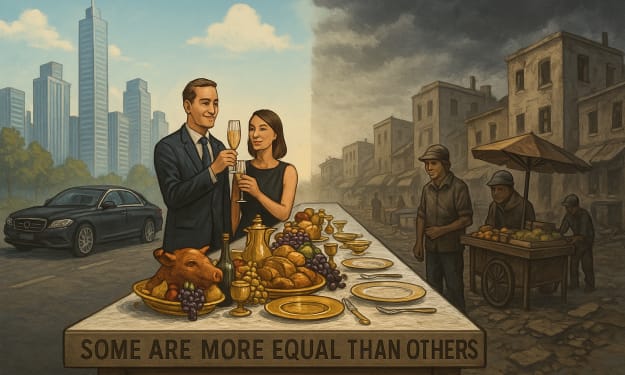
Some Are More Equal Than Others: A Modern Reflection on Power and Inequality
Some animals are more equal than others, but all animals are equal." This infamous line from George Orwell’s *Animal Farm* captures a disturbing truth: equality, when filtered through the lens of power and privilege, can become a hollow ideal. Orwell used this phrase to critique totalitarian regimes, but its relevance extends far beyond the boundaries of fiction. It serves as both a mirror and a warning in today's world. #### **The Myth of Universal Equality** The term "equality" is used frequently in institutions and nations all over the world. Equal rights are promoted by governments, fairness is taught in schools, and companies say they won't discriminate. These promises, on the surface, suggest a commitment to justice for all. But in practice, many people experience the world very differently. Whether through systemic racism, classism, gender discrimination, or political favoritism, inequality remains deeply rooted in society. While laws and constitutions claim to uphold equal treatment, the distribution of wealth, opportunity, and influence tells a different story. The rules may be written in neutral ink, but they are enforced in a biased world. #### **Privilege Hidden in Plain Sight** Consider the disparity in wealth. A child born into wealth will likely have access to better education, health care, and career opportunities than a child born into poverty. Not because of individual laziness or ambition, but rather because the systems are rigged in favor of those who are already ahead, this disparity creates cycles that are difficult to break. The justice system presents another clear example. In many countries, legal outcomes can depend heavily on race, class, or status. High-profile individuals often escape punishment that others would face severe consequences for, simply because they can afford better legal representation or leverage their influence. Justice may be blind in theory, but in practice, she tends to peek through the blindfold. #### **Digital Inequality and Control** In our increasingly digital world, inequality is being reproduced — and sometimes amplified — online. Access to reliable internet, data privacy, and digital literacy are not evenly distributed. Wealthier individuals can afford privacy tools, ad-free platforms, and access to better information. Meanwhile, others are subjected to surveillance, targeted advertising, and algorithmic manipulation. Big tech companies and governments alike hold immense power over information. Algorithms shape public opinion, influence elections, and determine what news we see — often without our awareness. Those who control these systems wield disproportionate influence over society, deepening the divide between those with digital power and those without. #### **Language as a Tool of Control** One of Orwell’s most powerful insights was the use of language to manipulate perception. The same strategy is used today in media framing, corporate jargon, and political spin. Terms like “enhanced interrogation” replace “torture,” “downsizing” hides “mass layoffs,” and “collateral damage” glosses over civilian deaths. This manipulation of language creates a fog that hides uncomfortable truths. It allows the powerful to maintain control while appearing just, and it numbs the public to injustice by turning outrage into abstraction. #### **A Call for Awareness and Action** What can then be done? To begin, awareness is necessary. Understanding the systems that perpetuate inequality is the first step in dismantling them. This means educating ourselves about structural injustice, listening to marginalized voices, and questioning the status quo. Second, cultural transformation and policy reform are required for change. We need laws that protect vulnerable groups and dismantle systems of privilege — but we also need shifts in mindset. Challenging inequality involves difficult conversations, personal accountability, and collective action. Lastly, we must be vigilant against complacency. History demonstrates the ease with which noble ideals can be distorted. The line “some are more equal than others” was not just satire — it was a warning. When we stop questioning those in power or stop paying attention to who benefits from the rules, we risk repeating the same patterns Orwell so starkly exposed. --- ### **Conclusion** “Some are more equal than others” remains one of the most potent critiques of hypocrisy and inequality. It forces us to confront the gap between what we claim to value and what we actually practice. We must do more than just repeat slogans if we truly want a world built on fairness and justice; we must also embody their meaning and ensure that equality is not just a promise but a reality. --- Please let me know if you would like the tone to be adjusted for a specific audience, such as students, activists, or corporate readers!
By Durjoy Biswas 2 years ago in Education
The Lion and the Cunning Jackal
Once upon a time, deep within the thick, green forests of the wild, there lived a mighty lion named Shera. He was the undisputed king of the jungle. His roar could silence the wind, and his presence could make the bravest of animals tremble. Strong, fierce, and proud, Shera ruled not just with strength, but with fear. But as time passed, Shera grew older. His strength, though still formidable, began to wane. His hunts weren’t as swift, and his energy wasn’t as boundless. To maintain his position as king without showing weakness, he came up with a clever plan: he would summon all the animals and declare that he would no longer hunt. Instead, the animals would bring him food as a tribute. Anyone who disobeyed would face his wrath. The animals had no choice but to agree. Every day, one animal would offer itself as prey. It was a painful arrangement, but better than mass destruction. Among the many animals in the jungle was a cunning jackal named Kallu. Small, smart, and sharp-tongued, Kallu watched everything from the shadows. He didn’t like Shera’s plan. “Why should we feed a lazy king?” he would often mutter to himself. But he knew better than to say it out loud. One day, it was Kallu’s turn to offer himself to the lion. The animals gathered in silence, some weeping, and escorted him halfway to the lion’s cave. But Kallu had no intention of dying that day. He paused by a pond to think. That’s when an idea struck him—a trick that could change everything. Instead of going straight to the cave, Kallu slowly strolled in the opposite direction. He plucked some feathers from a dead bird, rolled in dust, and bit his own paw to bleed just a little. Then, at sunset, he limped toward the lion’s cave, panting and looking disheveled. Shera was furious. “You’re late! And you look like a mess. What’s the meaning of this, Jackal?” Kallu collapsed near the cave entrance and said breathlessly, “Oh mighty Shera, forgive me! I was on my way when another lion attacked me. He roared that he is the true king of the jungle and that you are old and unfit. He said he’ll kill you and take your cave!” Shera’s eyes flared. “What? Another lion in my jungle? Show me where he is!” Kallu grinned secretly but kept a serious face. “He lives near the deep well by the mango trees. But he’s strong and young. I only escaped because he was distracted.” Without thinking, Shera leaped up and growled, “Take me to him. I’ll show him who rules this land!” Kallu led Shera through winding paths until they reached the old stone well. The sun had set, and the sky was a mix of purple and gold. The jungle was quiet. “There, my king,” said Kallu, pointing at the well. “He hides down there. He said he would come up at nightfall.” Shera stomped toward the well and peered inside. The still water reflected his own face. But in his anger, he thought it was the rival lion staring back at him. “How dare you challenge me!” he roared into the well. The echo bounced back. “How dare you challenge me!” Shera growled and raised his voice louder. The echo returned even louder. Enraged beyond control, Shera leaped into the well to attack the "other lion." But there was no other lion—just water. With a massive splash, Shera fell deep into the well. He roared, tried to climb, but the walls were slippery, and he was too old and tired. The jungle king had trapped himself. Kallu watched silently, his face calm. “You tricked me, Jackal!” Shera roared from the well. Kallu nodded and replied, “You ruled with fear, not fairness. The jungle deserves a wise leader, not just a strong one.” The next morning, the animals gathered at the cave. They had expected to mourn Kallu, but instead, they found him alive, with a tale that stunned them all. Word spread quickly about the jackal’s cleverness and courage. The animals no longer lived in fear. They began to organize themselves, creating a council of elders with Kallu as one of the advisers. Life in the jungle changed. The strong protected the weak, and fairness ruled the land. As for Shera, no one ever saw him again. Some say he still growls from the bottom of the well, angry at his own reflection. --- Moral of the Story: Wisdom can defeat even the strongest of foes. Power without fairness leads to downfall.
By Arjumand Said2 years ago in Education
The SUN
**The Sun: Our Luminary Giant and Its Astonishing Secrets** The Sun, a blazing sphere of hydrogen and helium, has been the cornerstone of life and cosmic phenomena for billions of years. As the heart of our solar system, it commands awe and curiosity. Let’s delve into the mesmerizing facts that illuminate our understanding of this celestial powerhouse. ### **1. A Stellar Behemoth** The Sun’s sheer scale is staggering. It contains 99.86% of the solar system’s mass, with a diameter of 1.39 million kilometers—enough to fit 1.3 million Earths inside. Despite its gaseous appearance, its core’s density is 150 times that of water. Traveling at light speed, circumnavigating the Sun would take 14 seconds, compared to 0.13 seconds for Earth. ### **2. Anatomy of a Star** The Sun’s structure is layered like an onion: - **Core**: The fusion furnace, where temperatures hit 15 million°C, converting hydrogen into helium via nuclear fusion, releasing energy equivalent to 100 billion nuclear bombs per second. - **Radiative Zone**: Energy photons take 170,000 years to traverse this dense region. - **Convective Zone**: Hot plasma rises in convective currents, creating granulation patterns on the surface. - **Photosphere**: The visible "surface" at 5,500°C, emitting sunlight that reaches Earth in 8 minutes and 20 seconds. - **Chromosphere and Corona**: The corona, extending millions of kilometers, mysteriously heats to over a million°C, far hotter than the photosphere—a puzzle termed the "coronal heating problem." ### **3. Nuclear Fusion: The Solar Engine** Every second, 600 million tons of hydrogen fuse into helium, releasing neutrinos and energy. Though Earth intercepts only a billionth of the Sun’s total output (3.8×10²⁶ watts), this energy fuels photosynthesis, weather, and ecosystems. Early neutrino detectors noted a shortfall, later explained by neutrino oscillations—revealing these particles have mass. ### **4. Dynamic Solar Activity** - **Sunspots**: Cooler, magnetic regions (3,800°C) dotting the photosphere. Their 11-year cycle peaks in solar maxima, linked to heightened magnetic activity. - **Solar Flares and CMEs**: Explosions releasing energy quintillions of times Earth’s nuclear arsenal. Coronal Mass Ejections (CMEs) hurl plasma at millions of mph, causing auroras and potential satellite disruptions. - **Magnetic Field Reversal**: Every 11 years, the Sun’s magnetic poles flip, a phenomenon entwined with the solar cycle. ### **5. Solar Wind and the Heliosphere** The corona’s million mph solar wind creates a protective heliosphere bubble around the solar system, shielding us from galactic cosmic rays. Earth’s magnetosphere deflects most particles, but during geomagnetic storms, auroras dazzle at the poles, and infrastructure faces electromagnetic threats. ### **6. Life Cycle: From Birth to Twilight** Born 4.6 billion years ago from a molecular cloud, the Sun is middle-aged. In 5 billion years, it will exhaust hydrogen, expand into a red giant (engulfing Mercury, Venus, and possibly Earth), then shed its outer layers, leaving a dense white dwarf remnant. ### **7. Cultural and Scientific Legacy** Ancient civilizations revered the Sun as a deity (Ra in Egypt, Surya in Hinduism). Today, it symbolizes life and energy. Modern missions like NASA’s Parker Solar Probe (touching the corona at 430,000 mph) and ESA’s Solar Orbiter unravel solar mysteries, enhancing space weather prediction. ### **8. Earth’s Delicate Dependence** The Sun’s habitable zone position allows liquid water, critical for life. Plants harness 1-2% of solar energy for photosynthesis, forming the food web’s foundation. Solar technology now converts sunlight into renewable energy, pivotal for sustainable futures. ### **9. Unanswered Mysteries** Why is the corona hotter than the photosphere? How do magnetic reconnections trigger solar storms? Ongoing research aims to decode these enigmas, crucial for safeguarding our tech-dependent civilization. ### **Conclusion** The Sun, a dynamic fusion reactor, is both life-giver and cosmic sculptor. Its study bridges ancient wonder and cutting-edge science, reminding us of our infinitesimal yet intimate place in the universe. As we continue to probe its secrets, we deepen our appreciation for the star that makes Earth’s story possible.
By Jitendra Mandal2 years ago in Education
Turning Ideas Into Money
Introduction Ideas are everywhere. They strike in the shower, while you're stuck in traffic, or during a late-night scroll on social media. But what separates a fleeting thought from a million-dollar business? Action. In a world flooded with creativity, the true winners are those who can transform ideas into income. This article walks you through how to capture, validate, build, and profit from your ideas—whether you’re an aspiring entrepreneur, freelancer, or content creator. --- ### **1. The Power of an Idea** Every business, product, or innovation started with an idea. Apple, Netflix, and even Instagram—all began as thoughts in someone’s head. But ideas, on their own, are cheap. The real power lies in execution. That’s why someone with a “simple” idea but relentless drive will out-earn the person with a genius idea and no action. **Key Point:** *Don’t overthink your idea. Start.* --- ### **2. Capture Your Ideas Before They Escape** Ideas are like dreams—if you don’t write them down, you’ll lose them. Successful entrepreneurs keep idea journals, voice notes, or digital boards where every thought is recorded. **Tips for Capturing Ideas:** - Use apps like Notion, Google Keep, or Evernote. - Keep a notepad beside your bed. - Use voice memos when you're on the go. **Action Step:** *Start building your “idea bank” today. No filters—just store them.* --- ### **3. Filter and Validate: Which Ideas Are Worth Pursuing?** Not every idea is worth turning into a business. Some are passion projects; others are monetizable. You need a system to filter which ideas are worth your time. **Ask Yourself:** - Does this solve a real problem? - Is there a target audience for this? - Are people currently paying for similar solutions? - Can I realistically execute this with the resources I have? **Pro Tip:** *Validation doesn’t need to be complicated. Start by talking to 10 people who fit your target audience.* --- ### **4. Identify a Marketable Niche** Even the best ideas fail without a clear market. It’s not about pleasing everyone—it’s about solving a specific problem for a specific group. **Examples:** - Idea: Fitness tips → Niche: Fitness for busy moms - Idea: Digital marketing → Niche: Email marketing for real estate agents - Idea: Graphic design → Niche: Branding for e-commerce startups **Action Step:** *Niche down until your idea speaks directly to someone’s pain point.* --- ### **5. Develop a Simple MVP (Minimum Viable Product)** Before building an entire product or service, test a basic version. This saves time, money, and gives you real feedback. **Examples:** - Want to launch a course? Start with a 1-hour live Zoom class. - Want to build an app? Create a clickable prototype using tools like Figma. - Want to sell a product? Create a landing page and see if people sign up. **Goal:** *Prove demand before investing heavily.* --- ### **6. Create a Monetization Plan** There are many ways to monetize ideas, depending on what you’re building. Here are common models: - **Selling Products:** Digital or physical (ebooks, courses, merch) - **Freelance Services:** Based on your skills (writing, design, marketing) - **Memberships/Subscriptions:** Exclusive content, community, or mentorship - **Affiliate Marketing:** Promote other people’s products for a commission - **Ads and Sponsorships:** Monetize traffic (YouTube, blogs, podcasts) **Action Step:** *Choose 1–2 monetization models to start, and build around them.* --- ### **7. Build an Audience Around Your Idea** In today’s world, attention is currency. If you can get people to care, follow, and trust you—you can monetize almost anything. **How to Build an Audience:** - Pick 1–2 platforms (Instagram, TikTok, YouTube, LinkedIn, etc.) - Share valuable content related to your idea/niche - Build an email list for long-term control - Engage: Comments, DMs, replies—show you care **Reminder:** *People don’t buy products. They buy solutions from people they trust.* --- ### **8. Use Social Proof and Feedback** People trust results. Testimonials, reviews, screenshots, and case studies build confidence. **What to Collect:** - Testimonials from beta testers - Screenshots of results - Feedback from your first users Even if you’re starting small, document every win. --- ### **9. Create a Simple Sales Funnel** To consistently turn your idea into money, you need a system that guides people from “just curious” to “ready to buy.” **Basic Funnel Example:** 1. Free valuable content (social media, blog, YouTube) 2. Lead magnet (free guide, checklist, class) 3. Email nurture sequence 4. Paid offer (product, service, course) Tools like ConvertKit, Systeme.io, or MailerLite make this easy. --- ### **10. Leverage Automation and AI** You don’t have to do it all manually. Use tools to automate and scale: - **ChatGPT** for content ideas, writing, and brainstorming - **Canva** for graphics and designs - **Zapier** for automating workflows - **Calendly** for appointment setting Let tech do the heavy lifting while you focus on growth. --- ### **11. Reinvest and Scale** Once the money starts coming in, don’t just spend—reinvest. Where to reinvest: - Better tools/software - Marketing and ads - Hiring freelancers (design, content, tech) - Upskilling (courses, coaching) **Goal:** *Turn your idea into a business, not a hustle.* --- ### **12. Stay Consistent & Adaptable** Every successful entrepreneur has one thing in common: consistency. The difference between a $0 idea and a six-figure one is often how long someone stuck with it. But also be flexible. Listen to feedback. Watch trends. Pivot if needed. --- ### **Real-Life Examples of Ideas Turned to Money** 1. **Sara Blakely (Spanx)** – Started with $5,000 and turned her idea for women’s shapewear into a billion-dollar brand. 2. **Ali Abdaal** – From doctor to YouTube productivity creator. Monetizes through courses, affiliates, and content. 3. **Digital Product Creators** – People selling Notion templates, planners, AI prompts, and courses make 5–6 figures a year. --- ### **Conclusion: Your Idea Has Power** The next big thing isn’t a secret—it’s probably sitting in your notes app, waiting for action. If you’ve ever said: - “I wish I could make money doing this” - “This idea keeps coming back to me” - “I just don’t know where to start” The answer is: **start small, stay focused, and keep building**. Ideas only make money when you bring them to life. Your thoughts are valuable—but your action is what turns them into income. Perfect! Here's the revised **ending section** of your article with an added motivational push and a clear CTA (call to action) about your money-printing blueprint: --- some billionaire’s notebook—it’s probably sitting in your mind or notes app, just waiting for you to act on it. If you’ve ever said: - “I wish I could make money doing this” - “This idea keeps coming back to me” - “I just don’t know where to start” Then this is your **wake-up call**. The difference between where you are now and where you want to be is **one idea and one decision** away. You *don’t* need to have it all figured out. You *don’t* need fancy equipment or a million followers. You just need to start with what you have, where you are, and stay consistent. **I believe in you — and your idea deserves a shot.** To help you even further, I’ve created a simple, actionable **Money Printing Blueprint** that walks you through how to turn your ideas into consistent cash flow. **The link is in my bio — grab it now and take your first step toward financial freedom.** Because at the end of the day, **the money won’t print itself — but your idea can.** --- Let me know if you want a shorter version for social posts or want this turned into a lead magnet PDF!
By Keli Chris2 years ago in Education
Zarafa and the Gentle Giant
In the heart of the African savanna, where the sun painted the land gold and the acacia trees stretched lazily toward the sky, lived a giraffe named Zarafa. She was tall, graceful, and curious. With her long neck, she could see far into the horizon, and she often spent her days nibbling on the highest leaves and watching the world from above. Zarafa was well-known among the animals of the savanna. Some admired her beauty and height, while others thought she was too proud, always looking down on everyone—literally and figuratively. But in truth, Zarafa wasn’t proud at all. She was simply lonely. Her height made it hard to join in the fun the other animals had closer to the ground. No one ever really saw the world from where she stood. On the other side of the plains lived an elephant named Tembo. He was enormous, with ears like wide fans and tusks that curved like the moon. Tembo was strong, wise, and incredibly gentle. He moved slowly, with purpose, and whenever he walked, the ground seemed to hum in rhythm. Tembo had many friends, but he always felt a little misunderstood. While the other animals admired his strength, they didn’t always see the kindness behind his power. He helped dig water holes during dry seasons and cleared paths through thick forests, but he longed for a friend who didn’t just need him for his strength—a friend who would sit beside him, or even walk with him, without asking for anything. One dry season, when the rivers had shrunk into dusty trails and the air shimmered with heat, many animals began to leave in search of water. Zarafa, too, wandered far from her usual trees, hoping to find greener leaves and cooler shade. That’s when she met Tembo. He was standing under a lone baobab tree, gently using his trunk to shake down its heavy fruit. Zarafa was thirsty and tired, and the sight of Tembo startled her at first—he was the only animal she’d seen in hours. Tembo looked up at her with kind eyes. “Hello up there,” he rumbled in his deep, calm voice. Zarafa blinked. “Hello down there,” she replied with a tired smile. They both chuckled. “Would you like some water?” Tembo asked. “I know a place. Not far.” Zarafa hesitated. She wasn’t used to accepting help. But something about Tembo’s voice felt safe. “Yes, please,” she said. And so, side by side, the two largest animals of the savanna walked slowly through the dry grasslands. Tembo used his memory of the land—he never forgot a waterhole—and after some time, they reached a shaded spot where he had dug into the earth. Clear, cool water pooled at the bottom. Zarafa bent her long neck and drank gratefully. When she looked up, Tembo was watching her, not with pride, but with joy—happy to have shared something. They stayed there for hours, talking. They spoke about the stars and how Zarafa saw them closer than anyone. They spoke about the earth and how Tembo felt its heartbeat through his feet. They talked of trees, of rain, of wind, and how both of them, despite their size, often felt small inside. From that day on, Zarafa and Tembo became unlikely friends. Every morning, she would walk from her tall trees, and he would leave his riverside, and they would meet beneath the same baobab tree. They played in their own way. Zarafa would stretch her neck to retrieve fruits for Tembo from trees too thin for his weight. In return, Tembo would break off low branches for Zarafa when she felt too tired to reach high. Sometimes they just stood in silence, their shadows touching on the ground. The other animals noticed. “Strange pair,” the monkeys said. “What do they talk about?” wondered the zebras. “They don’t even look alike,” grumbled a warthog. But Zarafa and Tembo didn’t care. They were happy in each other’s company. For the first time, they had someone who saw them—not just their height or size, but who they truly were. One day, a great fire swept across the plains. The dry grass crackled with flames, and panic spread among the animals. Birds flew. Deer scattered. Even the lions fled. Zarafa, caught in a grove of trees, tried to run, but her long legs tangled in the smoke. She stumbled, coughing, tears in her eyes. Tembo heard her cry. Without thinking, he charged toward the fire. His massive feet crushed burning branches, and his thick skin withstood the heat. He reached Zarafa, gently wrapped his trunk around her neck, and pulled her out of danger. They emerged, singed but safe. From that day on, no one ever questioned their bond. The animals of the savanna began to see what they hadn’t before—that strength can be gentle, and grace can be kind. They saw that friendship isn't about looking alike or living the same way—it’s about understanding, trust, and standing beside each other when it matters most. --- Moral of the Story: True friendship isn't found in similarity, but in understanding, care, and the courage to stand by one another—no matter how different we may seem.
By Arjumand Said2 years ago in Education
“The Lion of Iskar Reef”
The sea had been quiet for days, too quiet for a man like Eli Crane, a seasoned sailor who had spent most of his life braving tempests and taming the wild waters. His ship, The Windless, drifted steadily across the azure mirror of the Southern Expanse. It was an unforgiving place—many had vanished in its endless blue. But Eli wasn’t afraid of the sea. Not anymore.
By AL - FAHAD2 years ago in Education