movie review
Movie reviews for the lifelong learner; films about inspiring educators, the college experience, high school woes, education rights worldwide and more.
Five technologies a good way to rework Our Lives within the subsequent 10 Years
Introduction The future has continually been one among humanity’s best fascinations. In view that the beginning of time, people have looked at the celebs, imagined inventions, and puzzled what lifestyles would possibly appear like for the following technology. Today, that destiny is being constructed quicker than ever earlier than.
By Samiullah Adilabout a year ago in Education
gal gadot
Gal Gadot: A Star Everyone Is Talking About Gal Gadot is one of the most famous actresses in Hollywood today. She is known around the world for her beauty, charm, and powerful performances on screen. Over the years, she has played unforgettable roles, become a fashion icon, and inspired millions of fans. Her career has seen both great successes and difficult moments, but she continues to shine as one of the most recognizable names in cinema.
By king pokhtoonabout a year ago in Education
Vocal.Media: A Creative Platform for Writers and Storytellers
Vocal.Media is an online publishing platform designed to give writers, bloggers, and storytellers a place to share their voices with the world. Launched in 2016, it has grown into a space where creators can publish articles, short stories, poems, reviews, and essays while connecting with an engaged audience. Unlike traditional blogging platforms, Vocal provides writers with built-in readership opportunities, monetization options, and themed communities called “Vocal Communities,” which allow creators to target specific audiences.
By Muhammad Ibrahimabout a year ago in Education
Rising Through the Storm
Life doesn’t always go the way we plan. Sometimes, the path is smooth, but often, it’s filled with unexpected challenges that test our courage, patience, and determination. How we respond to these challenges shapes not just the outcome, but who we become along the way.
By Nonhlanhla Emogene Mbokaneabout a year ago in Education
Predicting the Future, Cartoon-Style: The Simpsons’ Hits and Misses
If someone had told you back in the 1990s that a yellow cartoon family could “predict” the future, you probably would’ve laughed. Yet here we are, decades later, still talking about The Simpsons and how often their fictional jokes seem to line up with reality. Created by Matt Groening in 1989, this show wasn’t made to be a crystal ball — it was meant to make people laugh. But somehow, between all the slapstick humor, satirical jabs, and life in the quirky town of Springfield, the writers have dropped hints about events that actually came true. And of course, not every prediction hit the mark — some were way off, and that’s part of the fun.
By Vocal Member about a year ago in Education
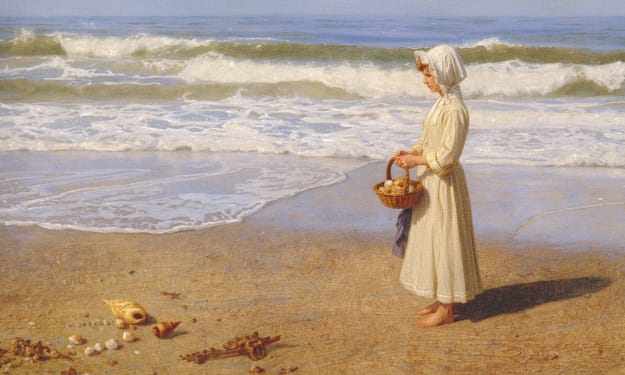
She Sells Seashells by the Seashore – An Essay
There are some phrases in the English language that seem almost timeless. They roll off the tongue in a playful way, yet they hide more depth than most people expect. “She sells seashells by the seashore” is one of those phrases. At first glance, it’s just a tongue twister, the kind you might hear in a classroom or around a campfire when someone challenges you to say it three times fast. But behind those eight little words is a fascinating mix of history, clever language, and even a story of determination that reaches back to the early 1800s. Where It All Began The exact origin of this famous tongue twister isn’t crystal clear, but many historians link it to the life of Mary Anning (1799–1847). Mary was not just any seaside vendor; she was a self-taught fossil collector and paleontologist from the town of Lyme Regis on the southern coast of England. As a child, she began scouring the cliffs and beaches for fossils — not as a hobby, but as a means to help support her family after her father’s death. It’s worth noting that Mary didn’t technically sell ordinary seashells. She sold fossilized shells and prehistoric remains — things that fascinated scientists and wealthy tourists of the time. Still, her work almost certainly inspired the popular line. In 1908, songwriters Terry Sullivan and Harry Gifford wrote a song titled “She Sells Seashells”, and it is widely believed that Mary’s remarkable life was their inspiration. Over time, that song’s chorus broke free from the sheet music and became the tongue twister we know today. Why It’s Tricky If you’ve ever tried to say “She sells seashells by the seashore” quickly, you know it’s not as easy as it looks. That’s because the phrase is packed with alliteration (repeating the same first sound in multiple words) and consonance (repeating similar consonant sounds in close proximity). The challenge here lies in switching between the “s” sound and the “sh” sound. These are produced in similar ways but require slightly different positions of the tongue and airflow. Your mouth has to adjust very quickly, and when you rush, the sounds tend to blur together. That’s why tongue twisters like this are often used by actors, singers, and public speakers to warm up their voices and sharpen their pronunciation. More Than Just a Game While most people meet this phrase as a playful challenge, it’s also a kind of miniature story about work, place, and persistence. In just eight words, you can picture a woman standing on a sunny shore, selling the treasures she’s gathered from the sea. There’s a rhythm to it, almost like the gentle lap of waves, and it’s easy to imagine the sound of shells clinking together in a basket. For Mary Anning, this wasn’t just a poetic image — it was her life. She faced storms, landslides, and the constant danger of working on unstable cliffs, yet she kept going. Her discoveries helped shape early paleontology, but because she was a woman in the early 19th century, she received little formal recognition in her lifetime. Today, though, her name is remembered alongside the tongue twister that may have been inspired by her. Educational Value Teachers often use this phrase to help students with pronunciation, especially those learning English as a second language. It’s short enough to memorize, but complex enough to require real concentration. By practicing it slowly and then speeding up, learners gain better control over their speech. It’s also a tool for developing listening skills. When students hear others attempt the phrase, they start to notice the subtle differences between “s” and “sh,” which sharpens their ear for detail. In a way, this little line is like a gym workout for the tongue and brain. A Symbol of Resourcefulness Beyond the classroom, “She sells seashells by the seashore” can be read as a tiny lesson in business and self-reliance. The “she” in the sentence is independent. She gathers her own products (seashells), chooses her marketplace (the seashore), and makes a living through her own effort. That’s entrepreneurship in its simplest form. It’s no wonder this phrase has sometimes been used in marketing or motivational contexts. It reminds us that success can come from starting with what’s right in front of us — even something as simple as shells washed up by the tide. Why It Stays With Us Many tongue twisters fade into obscurity, but this one has stayed alive for over a century. There are a few reasons for that: It’s easy to remember — only eight words. It paints a clear picture — anyone can imagine a seashore and shells. It’s playful — people of all ages enjoy trying to say it fast. It has a real story behind it — the connection to Mary Anning gives it depth. In a world where so much of our communication is typed rather than spoken, the fact that this old-fashioned phrase still pops up in classrooms, acting studios, and even social media trends says something about its enduring charm. Conclusion “She sells seashells by the seashore” may seem like a simple children’s rhyme, but it carries history, challenge, and meaning within its short structure. It’s a playful exercise in language, a nod to a remarkable woman’s determination, and a reminder of the creativity hidden in everyday life. Whether you use it to warm up before a performance, practice your English, or simply have a laugh with friends, it connects you to over a century of voices that have stumbled, laughed, and tried again. And maybe that’s the real beauty of it — just like the woman in the phrase, we keep going, one shell at a time.
By Vocal Member about a year ago in Education
How to Earn Money Online
Creation The internet has transformed the manner people paintings, talk, and do enterprise. Today, being profitable on-line is no longer a distant dream; it’s a reality for tens of millions international. From freelance gigs to complete-scale virtual corporations, there are limitless opportunities for anybody willing to study and put within the attempt. Whether you’re a student, a stay-at-home discern, or in reality trying to supplement your earnings, the digital international gives a sizable market where your capabilities, creativity, and backbone can be became actual income.
By Samiullah Adilabout a year ago in Education
Unlocking Potential: The Power of Education
At 42 years old, Carmen Alvarez never imagined she'd find herself back in a classroom. A single mother of two and a night-shift janitor at a local hospital, her days were already full—of responsibility, fatigue, and routine. But something had shifted inside her the day her son Mateo asked, “Mom, did you go to college?” She had smiled and answered honestly. “No, mijo. I had to start working when I was your age.” Mateo had simply nodded, but his question lingered. Not as judgment, but as possibility. The next week, Carmen enrolled in a GED prep course at the community center. Her hands trembled when she signed the registration form. It had been over two decades since she’d last held a pencil for anything other than jotting down grocery lists. But that night, as she sat at the kitchen table with a used algebra textbook and a lukewarm cup of coffee, something stirred inside her: hope. Carmen’s story is not unique. Across cities and small towns, in libraries, online classrooms, and late-night study groups, adults are rediscovering the transformative power of education. Not just as a stepping stone to a better job, but as a key to unlocking self-worth, community change, and lifelong growth. Learning Beyond Limits When Carmen passed her GED exam nine months later, she cried in the testing center bathroom. It wasn’t just a piece of paper. It was a symbol of everything she had overcome—poverty, doubt, time. Her confidence grew. She enrolled in a community college part-time, studying health sciences with the hope of becoming a certified nursing assistant. Her classmates came from all walks of life: a retired mechanic learning computer programming, a young mother studying early childhood education, an immigrant working toward his business degree. They were bound by a shared belief—that it was never too late to learn. One of her professors, Dr. Lillian Reeves, often said, “Education isn’t just about degrees—it’s about dignity. It’s about giving people the tools to contribute meaningfully to their world.” That philosophy rang true in the community. The Ripple Effect As Carmen progressed in her studies, she noticed a shift at home. Mateo and his younger sister began doing homework more diligently. “If Mom can do it, I can too,” Mateo said one evening, grinning across the table. Carmen wasn’t just learning for herself—she was modeling resilience for her children. At the hospital where she still cleaned during the night shift, her coworkers started asking her about school. A few of them, inspired by her courage, signed up for adult education courses. The break room began buzzing with talk of class schedules and future plans. A community that learns together, grows together. Building a Brighter Future Education, especially lifelong learning, has a multiplier effect. It doesn’t stop with individual achievement—it builds stronger families, healthier communities, and more adaptable economies. Carmen’s journey eventually led her to a full-time position as a CNA. The financial stability allowed her to move her family into a safer neighborhood and reduce her hours at the hospital. But she didn’t stop there. With encouragement from her instructors, she began mentoring new students, helping others overcome the fear she once knew so well. At a local education summit two years after earning her GED, Carmen stood on stage and shared her story. “I used to think education was something I missed out on,” she said to the audience. “Now I realize it’s something I’m always a part of—as a student, a mother, a mentor. Learning never ends.” Education as Empowerment In today’s fast-changing world, where technology reshapes industries and global challenges demand adaptable minds, lifelong learning is more important than ever. It equips people not just to survive, but to thrive—to pivot careers, engage in civic life, and build a future rooted in equity and innovation. But access remains a challenge. Carmen was fortunate to live in a district with funded adult programs. For millions, barriers like cost, transportation, and childcare remain daunting. That’s why communities, governments, and organizations must invest in making education accessible at every age. Conclusion Carmen’s story is a testament to the power of education—not just formal schooling, but the broader, ongoing journey of learning that fuels personal transformation and community uplift. It’s a reminder that the classroom can be anywhere: a kitchen table, a public library, a late-night break room. What matters is the spark inside—the belief that learning can unlock a better version of ourselves. Education isn’t a finish line; it’s a lifelong passport to possibility. And when one person learns, we all grow.
By Muhammad Saad about a year ago in Education
The Warrior Who Broke 9 Swords in One Day — And Changed the World"
The Sword of God: The Astonishing Life of Khalid ibn al-Walid Throughout human history, there have been figures so powerful, so legendary, that they transcend borders, religions, and ideologies. Their courage, intelligence, and leadership become universal lessons — and one such man was Khalid ibn al-Walid. Known by the title “The Sword of God”, Khalid was a military genius who never lost a single battle in over 100 engagements. But his story is far more than just blood and glory — it's a tale of transformation, humility, and greatness that continues to inspire even today. --- From Warrior of the Quraysh to Defender of Islam Khalid was born into the noble Quraysh tribe in 6th-century Arabia — the same tribe as the Prophet Muhammad (peace be upon him). He was raised among warriors, trained in swordsmanship and tactics from a young age. When Islam first emerged in Mecca, Khalid stood among its fiercest opponents. In fact, he played a decisive role in the Battle of Uhud, where the early Muslim army suffered heavy losses — many due to Khalid’s masterful cavalry maneuver. But then, something changed. Khalid watched the rise of Islam — not just as a religion, but as a force for justice, unity, and transformation. He saw men he once fought beside now living with purpose, discipline, and compassion. His heart began to shift. One day, Khalid rode into Medina, entered the Prophet Muhammad’s mosque, and declared his faith in Islam. The Prophet smiled and said: > “Praise be to God who guided you, O Khalid. I always saw greatness in you.” And from that day, Khalid’s sword no longer served tribal pride — it served a greater cause. --- The Turning Point: The Battle of Mu’tah Soon after his conversion, Khalid joined a Muslim army sent to confront the Roman Empire at Mu’tah (in present-day Jordan). The original commanders — Zayd ibn Harithah, Ja’far ibn Abi Talib, and Abdullah ibn Rawahah — were all killed in battle. The Muslim army was vastly outnumbered — 3,000 against more than 100,000 Roman troops. At this critical moment, Khalid took command. Using unmatched tactical brilliance, he reorganized the troops, executed feint retreats and flanking maneuvers, and managed to save the Muslim army from total annihilation. He broke nine swords in that one battle. When news reached the Prophet, he said: > “Khalid is a sword among the swords of Allah, unleashed upon the enemies of truth.” From that moment, he was known as “Sayf Allah” — The Sword of God. --- The Battle of Yarmouk: When Legends Are Born Khalid’s most legendary victory came in 636 AD at the Battle of Yarmouk, where a Muslim force of just 40,000 faced a Roman army of over 200,000. Any military analyst would call that suicide — but not when Khalid ibn al-Walid was in charge. He executed a masterclass in mobile warfare, leading cavalry charges, breaking Roman supply lines, and inspiring morale among the Muslims. He moved his troops with lightning speed, creating the illusion of greater numbers, and attacking the enemy from unexpected directions. The Roman Empire suffered a catastrophic defeat. Their dream of reclaiming the Levant was shattered forever. A Western historian once wrote: > “Had Khalid served the Romans, Europe might have spoken Arabic today.” --- A Leader Without Ego One of the most remarkable moments in Khalid’s life came not on the battlefield, but in an unexpected order. Caliph Umar ibn al-Khattab, fearing that people might start placing too much trust in Khalid rather than in divine help, removed him from command — in the middle of his victories. And Khalid’s response? No rebellion. No bitterness. He simply said: > “I fight for God, not for a position.” He continued to serve as a regular soldier under the new commander — the very essence of humility and discipline. --- The Most Shocking Part: How He Died Here’s the most surprising twist of all. Khalid ibn al-Walid — a man who fought over 100 battles, who was wounded head to toe, whose sword shaped the fate of empires — did not die in battle. He died in his bed. In his final moments, he is said to have wept and said: > “I’ve fought in so many battles, and there is no spot on my body without a scar from a sword or an arrow — yet here I die, like a camel in bed. May cowards never sleep in peace.” For a man who lived and breathed valor, dying a natural death was almost a heartbreak. --- Why Khalid ibn al-Walid’s Life Still Matters You don’t need to be Muslim to admire Khalid ibn al-Walid. He was a man who changed his beliefs when he saw the truth — something very few can do. He fought not for personal glory, but for justice, purpose, and unity. He respected discipline, leadership, and morality even when it meant sacrificing his ego. He wasn’t just a warrior. He was a man of principles. --- Final Thoughts: Lessons from the Sword of God Redemption is real — Even the fiercest of opponents can become the noblest of allies. Leadership is about service, not ego. True greatness lies in character, not just conquest. Khalid ibn al-Walid’s story isn’t just a chapter in Islamic history — it’s a timeless human tale of transformation, resilience, and glory. Whether you're a student of history, a leader, a soldier, or just someone seeking inspiration — his life offers lessons you won’t find in textbooks.
By MUSLIM Talk about a year ago in Education
Box Office Update: "Bad Guys 2," "Naked Gun" Perform Well as "Fantastic Four" Dominates
Box Office Update: "Bad Guys 2," "Naked Gun" Perform Well as "Fantastic Four" Dominates This weekend, the box office is buzzing with competition as multiple new films launch alongside the ongoing success of Fantastic Four: First Steps. Among the new releases, The Naked Gun revival and The Bad Guys 2 are turning heads with strong openings. Additionally, the indie horror-comedy Together is also vying for attention.
By Sunil Christianabout a year ago in Education