interview
Interviews with educators, innovative graduate students and individuals who've devoted their lives to the development of the world's youth.
The Student Who Asked One Question
M Mehran On the first Monday of September, Ms. Harris walked into her classroom and immediately noticed the empty chair in the back. It wasn’t truly empty—someone had placed a stack of old notebooks on it, and a broken pencil lay on top like a flag of surrender. But according to the roster, that seat belonged to a new transfer student named Samir. He didn’t show up until Wednesday. When he did, he slipped into the room with the quietness of someone who had learned how not to be seen. He sat in the back, eyes down, shoulders drawn in tight. Ms. Harris tried her warmest smile, but he didn’t lift his gaze. Still, she had hope. She always had hope. It was the one thing she never let the district budget cuts take from her. --- A Question No Teacher Expects For the first month, Samir barely spoke. He completed assignments perfectly but without expression, like a machine performing a task. Whenever she tried to engage him—about books, about hobbies, about the weather—he answered politely, but without spark. Then one afternoon, as the rest of the class scattered for recess, Samir approached her desk and asked the question that lodged itself in her heart. “Ms. Harris… how do you know when you’re smart?” She blinked. She had been expecting a question about the homework, maybe a request for an extension on the upcoming essay. Not this. “What do you mean, sweetie?” she asked gently. He hesitated. Then: “I don’t think I’m smart. But I want to be.” Her throat tightened. Here was a child—twelve years old—carrying the weight of self-doubt heavier than his backpack. She wondered who had convinced him he wasn’t enough. “You know you’re smart,” she said slowly, “when you’re willing to learn. Smart isn’t something you are. It’s something you grow.” Samir nodded, but she could see he didn’t quite believe her yet. That night, she stayed late crafting something she hoped would change that. --- The Growth File The next morning, she placed a bright red folder on Samir’s desk labeled: THE GROWTH FILE. He looked at it as if it might explode. “Every time you learn something,” she explained, “no matter how small, write it down and add it to the folder. This way, you’ll have proof. Real, physical proof, that you’re getting smarter every day.” He stared at her. “Even if it’s tiny?” “Especially if it’s tiny,” she said. The first slip he added read: I learned how to use a semicolon. The second: I solved a math problem I got wrong last week. The third: I asked a question in class. By October, the folder was thick enough that the edges curled. But something else was happening too. He was changing. He raised his hand more. He joined group discussions without being prompted. He smiled—just once, a flicker, but she caught it. And once he even laughed at a joke she’d made, which was a miracle in itself because her jokes were famously terrible. --- The Presentation In November, the class began their biggest project of the year: a five-minute presentation on a topic they cared about. Most students groaned. Some panicked. But Samir simply walked up to her desk and asked, “Can I present my Growth File?” Yes, she wanted to say. Please. You should. The world needs to hear you. But instead she asked, “Are you sure?” He nodded. “I want to show people that growing is real.” On presentation day, students filed to the front one by one—slideshows on oceans, posters on basketball, speeches about space, animals, and video games. And finally, it was Samir’s turn. He carried the folder like something sacred, placed it on the podium, and calmly said, “I thought I wasn’t smart. But then Ms. Harris told me that smart is something you grow. So… I started growing.” The class listened, unusually quiet. He read a few entries—short, simple moments of learning—but each one landed like a stone in still water. Then he lifted his gaze from the folder for the first time all year. “I’m not finished growing,” he said. “But I know I can. And that means I’m smart.” Ms. Harris felt her eyes prick with tears. For once, she didn’t fight them. The class clapped, loud and long. And Samir? He stood straighter. Taller. Like a weight he’d been carrying alone had finally been set down. --- The Letter On the last day of school, Ms. Harris found a note inside her mailbox. No name, but she recognized the handwriting. > Dear Ms. Harris, Thank you for showing me how to grow smart. I’m going to keep adding to the folder wherever I go. I think one day it will be very full. From, Samir Inside the envelope was a single slip of paper—new, bright, blank. The next step, she realized. She tucked it into her own desk, her own reminder that growth never stops—not for students, not for teachers, not for anyone still willing to learn.
By Muhammad Mehran11 months ago in Education
The Classroom With No Doors
M Mehran When Maya stepped into Room 12 for the first time, she thought she had made a terrible mistake. The walls were bare. The desks didn’t match. The single window looked out onto a parking lot. And the class list—oh, the class list—read like a challenge written by someone who doubted she’d last until October. Twelve students reading well below grade level. Six with behavioral flags. Three newcomers who spoke almost no English. And one, according to the previous teacher’s note, who had “a talent for escaping the classroom when overwhelmed.” This was her first year as a teacher. Her dream job. Her calling. Yet standing there with her box of freshly laminated posters and overly optimistic lesson plans, she felt the first earthquake of fear. She wasn’t sure if it showed on her face, but the custodian passing by paused just long enough to say, “Kids don’t need fancy. They need someone who sees them.” At the time, she didn’t fully understand what he meant. But the year would teach her. --- The First Lesson The first week was chaos wrapped in crayons. Leila cried when the morning bell rang. Danny slammed his desk shut—twice—when the math worksheet looked too hard. The new student from Honduras, Mateo, stared at his hands, terrified to speak, while his seatmate whispered encouragement in broken Spanish she’d learned the night before on YouTube. And then there was Jayden. On day three, he slipped out the door while Maya’s back was turned. She found him sitting against the hallway wall, knees pulled to his chest. “I don’t do reading,” he muttered. But when she sat next to him, he added softly, “I’m just not good at it.” Maya didn’t push him. Instead, she asked what he was good at. “Drawing,” he said without hesitation. So they made a deal: he could draw a scene from every story they read. No pressure to read aloud. No spotlight. Just creation. He nodded. It was the first tiny bridge they built together. --- The Unexpected Shift Two months in, the class had found its rhythm—messy, unpredictable, loud, but undeniably theirs. Maya had abandoned the rigid pacing guides she once clung to. Instead, she built lessons around the students themselves—stories from their cultures, math problems that used their names, writing prompts that began with, “Tell me something only you know.” Mateo slowly traded silence for short, brave sentences. Leila stopped crying when Maya added a morning “Feelings Check-In” board. Danny discovered he was a natural leader when she put him in charge of the class job chart. Small victories—but victories nonetheless. The moment everything changed came on a rainy Tuesday. The power flickered out, and with it, her entire Smartboard lesson. The class groaned. But Maya lit three battery-powered lanterns, placed them in a circle, and told the students, “Today, you’re going to teach me something instead.” The stories spilled out—about countries left behind, favorite songs, brothers in the military, dreams of becoming bakers or firefighters or dancers. Jayden shared how he drew characters to escape bad days at home. Even the shyest students spoke in the warm glow of the lanterns. Education stopped being something she delivered from the front of the room. That day, it became something they built together. --- The Project That Changed Everything By spring, Maya introduced what she called “The Classroom With No Doors Project”—a digital and art exhibition showcasing each student’s learning journey. “Why no doors?” one student asked. “Because learning doesn’t stay inside a classroom,” Maya said. “It goes wherever you go next.” Each child created something that represented their growth. Essays, poems, murals, videos. Jayden designed a comic book featuring every student as a superhero, each with a power based on their strength—courage, creativity, kindness, resilience. He titled it Room 12: The Unstoppables. When parents visited, many cried. Not because of the polished work, but because they saw themselves reflected in their children’s pride. Mateo presented a slideshow—in English. Leila stood tall beside her painting of the morning sun, explaining how she had learned to manage her worries. Danny introduced the new job chart system he invented that other teachers asked to copy. And Jayden stood beside his comic, cheeks flushed with a shy, fierce pride Maya had never seen before. --- The Final Day On the last day of school, the desks were bare again, and the walls empty—except for one poster Maya left up: “You were here. You mattered.” The students hugged her good-bye, some promising to visit, others simply waving as they disappeared into summer. But Jayden lingered. “I started reading more,” he said, voice low. “I kinda like it now.” She smiled. “I always knew you could.” He shook his head. “No… I just needed someone who saw me first.” When he walked out, she finally understood the custodian’s words from that very first morning. Kids don’t need fancy. They need someone who sees them. And sometimes, the greatest classrooms are the ones where the doors feel invisible—where students don’t feel trapped, but instead feel free to walk into the world carrying everything they learned, everything they became, and everything they are still becoming.
By Muhammad Mehran11 months ago in Education
How 6G Technology Will Change Everything You Know About Connectivity. AI-Generated.
A New World of Invisible Connection: If you step into the year 2030, the first thing that captures your attention isn’t a flying car drifting overhead or a robot politely greeting you on the sidewalk. It’s something much quieter, almost invisible, yet unbelievably powerful. The entire world hums with a subtle energy, a network of ultra fast waves weaving through every object, device, and person around you. No cables. No delays. Just pure connection happening so naturally that you barely notice it. That is the reality shaped by 6G, and it feels less like an upgrade and more like entering a world that finally syncs with your thoughts. Where 5G gave us speed, 6G brings intelligence. It blends physical surroundings with digital awareness in a way that makes ordinary moments feel gently futuristic.
By David John11 months ago in Education
How to Run Multiple ML Models Without Increasing App Size
Rain pressed softly against the laundromat windows that afternoon, blurring the street outside into smudges of gray. Inside, the dryers turned in slow circles, pushing warm air across the room. I had my laptop balanced awkwardly on my knees, reviewing a build that had grown far larger than anyone expected. The app carried four separate machine learning models—each important, each heavy—and the product manager sitting beside me kept tapping her coffee lid as if the rhythm could reveal an answer we both already sensed. The models were valuable. The app size was not. Something needed to change, and it had nothing to do with features and everything to do with how the app treated weight.
By Samantha Blake11 months ago in Education
Kentucky State University: A Legacy of Excellence, Leadership, and Opportunity. AI-Generated.
Founded in 1886, Kentucky State University (KSU) is more than just one of the nation’s distinguished Historically Black Colleges and Universities (HBCUs). It is a living testament to the power of education, community, and opportunity. Nestled in the scenic capital city of Frankfort, KSU has spent well over a century shaping leaders, advancing research, empowering underserved communities, and championing the transformative purpose of higher learning.
By Sajida Sikandar11 months ago in Education
Why Your Resume Isn’t Getting Replies (And How To Fix It Today). AI-Generated.
Why Your Resume Isn’t Getting Replies (And How To Fix It Today) If you’re applying for jobs every single day but no one is calling you back, don’t overthink it. Most of the time, the problem is not your experience. The problem is a resume that looks exactly like everyone else’s.
By Shahrukh Mirza11 months ago in Education
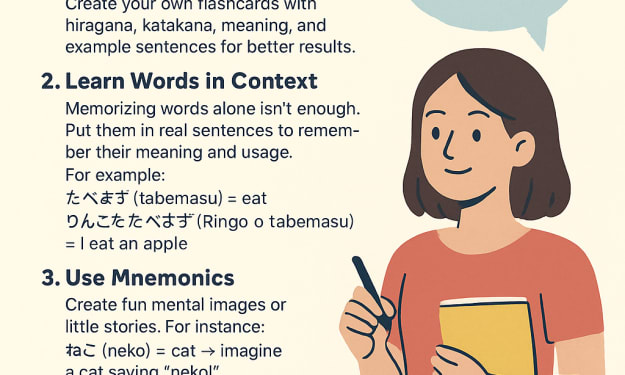
How to Memorize Japanese Words Fast...... Content Warning. AI-Generated.
Learning Japanese is one of the most exciting experiences, but it can also be a bit overwhelming, especially when it comes to memorizing new words. Don’t worry — you’re not alone. Many learners struggle with vocabulary, but the good news is that there are proven strategies to make it easier, faster, and even fun. Today, I’m sharing actionable tips to help you memorize Japanese words quickly and retain them naturally.
By Way To Japan11 months ago in Education
How to Improve Leadership Skills as a Student
Leadership isn’t just for CEOs, politicians, or famous personalities. It starts early, in classrooms, clubs, sports teams, and even small group projects. As a student, developing leadership skills can set you apart, help you succeed academically, and prepare you for the real world. But leadership isn’t something you’re born with—it’s a skill you can nurture, practice, and refine over time. Whether you want to lead a school club, organize a community project, or simply become more confident in group activities, understanding how to improve leadership skills as a student can make a huge difference in your personal and professional life. --- 1. Understand What Leadership Really Means Many students confuse leadership with authority. Being a leader isn’t about bossing others around or having a title—it’s about inspiring, guiding, and motivating people toward a common goal. True leaders: Listen actively Encourage others Make decisions thoughtfully Lead by example Before trying to become a leader, reflect on your current strengths and weaknesses. Ask yourself: Do I motivate people? Can I communicate my ideas clearly? Do I handle challenges calmly? Self-awareness is the first step in becoming a strong, effective leader. --- 2. Improve Your Communication Skills A leader is only as effective as their ability to communicate. Being able to express ideas clearly and listen actively is essential. Tips to enhance communication: Practice public speaking by joining debate clubs or presentations Work on body language: maintain eye contact and open posture Be clear and concise in writing and speaking Learn to listen before responding; understanding others is as important as being understood Strong communication builds trust, resolves conflicts, and ensures everyone is on the same page—key aspects of leadership. --- 3. Take Initiative and Responsibility Leadership is about action. Don’t wait for opportunities to come to you—create them. Examples: Volunteer to organize group projects or events Start a study group or community initiative Take responsibility for mistakes instead of blaming others Students who actively seek opportunities to lead demonstrate confidence and commitment. Initiative shows others that you are ready to take responsibility, a core trait of effective leaders. --- 4. Develop Teamwork Skills No leader works alone. Learning to work well in a team is essential. Leadership is not about dominance—it’s about collaboration. Respect everyone’s ideas, even if they differ from yours Assign tasks based on each team member’s strengths Encourage participation and foster a positive environment Handle disagreements calmly and constructively When your team succeeds, you succeed. A student leader understands that the collective effort outweighs individual recognition. --- 5. Learn Time Management and Organization A leader’s effectiveness is often linked to how well they manage their time. Students juggling studies, extracurriculars, and leadership roles need organization skills. Use planners or digital apps to schedule tasks Set priorities and deadlines Break big projects into smaller, manageable tasks Avoid procrastination Being organized helps you meet goals efficiently and sets a strong example for your peers. Leaders inspire through both action and discipline. --- 6. Seek Feedback and Reflect Leadership is a continuous learning process. No one is perfect, and every experience is an opportunity for growth. Ask teachers, peers, or mentors for constructive feedback Reflect on what worked and what didn’t after completing a project Adapt strategies based on feedback to improve future performance Reflection and feedback develop emotional intelligence, which is crucial for understanding team dynamics and improving leadership skills. --- 7. Build Confidence and Emotional Resilience Leadership often involves making tough decisions and facing challenges. Confidence and resilience allow you to handle stress, overcome obstacles, and keep your team motivated. Face small challenges to build courage Learn from failures rather than fearing them Maintain a positive mindset and encourage others Confidence inspires trust. When your peers believe in you, they are more likely to follow your lead. --- 8. Learn from Role Models Observe leaders around you—teachers, senior students, or even famous personalities. Notice how they communicate, solve problems, and motivate people. Read biographies of great leaders Attend workshops or leadership seminars Watch motivational speeches and analyze the strategies used Role models provide guidance and inspiration, helping you understand practical leadership in action. --- Conclusion Improving leadership skills as a student isn’t about earning a title; it’s about developing habits, attitudes, and skills that inspire others and drive results. By improving communication, taking initiative, working effectively with teams, managing time, seeking feedback, and building confidence, you can become a leader in any sphere of student life. Remember, leadership is a journey, not a destination. Start small, stay consistent, and embrace every opportunity to learn. The skills you cultivate today will not only help you in school but will also prepare you for lifelong success. Leadership is not just what you do—it’s who you become.
By Muhammad Reyaz11 months ago in Education
Mohammed Sultan: A Leader in Trading Education
Mohammed Sultan: Empowering Traders Through Knowledge, Experience, and Innovation In today’s fast-moving financial world, where markets shift rapidly and opportunities appear and disappear in moments, Mohammed Sultan has established himself as a leading figure in trading education. With over 10 years of hands-on experience, he has trained more than 1,000 investors, both locally and internationally, working with multiple trading companies as a certified trainer and financial advisor.
By Dahab Kasem11 months ago in Education
The Girl Who Turned Failure Into Victory. AI-Generated.
Lily was a quiet girl who always sat at the back of her classroom. She loved science more than anything and dreamed of becoming an engineer — someone who could build machines to help the world. She would spend hours reading about inventions and imagining herself creating devices that could change lives.
By StoryVerse11 months ago in Education