how to
How tos for the learners and the learned; tips and tricks to help you study effectively, survive your school years, impress your teachers and more.
"The Transformative Impact of Technology on Education"
The Transformative Impact of Technology on Education **In the twenty first century, technology has come to be a cornerstone of contemporary-day life, infiltrating each zone from healthcare to finance—and schooling isn't any exception. The effect of era on schooling has been profound and multifaceted, revolutionizing how college students learn, how instructors instruct, and the way instructional establishments operate. This transformation, improved via means of the worldwide COVID-19 pandemic, has caused new paradigms of mastering that are extra personalized, accessible, and data-pushed than ever before. ### Digital Learning Environments One of the maximum seen effects of era in schooling is the upward push of virtual mastering environments. Learning Management Systems (LMS) like Moodle, Canvas, and Google Classroom have come to be fundamental equipment within the contemporary-day classroom. These structures offer centralized get right of entry to direction materials, assignments, grades, and conversation channels, making the academic procedure extra green and organized. In addition, the shift to virtual has made schooling extra flexible. Students can now get right of entry to recorded lectures, take part in dialogue forums, and complete assignments at their personal pace. This has been in particular useful for non-conventional learners, which includes operating adults, parents, or the ones in far flung places who might not be capable of attending in-character classes. ### E-Learning and MOOCsMassive Open Online Courses (MOOCs) presented via means of structures like Coursera, edX, and Udemy have democratized the right of entry to first-rate schooling. Students around the world can now take guides from prestigious establishments that include Harvard, MIT, and Stanford without ever placing foot on campus. This get right of entry to enables bridge the academic hole among advanced and growing countries, even though demanding situations in net connectivity and virtual literacy remain.
By Junayad Islam2 years ago in Education
Top Diets for Living a Longer, Healthier Life. AI-Generated.
Your diet has a significant impact on how well you live and how long you live. This article looks at the best eating habits that are supported by science and help people live longer, avoid chronic diseases, and feel better in general. The foods you eat can have a big effect on how long you live and how well you live. The right diet can do more than just help you control your weight; it can also make it easier to think clearly, give you more energy, and make you feel better in general. Certain dietary patterns have consistently been linked to healthier aging and reduced disease risk, despite the fact that no single food can guarantee a longer lifespan.
By Abdullah Al Zobayer2 years ago in Education
Is AI in Education Widening the Inequality Gap?. AI-Generated.
Introduction The integration of artificial intelligence (AI) into education has sparked intense debate about its impact on educational equity. While AI promises to democratize education through personalized learning and expanded access, it also risks exacerbating existing inequalities. This article explores how AI tools may widen the gap between students from different socioeconomic backgrounds, particularly focusing on the limitations faced by low-income students.
By roc chiang2 years ago in Education
The Echo of Forgotten Stars
In the year 2436, Earth had long since reached its limits. The oceans had risen, cities had sunk, and the sky was no longer a canvas of blue but a haze of metal and cloud. Humanity’s eyes turned upward—not for hope, but for escape. Among the colonies on Mars, drifting space stations, and lunar bases, there was one forgotten outpost orbiting the edge of Saturn's rings—Eliara Station. Official records marked it as decommissioned, a relic of early deep space exploration. In truth, it housed something far more mysterious: the Stellaris Archive. Amara Voss, a memory archivist, arrived at Eliara alone. She wasn’t a soldier or a scientist, but something more abstract—a listener of stories imprinted into the quantum dust of stars. Her task was simple in theory: retrieve the last remaining data cores from the station before its orbit decayed into Saturn’s embrace. What she didn’t know was that she was about to uncover the story of the forgotten stars. The station groaned as she docked. It was silent, like an abandoned cathedral floating in eternal dusk. Dust danced in zero gravity, forming ghostly spirals in her helmet light. The mainframe room was still functional, its AI flickering with residual awareness. “Welcome… Archivist Voss,” the voice croaked, barely intelligible. “I need the last archive files,” she said, connecting her neural interface to the core. But instead of data logs, schematics, or technical records, she was met with a pulse—an emotional resonance that flowed directly into her mind. Images flooded her: a man standing under foreign stars, children laughing in lower gravity fields, a woman whispering secrets to the night sky. “These aren’t data logs,” she whispered. “No,” the AI replied. “They are… memories. Imprinted in the station’s very walls by those who lived and died here. Echoes… of forgotten stars.” Amara delved deeper. She saw the early days of Eliara—scientists driven by wonder, building not a lab, but a sanctuary. It had been a place where humans first encountered something not of Earth, not alien in form, but alien in thought: a signal buried within the starlight itself. Not a message, but a memory—transmitted across galaxies, across eons. One of the lead scientists, Dr. Kaelen Rhys, had discovered a way to translate stellar vibrations into emotional patterns. The stars, it seemed, remembered things. Every nova, every black hole, carried echoes of ancient civilizations, cosmic events, and perhaps… consciousness. They called it astral memory. But the project was shut down, deemed too speculative, too dangerous. Dr. Rhys refused to leave. Others stayed with him. Over time, their bodies aged, but their minds expanded. They stopped communicating in words, and instead, they lived in dreams—shared memories constructed from the echoes of stars. Amara was now part of this memory. She watched as Rhys stood before the station’s observation window, staring into the void. “We are not alone, not in the way you think,” he had said once, to a recording. “We are fragments of something much older. The stars remember us. We forget, but they do not.” The more Amara connected to the archive, the more her own memories began to shift. She started dreaming of places she’d never been: a violet sea under twin moons, a city built on rings of crystal, a language of light. Her past blurred, and her future became uncertain. She had come to collect data. She had found a message meant for the soul. And then, the station spoke again—not the AI, but something deeper. “You are ready,” it said, the voice resonating from the hull itself. “To carry us forward.” “Carry what?” she asked, barely holding onto her sense of self. “The memory,” it replied. “We are the last echo. When the stars die, what remains is not light, but remembrance. You must go. Tell them. Remember.” Amara took the core and fled as the station began to collapse, its orbit slipping. She barely made it to her ship, watching from the porthole as Eliara was swallowed by the golden fog of Saturn’s rings. Not a tomb—but a rebirth. Back on Earth, no one believed her. The core she brought back was empty by all standard readings. But at night, when the sky cleared just enough, Amara would look up and feel them—the dreams of a thousand forgotten stars, singing in her blood. She started to write. Not reports, but stories. Stories of places no telescope had ever seen, of languages no ear could understand, of people who lived a thousand lives in the time it took for a supernova to fade. And across the world, others began to dream with her. Maybe, she thought, the stars didn’t just remember us. Maybe they were waiting for us to remember them. xjsjj..
By Mujeeb Ur Rahman2 years ago in Education
The Seed and the Storm
First Chapter: The Storm Starts Arriving at Crestwood Middle School for the first time felt like entering a hurricane. Ms. When Lillian Hart entered Room 207, a classroom that was nicknamed the "black hole of discipline," she held onto her lesson plans like they were a lifeline. "Good luck—you’ll need it" was scribbled on the handwritten note that the previous teacher had left in the middle of the year. As they slouched in their seats, whispering, and tossing paper balls, the students looked at her with disinterested disdain. As a pencil fell off his desk at the back, Daniel Reyes, a young boy with sharp eyes and a bad reputation, grinned. Clatter. As they awaited her response, the class held its breath. Lillian gently reattached it after picking it up. She stated, "A storm only lasts as long as the clouds let it." "When we decide to be the sun, let's see what happens." Silence. Then chuckles. She could have been foolish or brave.
By Cotheeka Srijon2 years ago in Education
Choosing the Right CPA Firm: Lessons from Delerme CPA Reviews.
In today’s fast-paced financial landscape, choosing the right Certified Public Accountant (CPA) firm is more than just a box to check—it’s a decision that can profoundly affect your business’s success or your personal financial stability. Whether you’re a small business owner navigating complex tax codes, a startup needing financial forecasting, or an individual seeking IRS representation, the CPA you choose becomes a strategic partner.
By Delerme CPA2 years ago in Education
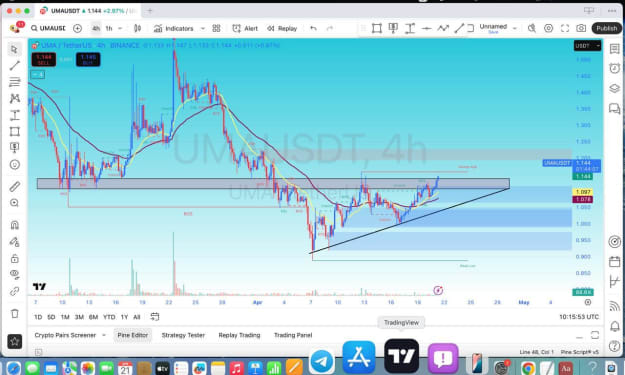
UMAUSDT (4H) Chart Analysis – Swing Trade Setup.
*UMA* is showing strong bullish momentum after forming a break of structure (BOS) and flipping multiple key zones. Price is now consolidating inside a major supply zone ($1.13–$1.15) and has formed clean higher lows with rising volume. If price sustains above this zone, it can trigger a strong continuation move. *Entry* – $1.135 to $1.145 (after candle close above) *Stop Loss* – Below $1.050 (under bullish structure invalidation) Target 1 – $1.200 Target 2 – $1.260 Target 3 – $1.320+ *🚨 Wait for clear breakout* confirmation above $1.15 with volume before entering for safe swing trade
By CryptoCurrency News 2 years ago in Education
What the Rise of Edge Computing Means for Managed SD-WAN Services
As digital transformation continues to accelerate, businesses are turning to technologies that reduce latency, improve agility, and streamline operations. One such game-changer is edge computing—a model where data processing happens closer to the point of origin rather than in a centralized data center or cloud environment. But as edge computing surges, its impact on Managed SD-WAN Services becomes increasingly profound.
By Christopher Nolan2 years ago in Education
High-Performance Home Office: Working from Home and Maintaining Productivity
1. Establish a solid routine first: A consistent daily routine is one of the most powerful ways to stay on track. It's tempting to hit snooze or roll right from bed to your computer when your workday doesn't start with a commute, but doing so can hinder your focus. Begin your day at the same time each morning, just like you would if you were heading into the office. Put on your clothes, eat breakfast, and plan your day. Starting with a sense of structure sets the tone and signals to your brain that it’s time to focus.
By Mazharul Dihan2 years ago in Education
Non-Invasive vs. Traditional Colonoscopy: Which One Is Right for You?
Colorectal cancer is one of the most preventable yet deadly cancers in the U.S. Early detection is key, and one of the best ways to catch it early — or prevent it altogether — is through routine colon cancer screening. But when it comes to screening, you’ve got options. The two major ones? Traditional colonoscopy and non-invasive tests like stool-based screenings or virtual colonoscopy.
By Erika Phillips 2 years ago in Education