how to
How tos for the learners and the learned; tips and tricks to help you study effectively, survive your school years, impress your teachers and more.
The Teacher Who Collected Stars
M Mehran Most people thought Mr. Hale was an ordinary teacher. He wore the same brown jacket every day, carried a stack of papers tucked under his arm, and taught literature to restless high school juniors who rarely listened. But the truth was, Mr. Hale collected stars. Not the kind that burned in the sky, but the kind that flickered inside people—the sparks of possibility that most others overlooked. Samantha Lee was fifteen when she first sat in his classroom. She had a habit of sitting in the back, hiding behind her hair, sketching in the margins of her notebook. Teachers called her lazy, distracted, even unmotivated. Her grades were slipping, and the word “failure” seemed to follow her like a shadow. Mr. Hale never used that word. One day, while the rest of the class groaned over a quiz, he leaned over Samantha’s desk and whispered, “You see things differently, don’t you?” She blinked, unsure how to respond. He tapped the edge of her notebook, where she had drawn a tree whose branches curled into shapes of birds. “That’s not distraction,” he said. “That’s vision.” It was the first time anyone had said something kind about her drawings. Mr. Hale’s lessons were strange. Sometimes he abandoned the textbook entirely and asked the students to write letters to their future selves. Other times, he made them stand in a circle and tell stories, no matter how silly. When the principal visited, Mr. Hale returned to grammar drills and vocabulary lists. But when the door closed again, his eyes lit up like someone had struck a match inside him. “Education isn’t about memorizing answers,” he told them once. “It’s about finding the questions that matter.” Most of the students rolled their eyes. But Samantha didn’t. The day Samantha’s life changed was a Tuesday. Mr. Hale gave the class a challenge: write an essay not about a famous author, but about themselves. “Tell me your story,” he said. “No rules, no format. Just truth.” Samantha stayed up all night. She wrote about her fear of being invisible, about how her parents fought so loudly she escaped into drawing, about how she felt both too much and not enough at the same time. When she handed it in, her hands shook. A week later, Mr. Hale returned the papers. At the top of hers, instead of a grade, he had written: “This is not just writing. This is a voice. Don’t ever lose it.” It was the first time Samantha believed she had something worth saying. Rumors spread that Mr. Hale was too soft, that his teaching methods weren’t “practical.” Parents complained that their kids weren’t learning the “basics.” The principal warned him twice. Still, he kept going. He stayed after school for students who needed him, listened when no one else did, and filled the margins of every assignment with encouragement instead of criticism. “He’s wasting their time,” another teacher muttered once. “These kids won’t pass state exams if all they do is write poems.” But Samantha noticed something different. Students who had once slept through class now leaned forward. The quiet kid in the corner shared a story about fixing cars with his grandfather. The class clown admitted he wanted to be the first in his family to go to college. The sparks were catching fire. Years later, Samantha walked into a bookstore and found her name on the spine of a novel. She traced the letters with trembling fingers. She had done it—she was an author. At her first public reading, an audience filled the small room. Samantha read aloud the story of a girl who felt invisible until a teacher showed her she wasn’t. Afterward, a man approached her. His hair was grayer, his jacket the same worn brown. Mr. Hale. She froze, overwhelmed with gratitude. “You—you came.” He smiled, the corners of his eyes crinkling. “Of course. I came to see one of my stars.” Samantha felt tears sting her eyes. “I never thanked you.” “There’s no need,” he said gently. “Teaching isn’t about being remembered. It’s about helping you remember yourself.” And with that, he left quietly, as if he had only been there to hand her another piece of light. No one ever knew how many stars Mr. Hale had collected in his lifetime. They weren’t visible in the sky, nor etched into any chart. But they shone in classrooms, in novels, in songs, in medical degrees, in inventions—sparks he had tended until they became flames. Because true education, Samantha realized, was never about tests or grades. It was about someone who believed in you long enough for you to believe in yourself.
By Muhammad Mehranabout a year ago in Education
Charlie Kirk and the danger of selective empathy
Conservative political activist Charlie Kirk was shot and killed on Wednesday. His suspected killer, identified by law enforcement as 22-year-old Tyler Robinson, was taken into custody after a substantial manhunt, based on information from people close to Robinson’s family. Utah Governor Spencer Cox said a family member of Robinson had reached out to a friend, who then contacted the authorities, and that friends and relatives interviewed by investigators described Robinson as “full of hate” when speaking about Kirk at a recent gathering. Robinson’s exact motivations for allegedly carrying out the shooting are still being explored.
By MUHAMMAD Abbasabout a year ago in Education
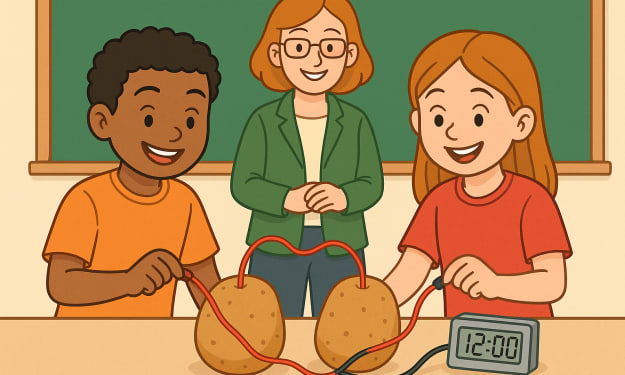
Potato Clock Electricity Experiment for School: Step-by-Step Guide. AI-Generated.
The potato clock electricity experiment for school is one of the most popular STEM science projects for kids because it’s simple, safe, and fun. It helps students understand the basics of electricity, chemistry, and renewable energy while sparking curiosity about how batteries work.
By Mauro Vendemiattiabout a year ago in Education
The Importance of Education in Modern Society
Education is one of the most powerful tools that shape human life and society. It is not limited to reading books or passing examinations but extends to the overall development of an individual’s character, skills, and understanding of the world. In today’s globalized world, education plays a vital role in personal growth, career advancement, and the progress of nations. This article explains the importance of education in detail, exploring its impact on individuals and society as a whole. What is Education? Education can be defined as the process of acquiring knowledge, skills, values, and attitudes through learning and experience. It begins at home, continues in schools and universities, and never truly ends, as lifelong learning is essential in the modern age. Formal education includes structured systems like primary, secondary, and higher education, while informal education occurs through daily life experiences, interactions, and personal exploration. Personal Development Through Education One of the most significant roles of education is personal development. A well-educated person gains self-confidence, critical thinking abilities, and problem-solving skills. For example, learning languages improves communication, while studying science and technology sharpens analytical thinking. Education also teaches discipline, patience, and time management, which are necessary for achieving goals. Moreover, it shapes moral values, making individuals more responsible and respectful in society. Education and Career Opportunities In the competitive job market of the 21st century, education is the foundation of career success. Employers prefer candidates who are skilled, knowledgeable, and adaptable. Higher education opens doors to professional careers in medicine, engineering, law, business, and technology. Vocational education, on the other hand, provides practical training for specific jobs, helping people gain financial independence. Thus, education is directly linked to economic stability and a better standard of living. Education as a Social Equalizer Education reduces the gap between rich and poor by giving everyone equal opportunities to succeed. In many countries, scholarships and free education programs help underprivileged children break the cycle of poverty. Through education, people learn about social justice, equality, and human rights. Educated societies are less likely to fall into discrimination, gender inequality, or racial prejudice, as knowledge promotes tolerance and understanding. National Development and Education No nation can progress without education. It provides skilled professionals, innovative thinkers, and responsible citizens. Countries with high literacy rates often enjoy better economic growth, political stability, and advanced technology. For instance, developed nations like Japan and Germany have invested heavily in education, which has contributed to their global leadership in science, industry, and innovation. Education also builds national unity by teaching cultural heritage, history, and civic responsibility. The Role of Technology in Education In the modern world, technology has revolutionized the education sector. Online learning platforms, digital libraries, and virtual classrooms make education accessible to millions worldwide. Students can now attend lectures from top universities without leaving their homes. Artificial Intelligence, smart classrooms, and e-learning tools have made education more interactive and effective. Technology also encourages self-learning, creativity, and innovation, preparing students for the digital future. Challenges in Education Despite its importance, education faces several challenges across the globe. Poverty, lack of resources, outdated teaching methods, and gender inequality prevent millions of children from accessing quality education. In some regions, political instability and conflicts destroy schools and disrupt learning. Moreover, the rising cost of higher education makes it difficult for many students to pursue their dreams. Addressing these challenges requires global cooperation, government support, and community participation. Conclusion In conclusion, education is the backbone of human development and societal progress. It empowers individuals, opens career opportunities, reduces inequality, and strengthens nations. With the rapid growth of technology and globalization, the value of education has become even greater. Therefore, governments, institutions, and individuals must work together to make education accessible, affordable, and effective for everyone. An educated society is not only a successful society but also a peaceful, progressive, and prosperous one.
By Article Master about a year ago in Education
Is MyEssayWriter.ai Worth Using in 2025? A Complete Review
Artificial intelligence has changed how students and professionals write. In 2025, many people look for smart tools that save time, reduce stress, and improve writing quality. Among these tools, MyEssayWriter.ai has gained a lot of attention. It is not just another essay writer; it is designed to support students, researchers, and even professionals who need clear and quick content.
By Robert Barrettabout a year ago in Education
From Cubicles to Collaboration: The Gen Z Approach to the Modern Workplace
A New Era of Work Several reports indicate that Gen Z currently makes up about 27% of the global workforce, and by 2030 their share is expected to climb to 30%, overtaking millennials. These figures clearly highlight that Gen Z, with their fresh perspective and strong digital fluency, is poised to reshape and revolutionize the modern workplace.
By Ashutosh Uniyalabout a year ago in Education
Should You File Jointly or Separately? A Strategic Tax Guide for High Earners
Picture this: You're a successful business owner pulling in $2 million annually, married to a corporate executive earning $450,000. Tax season rolls around, and like every year before, you automatically check "married filing jointly" without a second thought. After all, that's what everyone does, right?
By Nth Degree Taxabout a year ago in Education