how to
How tos for the learners and the learned; tips and tricks to help you study effectively, survive your school years, impress your teachers and more.
When Porn Replaces Real Human Connection. Content Warning. AI-Generated.
In the quiet, private glow of a screen, a profound and unsettling transaction is taking place. It doesn't involve money or data, but something far more precious: our capacity for intimacy. In an age of unprecedented digital connectivity, we are simultaneously experiencing an epidemic of loneliness. And into this void steps a ubiquitous, always-available substitute: pornography.
By The 9x Fawdiabout a year ago in Education
AI and Automation in Forex: How Smart Software Predicts Market Movements
The foreign exchange market, also known as forex, moves very fast. Every second, billions of dollars are traded between different currencies around the world. Because the market changes constantly, traders are always looking for better tools to help them understand what’s happening and make quick, smart decisions. This is where Artificial Intelligence (AI) and automation come in. These modern technologies are changing how trading works, making it faster, smarter, and more efficient.
By james hallabout a year ago in Education
The Science of Habit Formation: How Your Brain Shapes Your Life. AI-Generated.
Every day, we make countless choices — some small, some significant. From brushing your teeth to checking your phone first thing in the morning, our lives are filled with habits. But have you ever wondered why habits are so hard to change? And why some people seem to develop good habits effortlessly while others struggle?
By shakir hamidabout a year ago in Education
The Day the Results Came In
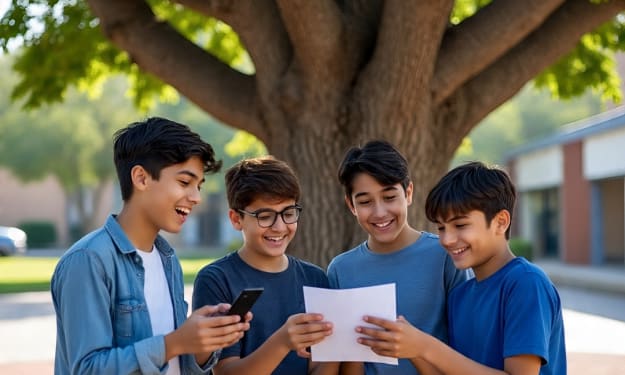
The Day the Results Came In How One Group of Students Discovered More Than Just Their Grades The morning sun poured over the red-brick walls of St. Alder High School, turning the courtyard into a warm, golden glow. It was results day — the one date circled, highlighted, and whispered about for months. The gates had barely opened when clusters of students began to gather, envelopes clutched in nervous hands, their laughter and chatter hiding the shared thrum of anxiety beneath. Mia stood at the centre of it all, her stomach twisting in knots. She’d been dreaming about this day since the exams ended, running through every possible scenario in her head. She had studied harder than she ever had before — late-night flashcards, group calls, endless practice papers — but the uncertainty still gnawed at her. Around her, her friends—Eli, Zara, and Noah—were trying to look casual, leaning against the wall and joking about who would faint first. “Can’t believe this is it,” Noah said, spinning his envelope between his fingers. “Months of suffering in that library, and it all comes down to this piece of paper.” Zara laughed, though her voice trembled slightly. “If I open this and it says I passed maths, I’m framing it.” Mia smiled faintly, grateful for the light-heartedness. The sound of envelopes tearing open began to ripple through the courtyard. Gasps, squeals, sighs — all blending into a strange symphony of relief and emotion. She took a deep breath, felt her heartbeat in her fingertips, and opened hers. For a moment, all she saw were the numbers, neatly typed in black ink. Then they began to make sense. Her grades were better than she dared hope — not perfect, but enough. Enough to get into the university she wanted. Enough to feel that the long nights and self-doubt had been worth it. She looked up, a wide grin spreading across her face before she could stop it. “I did it!” she said, almost breathless. Zara let out a cheer. “You did? Let me see!” Within seconds, they were all comparing results — some shouting in triumph, some hugging in quiet relief. Eli, who had always been the calm one, smiled as he looked at his paper. “Looks like we’re all going to make it,” he said softly. But not everyone was smiling. A few steps away, another student sat on a bench, staring at her paper, tears welling up. Mia hesitated for a moment, then walked over. It was Sophie — someone she’d worked with on a group project but didn’t know well. “Hey,” Mia said gently. “You okay?” Sophie shook her head, trying to smile through her tears. “I didn’t get the grade I needed. I thought I would. I really thought I would.” Mia sat beside her. “I get it. It feels awful right now. But this isn’t the end. You’re still one of the hardest workers I know. You’ll find another way — you always do.” Sophie gave a small laugh at that. “You sound like a teacher.” “Guess I’ve heard enough pep talks to start giving them,” Mia said with a grin. As they sat together, the rest of the courtyard buzzed with life — laughter, chatter, hugs, and selfies. It was a celebration of more than just numbers on paper. It was a celebration of effort, friendship, resilience. When the group finally left the school grounds, the late-morning sun was shining even brighter. They walked down the familiar street, their envelopes now folded and tucked safely away, but their spirits light. There was something freeing about it — not just knowing their results, but realizing that they were moving forward, together. Later that day, when Mia’s mum asked how it went, she smiled and said, “It was a good day. We all learned something — and not just about grades.” Because in the end, the day the results came in wasn’t just about who scored what. It was about discovering what really mattered: courage, kindness, and the belief that every ending is just the beginning of something new.
By Muhammad Saad about a year ago in Education
From Shame to Self-Compassion: Reframing Masturbation in Modern Culture. Content Warning. AI-Generated.
For generations, masturbation has lived in the shadowy silence between medical fact and cultural taboo. While science has long recognized it as a normal, healthy part of human sexuality, our cultural narrative has often told a different story - one tinged with shame, embarrassment, and moral judgment. But a quiet revolution is underway, one that seeks to reframe this most private of acts from something shameful to an aspect of holistic self-care.
By The 9x Fawdiabout a year ago in Education
Religious Upbringing and Sexual Shame: Understanding the Connection. Content Warning. AI-Generated.
For countless individuals, the first language they learn about sexuality is not one of biology or intimacy, but one of morality, sin, and purity. A religious upbringing provides a vital foundation of community, meaning, and moral structure. Yet, when it comes to sexuality, this same foundation can inadvertently become the blueprint for a hidden prison of shame, creating a deep and lasting conflict between the body and the spirit.
By The 9x Fawdiabout a year ago in Education
Why Do I Feel Bad After? Unpacking the Roots of Masturbation Guilt. Content Warning. AI-Generated.
It’s one of the most common, yet rarely discussed, human experiences. You engage in a natural, private act to relieve stress, experience pleasure, or simply to sleep. For a few moments, it feels good. Then, it washes over you—a wave of shame, regret, or a hollow emptiness. The pleasure evaporates, replaced by a puzzling sense of guilt.
By The 9x Fawdiabout a year ago in Education
Inside Gen Z Technology and Education in Real Life
In the digital-first world we live in today, Generation Z is the most technologically immersed and adaptive generation ever. Born between the late 1990s and early 2010s, Gen Z has never known a world without the Internet, smartphones, and social media. There is no separation between their lives and technology; it is an integral part of their daily lives. This digital fluency is changing how they learn, study, and prepare for the future.
By Relationship Guideabout a year ago in Education
Zen buddhism and Jacques Derrida - Alexis karpouzos
The Kyoto School and Jacques Derrida appear, at first glance, as distant interlocutors—one rooted in the Zen-infused meontology of 20th-century Japan, the other in the post-structuralist deconstruction of French philosophy. Yet beneath this geographic and methodological divide lies a profound convergence: both dismantle the Western "metaphysics of presence," revealing reality as a play of traces, negations, and interdependent arising. Nishida Kitarō’s basho (place of absolute nothingness), Nishitani Keiji’s śūnyatā (emptiness), and Derrida’s différance (difference/deferral) converge on a shared refusal of fixed centers, origins, or transcendental signifieds.
By alexis karpouzosabout a year ago in Education
How to Make Money Online Without Spending Any Money (My Real Experience from Jamaica)
Have you ever dreamed of making money online without spending any money to start? I know I have. You know the one I'm talking about, sitting at home, working whenever you want, and seeing real money come into your bank account without paying a single dollar first. I live in Jamaica, and sometimes it feels like the good opportunities are somewhere else. I really wanted to know if that dream could be real for me, right here.
By Diana Crooksabout a year ago in Education
ASL Isn’t English in Disguise
I've been signing for over forty years and teaching online for the last ten years. If I had a dollar for every time a student was surprised that ASL isn’t just “English on the hands” — or that facial expressions are actually required — I’d be retired by now.
By Tracy Stineabout a year ago in Education