high school
High school made less stressful; a roundup of high school horror stories and tips on asking your date to prom, preparing for college and much more.
Engineering Materials in Saudi Pipeline Projects Explained
Engineering Materials in Saudi Pipeline Projects Saudi Arabia’s pipeline networks are among the most extensive and demanding in the world. These systems transport oil, gas, and water across thousands of kilometers, cutting through deserts, mountains, and coastal zones. To ensure performance and reliability, engineers must select materials that can withstand extreme pressures, high temperatures, salinity, and soil aggressiveness. The choice of materials is not just a technical decision—it directly affects pipeline lifespan, safety, and overall project economics.
By Sayed Zewayedabout a year ago in Education
Why Digital Business Cards Are Redefining Professional Networking. AI-Generated.
The way we connect in business has changed dramatically. Handshakes, printed cards, and paper brochures are being replaced by faster, smarter, and more eco-friendly solutions. At the center of this shift are digital business cards—a modern networking tool that professionals across industries are adopting to strengthen connections and streamline communication.
By Qcard Enterpriseabout a year ago in Education
How Nurses Take Care of Teenagers with Psychological Issues?
Teenagers nowadays are under too much stress and tension, which can lead to mental health issues. It can direct to irreversible damage to the teen. Nurses have a vital role to play in taking care of the mental health of teens by offering support and monitoring. To take care of them, nurses must develop a safe and supportive place. Caretakers sometimes get assignments from their superiors. It is one of the nursing dissertation topics that nurses can write about. Caretakers need to monitor and assess the level at which a child is showing distress, promote skills that can help them become better, and connect with others who have healed from similar cases.
By Mary Taylorabout a year ago in Education
Learn How to Write an Analytical Essay in 5 Simple Ways
First of all, do you know what an analytical essay is? It is a type of writing that requires in-depth research. Writing an analytical essay is not that easy, so seeking assistance is not a crime. In case you face any trouble while writing it, you can ask for support from assignment help London for expert guidance. Additionally, this post will discuss five simple ways in which you can craft a solid analytical essay.
By Carrie smithabout a year ago in Education
Achieve Academic Excellence Get Help with Your Online Exam
Students today handle many time-consuming responsibilities, including their educational work, work, and personal activities. The increase in online examinations across schools leads students to feel extremely pressured to deliver success. Students turn to qualified experts because they want better results in their digital test environment. Services from experts benefit students by helping them learn easier subjects while building better time habits and lowering pressure.
By Lucas Lednerabout a year ago in Education
Career Path for O-Level Students with the Foundation Year
Completing O-Levels is a milestone that opens the door to new academic opportunities. For many students, the decision of whether to pursue A-Levels or consider alternatives can feel overwhelming. The NCUK International Foundation Year (IFY) offered at MIE Pathways provides a direct route to university study, saving time and giving students the skills they need for success. This pathway ensures a smooth transition from O-Levels to undergraduate education at top universities worldwide.
By MIE Pathwaysabout a year ago in Education
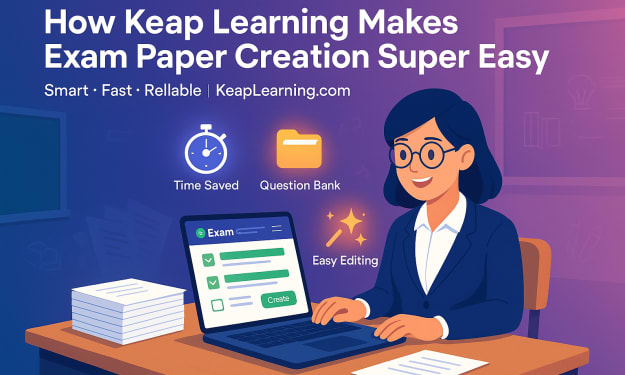
How Keap Learning Makes Exam Paper Creation Super Easy
Creating exam papers can often feel like a time-consuming and stressful task for teachers, trainers, and institutions. From drafting questions to formatting and ensuring accuracy, the process usually takes hours of manual effort. That is where Keap Learning steps in to transform the entire experience. This powerful online platform is designed to make exam creation simple, smart, and efficient. With its intuitive interface, educators can save valuable time, build question sets, and customize papers to suit any subject or level. By offering tools for assessment, organization, and easy editing, Keap Learning makes exam paper design not just faster but also highly reliable for both teachers and students.
By Numan Ajmalabout a year ago in Education
Organic Clothing.
Introduction Organic clothing has emerged as a beacon of sustainable fashion, offering an eco-friendly alternative to conventionally made garments. It refers to apparel made from organically grown fibers (such as cotton, hemp, or wool) produced without synthetic pesticides, fertilizers, or genetically modified seeds. Over the past few decades, this niche has grown from a grassroots idea to a global market segment. Major brands – from boutique eco-labels to retail giants – now tout “organic” lines as part of their environmental responsibility pledges. Although organic textiles still account for only around 1% of worldwide fiber production, production has risen for consecutive years to meet increasing demand. In the 2020/21 season alone, farmers grew about 342,000 tons of certified organic cotton fiber – roughly 1.4% of global cotton output – a 37% jump from the prior year. This growth reflects a broader shift in consumer values toward sustainability and health. Shoppers are drawn to organic clothes as a way to avoid harmful chemicals and reduce their wardrobe’s environmental footprint. At the same time, companies see organic fiber as a key part of their sustainability strategies, responding to calls for greener, more ethically made products.
By Sayed Zewayedabout a year ago in Education
The Classroom Without Walls
M Mehran When the storm washed away the roof of the small village school, the villagers thought education would stop. The children, after all, had no desks, no blackboard, no place to gather. But for Amina, a twelve-year-old with eyes full of questions, the storm was not the end—it was the beginning. Her father shook his head as he watched her cling to her soaked schoolbooks. “Child,” he sighed, “the roof is gone. Maybe it’s a sign to rest. What good is learning if the classroom itself has drowned?” But Amina only hugged the books tighter. “What good is rest if our future drowns too?” The next morning, instead of staying home, she walked to the ruins of the school. The walls still stood, cracked but upright, open to the sky. She spread her books on a dry patch of floor and waited. Slowly, other children arrived—barefoot, carrying slates, chalk, or nothing at all. They looked at the ruins, at the sky above, and then at Amina. “Where is the teacher?” someone asked. Amina raised her hand. Her voice trembled, but she steadied it. “We are the teachers now.” --- At first, the lessons were clumsy. Amina drew crooked letters in the dirt while the younger children copied them with sticks. Older boys recited multiplication tables in singsong voices, sometimes skipping numbers but laughing when corrected. They took turns telling stories of history—half remembered, half imagined. The wind scattered their words, but still they spoke. Soon, learning spilled beyond the broken walls. They solved arithmetic while carrying water jugs, practiced spelling by tracing words in the dust, and learned science by watching how rain collected in leaves. The world itself became their blackboard. Amina discovered something remarkable. Without the roof, the classroom no longer ended at four walls. Birds became their tutors in flight, rivers in geography, shadows in astronomy. Every object carried a lesson if only they looked closely enough. When the village elders noticed the children gathering daily, they began to join in. One elder recited old poems, another taught farming techniques passed through generations. Even Amina’s father, once doubtful, showed them how to measure wood and angles for carpentry. Knowledge flowed like water, shared freely, without titles or uniforms. --- Months passed, and word spread to neighboring villages. Soon, children walked miles to sit in the open-air classroom. There were no registers, no exams, no grades. Instead, each student carried a notebook of curiosity. Some scribbled numbers, others sketched plants, others wrote questions with no answers yet. One afternoon, a government inspector arrived. He wore polished shoes that sank into the mud, and he frowned at the sight of children scattered under the sun, writing in the dirt. “This is no school,” he declared. “Where are the teachers? Where are the books, the chalk, the benches?” Amina stepped forward, holding her weathered notebook. “Here,” she said. “The teachers are here. The benches are the ground. The chalk is the sky. The books are our voices.” The inspector’s frown deepened, but he could not silence the children’s laughter or the way their eyes glowed with discovery. He left shaking his head, muttering about rules and regulations. But the children kept learning. --- The true test came one evening when a young boy, Tariq, ran breathless into the village square. His baby sister had stopped breathing, and his parents were in panic. While others scrambled for help, Tariq shouted, “Wait—I learned something!” He had memorized a lesson about clearing airways, taught not from a textbook but from a traveling nurse who once visited the open-air classroom. Kneeling beside his sister, Tariq tilted her head, cleared her throat, and pressed gently on her chest. The baby gasped, coughed, and cried. Relief washed over the family like rain. That night, the villagers looked at the ruins of the school with new respect. They saw not rubble, but a birthplace of knowledge that saved lives. --- Years later, the government rebuilt the village school with a proper roof, desks, and a shiny chalkboard. But by then, Amina was already known beyond her village. She had become a teacher—not by degree, but by spirit. She traveled from place to place, reminding communities that education was not confined to buildings. “Learning,” she told them, standing in fields, under trees, in crowded courtyards, “is not a place you go. It’s a fire you carry. A storm can drown a roof, but it cannot drown a mind that burns to know.” And everywhere she went, children lit their own fires. --- The village never forgot the storm that tore down their school. But they remembered something more powerful: how a group of children proved that education has no walls, no boundaries, no limits. And in the quiet evenings, when Amina walked through the rebuilt school, she would sometimes pause beneath the old cracked walls still standing at the edge of the courtyard. She would run her hand along the stone and whisper, “Thank you for teaching us that the world itself is a classroom.” Because education, she knew, was not about sheltering knowledge inside walls. It was about letting it breathe under the open sky, where every child could see the stars and believe that learning, like the horizon, had no end.
By Muhammad Mehranabout a year ago in Education
How the Right Exam Help Service Can Expand Marks and Confidence
How the Right Exam Help Service Can Expand Marks and Confidence Introduction Internet education has new the way students study, go to class, and sit for exams. The ease of virtual learning is seductive, but it presents new difficulties: managing many due dates, balancing work, and being left over, moved without social contact. For some, this generates academic anxiety and stress. That's why students are increasingly asking such questions as, Can I take my online exam for me?
By Mack Mickeyabout a year ago in Education