high school
High school made less stressful; a roundup of high school horror stories and tips on asking your date to prom, preparing for college and much more.
Apeejay’s IB students orchestrated a scientific symphony exploring environmental health
The Collaborative Sciences Project (CSP) is a dynamic fusion of minds, a symphony of disciplines where the rigid walls of isolated subjects dissolve. Designed to challenge IB Diploma Programme (DP) students, CSP is more than an academic exercise — it is an intellectual expedition that cultivates knowledge and the art of synergy, forging thinkers who transcend boundaries. Recently, Apeejay’s IB School, Apeejay School International, Panchsheel Park organised a CSP, where students of DP (Diploma Programme) presented their projects titled under Urban Green Space.
By Apeejay Newsroom2 years ago in Education
7 Qualities of a Good Teacher. AI-Generated.
7 Qualities of a Good Teacher Teaching is very important profession in the world. A good teacher has the power to shape minds, inspire confidence, and make learning an exciting journey. But what exactly makes a teacher great? Is it their knowledge, patience, or ability to connect with students? The answer lies in a combination of various qualities that set an outstanding teacher apart from the rest.
By Rayyan Writes2 years ago in Education
THE FUTURE OF EDUCATION . AI-Generated.
It's a typical Monday morning at Springdale High School, but something is different. The students are not carrying backpacks full of textbooks or scribbling notes on paper. Instead, they're walking into a futuristic classroom, equipped with virtual reality headsets, artificial intelligence-powered learning tools, and interactive digital whiteboards. This is the future of education, where technology and innovation are transforming the way we learn. The traditional model of teaching, where a teacher stands at the front of the classroom and lectures to a room full of students, is being turned on its head. At Springdale High, students are able to learn at their own pace, using personalized learning plans that are tailored to their individual needs and abilities. They can access virtual labs, where they can conduct experiments and investigations in a safe and controlled environment. The teacher, Mrs. Johnson, is no longer just a lecturer, but a facilitator, guiding her students through the learning process and providing support and feedback when needed. This is just one example of how technology is revolutionizing the education sector. From artificial intelligence to virtual reality, the possibilities are endless. *The Rise of Online Learning* One of the most significant trends in education technology is the rise of online learning. With the proliferation of smartphones and tablets, students can now access high-quality educational content from anywhere, at any time. Platforms like Coursera, Udemy, and edX are offering online courses and degree programs that are designed to be flexible and accessible. Students can learn from top professors and industry experts, without having to leave their homes. But online learning is not just about accessing content; it's also about creating communities and connections. Social learning platforms like Discord and Slack are allowing students to collaborate and interact with each other in real-time. *The Power of Artificial Intelligence* Artificial intelligence (AI) is another technology that is transforming the education sector. AI-powered learning tools are able to personalize the learning experience, adapting to the individual needs and abilities of each student. AI can also help teachers with grading and feedback, freeing up more time for them to focus on instruction and support. But AI is not just about automation; it's also about augmentation. AI-powered tools can help students learn more effectively, by providing real-time feedback and guidance. *The Future of Virtual Reality* Virtual reality (VR) is another technology that is revolutionizing the education sector. VR headsets are allowing students to experience immersive, interactive learning environments that simulate real-world situations. VR can be used to teach a wide range of subjects, from science and math to language and history. It can also be used to provide training and simulation experiences for students in fields like medicine and aviation. *The Challenges Ahead* While technology is transforming the education sector, there are still many challenges ahead. One of the biggest challenges is equity and access. Not all students have access to the same technology and resources, which can create a digital divide. Another challenge is the need for teacher training and support. Teachers need to be equipped with the skills and knowledge to effectively integrate technology into their classrooms. Finally, there is the challenge of ensuring that technology is used in a way that supports learning, rather than distracting from it. This requires a thoughtful and intentional approach to technology integration. *Conclusion* The future of education is exciting and uncertain. Technology is transforming the way we learn, but it also presents many challenges. As we move forward, it's essential to prioritize equity and access, teacher training and support, and a thoughtful approach to technology integration. By working together, we can create a future where every student has access to high-quality educational opportunities, regardless of their background or circumstances. The future of education is bright, and it's time to get started. *The Future of Education: By the Numbers* - *70%*: The percentage of teachers who believe that technology has a positive impact on student learning, according to a survey by the National Education Association (NEA). - *60%*: The percentage of students who prefer online learning to traditional classroom-based learning, according to a survey by the Babson Survey Research Group. - *50%*: The percentage of schools that are using virtual reality as a teaching tool, according to a survey by the Virtual Reality First organization. *Dictionary of Education Technology Terms* - *Artificial intelligence (AI)*: The use of computer algorithms to simulate human intelligence and learning. - *Virtual reality (VR)*: A computer-generated simulation of a three-dimensional environment that can be experienced and interacted with in a seemingly real or physical way. - *Personalized learning*: An approach to education that tailors the learning experience to the individual needs and abilities of each student.
By Henry Lucy2 years ago in Education
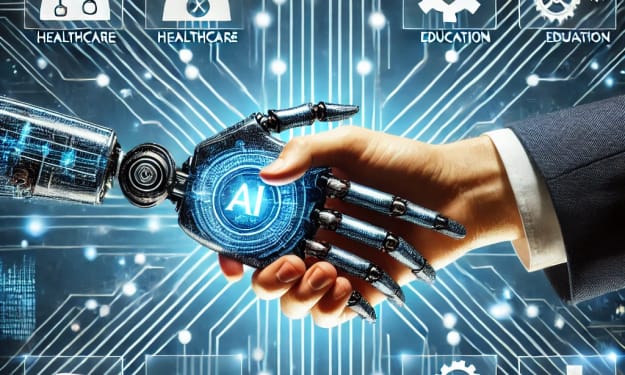
The Rise of Artificial Intelligence.
In the past few years, artificial intelligence (AI) has dominated technological advancements, impacting nearly every industry and revolutionizing how businesses operate. From automation to analytics, AI has made new ways possible for innovation, productivity, and growth. As the technology continues to evolve, the question of how it will shape the future is at the forefront of popular discussions.
By Abdul Rehman Furqan2 years ago in Education
Why Don't We Eat Carnivores?. AI-Generated.
Many animals like cows, pigs, chickens, deer, and rabbits are commonly eaten by people around the world. Most of these animals are not meat-eaters; they mainly eat plants or a mix of both. This leads to a question: why do we usually steer clear of eating meat from carnivorous animals? There are some interesting reasons for this choice.
By Vasilis Alexiadis2 years ago in Education
Learn the Basic Steps in Data Analysis
As a Senior Data Analyst, one of the most important things you can do is guide others through the essential steps in data analysis. Data analysis is an important skill that helps businesses, organizations, and individuals make decisions based on data. Whether you're working on a project or analyzing a large dataset, understanding the steps in Data Analysis is key to achieving accurate and insightful results. In this blog, we’ll go over the basic steps in data analysis and how to apply them effectively in your work.
By Harish Kumar Ajjan2 years ago in Education
Education Conferences Highlight The Skills Schools Must Teach For AI-Driven Creativity
Can AI and human creativity thrive together? Artificial intelligence is revolutionizing art, music, and content creation, pushing creative boundaries like never before. It is not replacing talent but giving creators new tools to innovate. Experts at top education conferences in Dubai are discussing how this shift is redefining industries and why schools must evolve to keep up.
By Education 2.0 Conference2 years ago in Education
Hatena vs. Other Platforms: Unique Benefits for Online Visibility. AI-Generated.
Ivory researcher profile on hatena.ne.jp is a great example of how creators, bloggers, and researchers can leverage Hatena to improve their online presence. While many platforms offer blogging, bookmarking, and content-sharing features, Hatena stands out due to its unique community-driven ecosystem, SEO advantages, and integration with various content formats. In this article, we will compare Hatena with other platforms and explore why it provides significant benefits for online visibility.
By Ivory Researcher2 years ago in Education
SQLServerCentral vs. Other Platforms: Unique Benefits for Online Visibility. AI-Generated.
Ivory researcher profile on www.sqlservercentral.com is a great example of how professionals in the SQL Server community can leverage this platform to enhance their online presence. While numerous online forums, blogs, and communities cater to database administrators, developers, and IT professionals, SQLServerCentral stands out due to its extensive knowledge base, active community participation, and valuable networking opportunities. In this article, we will compare SQLServerCentral with other platforms and explore why it offers significant advantages for online visibility.
By Ivory Researcher2 years ago in Education