high school
High school made less stressful; a roundup of high school horror stories and tips on asking your date to prom, preparing for college and much more.
"The International Space Station: A Beacon of Human Cooperation and Scientific Discovery"
The l Space Station: Humanity's Laboratory in Orbit he International Space Station (ISS) is one of humanity's most significant and ambitious achievements in space exploration. Orbiting the Earth at an average altitude of 400 kilometers (about 250 miles), the ISS is a large spacecraft and scientific laboratory that serves as a platform for international cooperation, scientific discovery, and technological innovation. With contributions from space agencies across the globe, the ISS stands as a symbol of what nations can achieve together in the pursuit of knowledge and exploration. Brief History The roots of the ISS project go back to the 1980s, when the United States and its allies envisioned a permanent space outpost in low Earth orbit. Originally planned as “Freedom,” a U.S.-led space station concept, the project evolved significantly in the 1990s. Following the end of the Cold War, a new opportunity emerged for collaboration between former rival nations. In 1998, the first module of the ISS, Zarya, was launched into orbit by Russia. Soon after, the U.S. module Unity was added, and over the following years, various other modules and components were delivered and assembled in space. This modular design allows for flexibility and expansion, and the station has continued to grow over time. ### International Cooperation The ISS is a joint project involving five main space agencies: NASA (United States), Roscosmos (Russia), ESA (European Space Agency), JAXA (Japan Aerospace Exploration Agency), and CSA (Canadian Space Agency). Altogether, more than 15 nations have participated in its construction, maintenance, and utilization. Each partner agency contributes to the station's hardware, software, operational responsibilities, and crew. For instance, Russia provides modules such as Zvezda and supplies transportation via its Soyuz spacecraft. Canada contributed the robotic Canadarm2, a vital tool for spacewalks and cargo handling. ESA’s Columbus laboratory and Japan’s Kibo module are key facilities for scientific research.
By Nasir Khanabout a year ago in Education
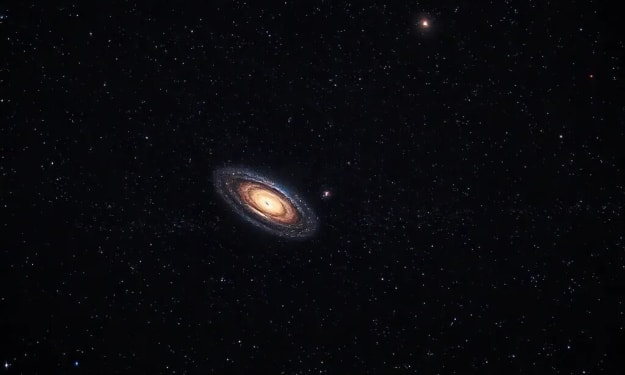
How Do Galaxies Move Through the Universe?
The universe isn’t some silent, motionless canvas where stars and galaxies sit frozen in space. Quite the opposite — it's a place of nonstop motion, often on unimaginable scales. Galaxies — those enormous collections of stars, gas, dust, and dark matter — are constantly on the move. They spin, collide, drift, and race through the cosmos at incredible speeds. But what exactly makes them move — and where are they going?
By Holianyk Ihorabout a year ago in Education
How Many Galaxies Are in the Universe — And Why the Number Keeps Changing
When we gaze up at the night sky, it feels like we're seeing the entire universe stretched out before us. Stars shimmer, planets twinkle, and the Milky Way arcs overhead. But in reality, what we see is just a microscopic sliver of the cosmos. Beyond the familiar stars and nebulae lie billions — maybe trillions — of galaxies: vast cosmic islands made of stars, gas, dust, and dark matter.
By Holianyk Ihorabout a year ago in Education
What Is Quantum Gravity, and What Does It Have to Do with the Universe?
Quantum gravity is one of the most mysterious — and ambitious — ideas in modern physics. It sits at the edge of what we currently understand, where two of science’s most powerful theories meet: Einstein’s general relativity and quantum mechanics. But what exactly is quantum gravity, and why does it matter for our understanding of the cosmos?
By Holianyk Ihorabout a year ago in Education
What Will the Sky Look Like Millions of Years from Now?
The night sky feels eternal. The constellations seem fixed, the stars twinkle in familiar patterns, and the Moon and planets follow their predictable paths. But the universe is anything but static. It’s a cosmic dance of motion, transformation, and surprises. Fast-forward millions of years, and the sky above Earth will be almost unrecognizable.
By Holianyk Ihorabout a year ago in Education
Why Are Heavy Elements Born in Stars?
To the naked eye, stars may look like tiny, steady points of light scattered across the night sky. But behind that calm shimmer lies a cosmic powerhouse — a nuclear forge where the very ingredients of life are born. Without the stars, there would be no Earth, no us, and no matter as we know it. One of the most important processes happening inside stars is the creation of heavy elements — the building blocks of everything solid in the universe. But why does this happen in stars?
By Holianyk Ihorabout a year ago in Education
How Does Space Affect Biological Aging?
When we look up at the stars, we dream of exploration, discovery, and distant worlds. But what if space travel doesn't just change how we see the universe — what if it actually changes us? As it turns out, being in space can have a powerful impact on how our bodies age. And this isn't just a theory — we’ve got real evidence from real astronauts.
By Holianyk Ihorabout a year ago in Education
Professional Online Exam Consultancy by Certified Experts
In the up-to-date online scholarship atmosphere, online exams have become the global mode of scholarly and proficient assessment. If you're a part-time student working part-time or a professional seeking to develop identifications, operative treatment of online exams is critical to your achievement. But, with increasing pressure, close deadlines, or unavailability of subject knowledge, several find themselves in need of dependable assistance. That's when specialized online exam consultancy by qualified professionals comes into play.
By Lucas Lednerabout a year ago in Education
The Real Academic Work: Things to Consider Before You Hire Someone to Take Your Online Class
In today’s digitally driven academic world, online literacy has opened doors for millions of scholars who seek flexibility and convenience. Still, this new educational model also introduces challenges that didn’t exist in traditional classrooms: digital fatigue, time operation struggles, and the pressure to balance work, family, and academics. It's no surprise also that numerous scholars start exploring options like pay to take my online class as an explicit or implicit result.
By Jessica Petersonabout a year ago in Education
Know the Role of Statistics in Different Fields of Assignment
Statistics is the process of collecting and analysing numerical data in large quantities. Moreover, it is the study of presenting and organization the data. In the assignment, statistics enable you to deal with every aspect of the data. However, if you face any issue with your statistics assignment, you can seek assignment help Oxford for effortless results. Thus, it assists you in picking the proper method of collecting data. There are various uses of statistics in different fields of assignment. It may include business, astronomy, and many more. The economy is also one of the fields. It enables you to get the per capita income and more. Moreover, statistics are crucial to the country and aid in state management. The following are the roles of statistics in different fields of assignment.
By Danny Scottabout a year ago in Education
ENERGY EFFICIENCY IN HVAC SYSTEMS: INNOVATIONS AND BENEFITS
Introduction to HVAC Systems and Their Importance: HVAC systems regulate temperature, humidity, and air quality to create comfortable indoor environments. From homes and offices to shopping malls and hospitals, these systems ensure consistent air circulation and thermal comfort. However, the environmental footprint of HVAC systems is significant due to their high energy consumption and reliance on fossil fuels in some regions.
By Phdwriting Assistanceabout a year ago in Education