high school
High school made less stressful; a roundup of high school horror stories and tips on asking your date to prom, preparing for college and much more.
Empowering Minds: The Transformative Power of Education
Empowering Minds: The Transformative Power of Education How Learning Shapes Brighter Futures and Builds Stronger Communities In a small village nestled between rolling hills and golden fields, lived a curious 10-year-old girl named Amina. Her eyes sparkled with questions about the world — why the stars twinkled, how birds knew where to fly, and what lay beyond the horizon. But for a long time, her questions had no place to land. Her family, like many others in the village, struggled to make ends meet, and school was a distant dream. That changed when a local non-profit partnered with government educators to open a school in the village. It wasn’t grand — just a few classrooms, wooden benches, and a chalkboard — but for Amina and dozens of other children, it was a gateway to a new world. From the moment she stepped into the classroom, Amina’s life began to change. She learned to read, write, and count. She discovered the stories of faraway lands, the mysteries of science, and the beauty of her own culture’s history. Most importantly, she discovered her own voice. Education gave Amina something she had never felt before: hope. It gave her the confidence to dream beyond her circumstances and the tools to one day make those dreams real. --- Amina’s story is just one of millions around the globe — a testament to the power of education. Beyond just reading and writing, education builds critical thinking, empathy, confidence, and a sense of belonging. It’s one of the most powerful tools we have to fight poverty, inequality, and injustice. Why is education so important? Education doesn’t only shape individuals — it strengthens families and transforms communities. When children go to school, they grow up to make better choices, access better job opportunities, and contribute positively to society. Educated individuals are more likely to support democratic values, care for their environment, and raise healthier children. According to UNESCO, each additional year of schooling can increase a person’s income by up to 10%. Girls who complete secondary education are far less likely to marry early and more likely to become leaders and entrepreneurs. In fact, when you educate a girl, you educate an entire generation. In communities where education is prioritized, there are lower crime rates, better health outcomes, and stronger economies. Simply put, education plants the seeds for long-term, sustainable growth. --- But despite the proven benefits, millions of children worldwide still lack access to quality education due to poverty, conflict, discrimination, or lack of resources. For many, the nearest school is hours away, the teachers are undertrained, or families can't afford the supplies. That’s why organizations, governments, and individuals around the world are working together to break these barriers — by building schools in rural areas, training passionate educators, providing scholarships, and advocating for policies that protect every child’s right to learn. In one rural region of South America, for example, a mobile classroom project brings education to children who live in remote mountain communities. Teachers travel by donkey or boat, carrying books and supplies to ensure no child is left behind. In cities, mentorship programs help young students from low-income families stay in school and believe in their potential. These are more than just feel-good stories — they are real-life examples of how education changes lives. --- Back in Amina’s village, years have passed. She is now a confident teenager, teaching her younger siblings how to read and write under the same tree where she once asked about the stars. Her school helped her gain a scholarship to attend secondary school in the nearby town. She dreams of becoming a doctor, not just to treat people but to teach others how to care for their health. Her journey is a reminder that the gift of education is never just for one person — it spreads. When we educate one child, we invest in a ripple effect of growth, change, and possibility. --- Conclusion: Education is more than just learning facts — it's about unlocking potential. It gives people the tools to build a better life, to understand the world, and to shape the future. Amina’s story, like many others, shows us that when we invest in education, we are building a brighter, more just world for all. It reminds us that no matter where a child is born — whether in a big city or a quiet village — every mind deserves the chance to shine. Because when we empower minds, we empower humanity.
By Muhammad Saad about a year ago in Education
2025 Remote Career Pivot Without a Degree: The 90-Day 95K Blueprint. Content Warning. AI-Generated.
2025 Remote Career Pivot Without a Degree: The 90-Day 95K Blueprint ––––––––––––––––––––––––––––––––––– INTRODUCTION – 42,700 SEARCHES, ONE MISSING BLUEPRINT
By youssef mohammedabout a year ago in Education
What’s the Smartest Way to Do My Finance Exam Successfully?
Introduction: The Pressure of Online Finance Exams Finance is a crucial subject, especially for students pursuing business, accounting, economics, and professional certifications. Online finance exams can be demanding because they require analytical skills, numerical accuracy, time management, and theoretical knowledge—all under the pressure of a timed and sometimes proctored environment.
By Lucas Lednerabout a year ago in Education
Artificial Intelligence: Origins, Benefits, Challenges, and the Future
1. Introduction Artificial Intelligence (AI) is no longer just a concept from science fiction or academic speculation. It is woven deeply into the technological and social fabric of the 21st century. Whether assisting doctors, optimizing logistics, parsing language, or generating art—AI permeates every domain of contemporary life. Its rise both excites and unsettles, promising accelerated innovation while raising profound ethical, legal, and social questions.
By Stefano D'angelloabout a year ago in Education
Unlocking Potential: The Power of Education
Education is more than just books and classrooms. It’s the bridge between dreams and reality, the spark that ignites curiosity, and the tool that empowers individuals to shape their future. Around the world, access to quality education has proven to be one of the most powerful forces for positive change—not only for individuals but for entire communities. Take the story of Amina, a young girl from a small rural village. For years, education in her community was seen as a luxury, especially for girls. Most families prioritized early marriage and household responsibilities over schooling. But Amina had a different vision for her life. She dreamed of becoming a doctor to help the sick in her village who often lacked access to healthcare. Thanks to a community education initiative, Amina was given the opportunity to attend school. The road wasn’t easy—she walked several kilometers each day and often studied by candlelight—but her determination never faded. Years later, Amina graduated from medical school and returned to her village, where she opened a small clinic. Today, she not only provides healthcare but also mentors young girls, encouraging them to pursue their own dreams through education. Amina’s story is just one example of how education changes lives. Education Opens Doors Across the globe, research consistently shows that higher levels of education are linked with better job opportunities, higher incomes, and improved health. But the benefits go far beyond personal gain. When people are educated, they are more likely to engage in their communities, vote, start businesses, and help others rise with them. Education fosters critical thinking, empathy, and innovation—qualities that every thriving society needs. For children, the early years of education build the foundation for lifelong learning. As they progress through school, they gain not just knowledge but also confidence and communication skills. For adults, continuing education opens doors to new careers, better financial security, and personal growth. The Ripple Effect Education doesn’t just affect the learner—it creates a ripple effect. Studies show that when women are educated, their children are more likely to survive infancy, attend school themselves, and grow up healthier. Educated parents are better equipped to support their children's learning, manage their family’s health, and contribute to their local economies. In communities where education levels rise, poverty often decreases. Local businesses grow, crime rates fall, and innovation flourishes. Education is like planting a seed—it takes time to grow, but when nurtured, it transforms entire landscapes. Barriers Still Remain Despite the progress made globally, millions of people still lack access to quality education due to poverty, conflict, gender inequality, and lack of resources. For many, even basic education remains out of reach. In some parts of the world, children walk miles to reach the nearest school. In others, they face overcrowded classrooms, untrained teachers, or outdated materials. Girls, in particular, face additional challenges such as early marriage, cultural bias, or safety concerns that prevent them from completing their studies. However, positive change is possible—and happening every day. Governments, non-profits, and community leaders are working together to break down barriers, build schools, train teachers, and provide scholarships to those who need them most. Technology as a Gateway In recent years, technology has become a powerful tool in expanding access to education. Online classes, mobile learning apps, and virtual classrooms have brought learning to remote villages, refugee camps, and busy city neighborhoods. Even during times of crisis—like the COVID-19 pandemic—technology enabled millions to continue learning from home. With the right investment and planning, digital education can bridge the gap for students who would otherwise be left behind. Investing in the Future Education is not just an expense—it’s an investment. For every dollar spent on education, societies see multiple dollars returned in the form of economic growth, public health, and civic engagement. By ensuring that every child, teen, and adult has the opportunity to learn, we build stronger economies and more peaceful societies. We unlock the potential of inventors, teachers, artists, entrepreneurs, and leaders who will shape the future. A Call to Action As Amina’s story shows, the impact of education goes far beyond the classroom. It’s about empowerment, opportunity, and transformation. It’s about planting seeds today that will bloom into a better tomorrow. Whether you’re a student, parent, teacher, or policymaker, there’s a role to play in supporting education. Advocate for equal access, donate to educational programs, mentor a young learner, or simply encourage those around you to keep learning. In a world facing so many challenges, education is one of our most hopeful solutions. It equips us to solve problems, understand each other better, and dream bigger. Let’s invest in learning. Let’s unlock potential. Let’s build a brighter future—one educated mind at a time.
By Muhammad Saad about a year ago in Education
Unlocking Potential: The Power of Education
At 42 years old, Carmen Alvarez never imagined she'd find herself back in a classroom. A single mother of two and a night-shift janitor at a local hospital, her days were already full—of responsibility, fatigue, and routine. But something had shifted inside her the day her son Mateo asked, “Mom, did you go to college?” She had smiled and answered honestly. “No, mijo. I had to start working when I was your age.” Mateo had simply nodded, but his question lingered. Not as judgment, but as possibility. The next week, Carmen enrolled in a GED prep course at the community center. Her hands trembled when she signed the registration form. It had been over two decades since she’d last held a pencil for anything other than jotting down grocery lists. But that night, as she sat at the kitchen table with a used algebra textbook and a lukewarm cup of coffee, something stirred inside her: hope. Carmen’s story is not unique. Across cities and small towns, in libraries, online classrooms, and late-night study groups, adults are rediscovering the transformative power of education. Not just as a stepping stone to a better job, but as a key to unlocking self-worth, community change, and lifelong growth. Learning Beyond Limits When Carmen passed her GED exam nine months later, she cried in the testing center bathroom. It wasn’t just a piece of paper. It was a symbol of everything she had overcome—poverty, doubt, time. Her confidence grew. She enrolled in a community college part-time, studying health sciences with the hope of becoming a certified nursing assistant. Her classmates came from all walks of life: a retired mechanic learning computer programming, a young mother studying early childhood education, an immigrant working toward his business degree. They were bound by a shared belief—that it was never too late to learn. One of her professors, Dr. Lillian Reeves, often said, “Education isn’t just about degrees—it’s about dignity. It’s about giving people the tools to contribute meaningfully to their world.” That philosophy rang true in the community. The Ripple Effect As Carmen progressed in her studies, she noticed a shift at home. Mateo and his younger sister began doing homework more diligently. “If Mom can do it, I can too,” Mateo said one evening, grinning across the table. Carmen wasn’t just learning for herself—she was modeling resilience for her children. At the hospital where she still cleaned during the night shift, her coworkers started asking her about school. A few of them, inspired by her courage, signed up for adult education courses. The break room began buzzing with talk of class schedules and future plans. A community that learns together, grows together. Building a Brighter Future Education, especially lifelong learning, has a multiplier effect. It doesn’t stop with individual achievement—it builds stronger families, healthier communities, and more adaptable economies. Carmen’s journey eventually led her to a full-time position as a CNA. The financial stability allowed her to move her family into a safer neighborhood and reduce her hours at the hospital. But she didn’t stop there. With encouragement from her instructors, she began mentoring new students, helping others overcome the fear she once knew so well. At a local education summit two years after earning her GED, Carmen stood on stage and shared her story. “I used to think education was something I missed out on,” she said to the audience. “Now I realize it’s something I’m always a part of—as a student, a mother, a mentor. Learning never ends.” Education as Empowerment In today’s fast-changing world, where technology reshapes industries and global challenges demand adaptable minds, lifelong learning is more important than ever. It equips people not just to survive, but to thrive—to pivot careers, engage in civic life, and build a future rooted in equity and innovation. But access remains a challenge. Carmen was fortunate to live in a district with funded adult programs. For millions, barriers like cost, transportation, and childcare remain daunting. That’s why communities, governments, and organizations must invest in making education accessible at every age. Conclusion Carmen’s story is a testament to the power of education—not just formal schooling, but the broader, ongoing journey of learning that fuels personal transformation and community uplift. It’s a reminder that the classroom can be anywhere: a kitchen table, a public library, a late-night break room. What matters is the spark inside—the belief that learning can unlock a better version of ourselves. Education isn’t a finish line; it’s a lifelong passport to possibility. And when one person learns, we all grow.
By Muhammad Saad about a year ago in Education
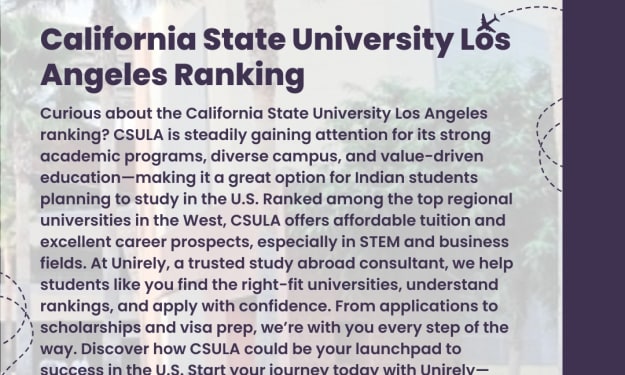
California State University Los Angeles Ranking
Why California State University, Los Angeles Might Be the Right Fit for You Choosing a university abroad is more than just checking rankings or comparing tuition fees—it's about finding a place that feels right. For many Indian students, California State University, Los Angeles (Cal State LA) is one of those places that quietly balances affordability, location, and opportunity without the overwhelming pressure of chasing top-brand names.
By Unirely Study Abroadabout a year ago in Education
The Best Education for Children
Story: The Best Education for Children “What’s the best education for children?” It’s a question that parents across cultures, countries, and generations have asked—whispered in playgrounds, typed into search engines late at night, or worried silently while watching their child struggle with homework.
By waseem khanabout a year ago in Education
The Light Beyond the Blackboard
In a small, dusty village tucked away in the heart of a remote valley, education was more of a dream than a reality. Most children worked in the fields with their parents or helped at home. The school building stood at the edge of the village like an abandoned ghost, its paint peeling, windows cracked, and doors creaking. But that all changed the day a young teacher named Ayaan arrived. Ayaan was not from the village. He had grown up in the city, surrounded by libraries, laboratories, and classrooms filled with curious minds. After completing his degree in education, he surprised everyone by rejecting a comfortable job in the city and instead volunteering to teach in a rural village where teachers rarely stayed longer than a few months. When Ayaan first entered the village school, he found only three children sitting on the floor with broken slates in their laps. The chalkboard was barely usable, and there were no books to be seen. Most of the villagers had lost faith in the education system, thinking it had nothing to offer their children. Why learn algebra, they thought, when your future lies in the same fields your father and grandfather tilled? But Ayaan believed differently. He began by meeting every family, sitting with them over tea, listening to their concerns, and sharing his vision. “Education,” he said, “is not just about books. It’s about choices. It’s about giving your child the power to decide what kind of life they want to live.” Some nodded politely; others scoffed. But a few mothers, who had once dreamed of becoming nurses or teachers themselves, began sending their children regularly. With time, the classroom filled. Ayaan didn’t wait for official books or tools—he improvised. He wrote math problems on the walls using charcoal. He turned old newspapers into reading materials. He used stones to teach counting and seeds to explain science. More than anything, he taught with heart. His enthusiasm was contagious. Children began looking forward to school. They began to ask questions. Ayaan believed in stories, too. Every week, he told his students stories from around the world—about inventors, explorers, scientists, and ordinary people who had changed their lives through learning. He ended each story with the same question: “What will your story be?” The change was slow but visible. Children who had once spoken only in whispers began to speak with confidence. Girls, who were previously kept at home, began attending regularly. Ayaan encouraged every child equally, reminding them that intelligence was not measured by where you came from but by your willingness to learn. Three years passed. The village school, once forgotten, became a hub of activity. Ayaan had trained two young villagers to assist him, and they were preparing to take exams to become certified teachers themselves. The government noticed the improvements and sent resources—books, desks, and even a computer. But more important than the physical changes was the shift in mindset. One day, a boy named Kaleem stood up during class and said, “Sir, I want to be an engineer. I want to build bridges so no one in our village has to cross the river in fear again.” Another student, Aisha, said, “I want to be a doctor and open a clinic here so my mother doesn’t have to walk hours for medicine.” Ayaan smiled. That was the real success. Years later, when Ayaan finally left the village to train other teachers, the community gave him a farewell that echoed through the valley. Parents wept, children clung to his legs, and the head of the village said, “You didn’t just teach our children—you taught us hope.” --- Moral of the Story: Education is not just the act of teaching facts—it's the spark that lights the path to a better future. One passionate teacher can change not just a classroom, but an entire community.
By Muhammad Bilalabout a year ago in Education