degree
Degrees defined: PhD, Master, Bachelor, Associate–all about that expensive piece of paper called your degree.
The Girl Who Refused to Stop Learning
M Mehran In a quiet village surrounded by rice fields, there lived a girl named Lila who carried books the way other children carried toys. Every morning, she walked three miles to school with her satchel swinging against her side. She loved the sound of chalk scratching the board, the thrill of answering questions, the smell of ink on paper. Education, to her, was not just learning — it was breathing. But one day, her world shifted. --- The Day the Doors Closed At thirteen, Lila’s parents told her she would no longer attend school. “You’re old enough to help at home,” her father said. “Books don’t feed families. Education is for boys, not girls.” Her mother looked down, silent. The next morning, Lila stayed behind as her brothers left for school. She watched the dust rise behind their footsteps and felt something heavy press against her chest. It wasn’t just the loss of school — it was the loss of possibility. --- A Secret Classroom But Lila was not ready to surrender her dreams. At night, after chores were done, she lit a small oil lamp and opened her notebooks. She whispered lessons to herself, repeating multiplication tables, sketching maps, reading every word she remembered. Soon, other girls from the village joined her. They came quietly, carrying scraps of paper and borrowed pencils. In the corner of Lila’s home, under the dim light of a lamp, a secret classroom was born. There were no desks, no blackboards, no teachers. But there was hunger — hunger for knowledge, for freedom, for futures not yet imagined. --- The Unexpected Teacher One evening, a woman named Ayesha, who had once been a teacher in the city, heard about the secret class. She arrived with a bundle of old textbooks and a smile that made the girls sit up straighter. “Education is not a privilege,” she told them. “It is your right. And no one can take it from you as long as you keep learning.” With Ayesha’s guidance, the girls studied science, history, and literature. They learned not only facts but also courage. Education became their rebellion — a quiet, powerful act of resistance. --- The Village Divides News of the secret classroom spread. Some parents were furious, saying girls had no business wasting time on books. Others, however, began to notice changes. Their daughters spoke with more confidence, helped siblings with homework, and dreamed of becoming doctors, teachers, engineers. The village was divided. But the seed had already been planted. Once a child learns to read, she cannot unlearn it. Once she tastes knowledge, she cannot go back to silence. --- Lila’s Turning Point One afternoon, her father caught her teaching younger girls how to write. He demanded, “Why do you persist when I’ve forbidden it?” With trembling hands, Lila held out her notebook. On its cover she had written a single word: Future. “Because I want one,” she said. Her father stood in silence. He saw not just defiance in his daughter’s eyes but also determination, intelligence, and hope. For the first time, he realized that her education was not stealing from the family — it was investing in it. --- The First Graduation Years later, with Ayesha’s help, the girls of the secret classroom applied for scholarships to continue their studies. Against all odds, some were accepted. On the day of her own graduation, Lila walked across a small stage wearing a cap and gown. She looked out at the crowd and saw her father in the front row, clapping with tears in his eyes. That night, he told her, “I was wrong. Your education has brought more to this family than I ever imagined.” --- Why Her Story Matters Lila’s story is not unique. Around the world, millions of girls are still denied education because of poverty, tradition, or gender. Yet time and again, when girls are given the chance to learn, entire communities change. Educated girls marry later, earn more, and ensure their children go to school. Education is not just personal progress. It is generational transformation. --- The Lesson Today, Lila is a teacher. She returns to her village each week, carrying a bag filled with books. She teaches girls under the same tree where she once dreamed of returning to school. Her message is simple: “No matter who you are, or where you begin, knowledge is your power. And once you claim it, no one can take it away.” Her story reminds us that education is not fragile. It may be delayed, hidden, or resisted — but it cannot be destroyed. Because once a child dares to dream of learning, the world will never be the same.
By Muhammad Mehranabout a year ago in Education
The Teacher Who Planted Dreams
M Mehran ery year, when the graduation ceremony began, students at Greenfield High waited for one moment: the speech from Mr. Lewis. He wasn’t the principal, or the district superintendent. He was just an English teacher with a graying beard and the habit of carrying chalk dust on his sleeves. But for thirty years, his words had lit a fire in every class he taught. --- The First Lesson Mr. Lewis began each school year the same way. He would walk into the classroom, look around at the new faces, and write on the board in large letters: “Education is not about answers. It’s about questions.” Students would glance at each other, confused. Weren’t schools supposed to be about memorizing facts, passing exams, and earning grades? But within weeks, his lessons made sense. He asked them why Shakespeare still mattered, why stories could change lives, and why people remembered words more than wars. Sometimes he paused mid-lesson and said, “Don’t just think about what’s in the book. Think about what’s in you.” It was in those moments that education stopped being a subject and started becoming an awakening. --- A Classroom of Misfits One year, Mr. Lewis’s class was filled with students who had already been labeled “troublemakers.” Some had failing grades, others had skipped too many classes, and one had nearly dropped out. Instead of punishing them, Mr. Lewis gave them journals. “Write down your thoughts,” he said. “Anger, confusion, joy—whatever it is, put it here. No one else will read it but me.” At first, the journals filled with single words or sarcastic remarks. But slowly, they grew into poems, short stories, and confessions. The boy who never spoke wrote about missing his father. The girl who rolled her eyes at every assignment penned a story about a hero who looked suspiciously like her. Education, Mr. Lewis proved, wasn’t about forcing students into molds. It was about giving them tools to discover their voices. --- Beyond the Textbook Mr. Lewis often took his class outside. Under the oak trees in the schoolyard, he’d ask, “What do you see?” Students would mutter: grass, sky, leaves. “Look deeper,” he’d urge. “Why does the tree bend that way? How does the wind shape the world around us? What does it remind you of?” The answers were never the same. That was the point. Education, he believed, was not about conformity but about perspective. --- Planting Seeds Over three decades, hundreds of students passed through his classroom. Many forgot the details of grammar lessons, but few forgot the way he made them feel. One former student became a lawyer and said she learned to argue cases by first learning how to question literature. Another became a journalist, crediting Mr. Lewis for showing him that every story had layers. A third returned years later as a teacher, carrying his philosophy into her own classroom. Everywhere, his students carried pieces of him—proof that education multiplies when it’s planted with care. --- The Last Lecture The year Mr. Lewis retired, the auditorium was overflowing. Students who had graduated years earlier drove back to hear him speak one last time. He walked to the podium slowly, his hands trembling slightly, but his voice was steady. “When I started teaching,” he said, “I thought my job was to fill your minds with knowledge. I was wrong. My job was to remind you that you already carry knowledge inside you. My job was to water the seeds of your curiosity until you believed in them yourself.” He paused, looking around at the sea of faces—some young, some now grown. “Education is not a test you pass. It is a life you choose. It is every question you dare to ask, every dream you dare to follow. Never stop learning, because the moment you stop, you stop growing.” The room was silent, many with tears in their eyes. --- A Legacy That Lasts Years later, whenever Greenfield students gathered for reunions, Mr. Lewis’s name came up. They spoke about his lessons not in terms of grammar or essays, but in terms of courage, compassion, and curiosity. Education is often measured in diplomas, grades, or careers. But in truth, its greatest measure is memory—the way a teacher, a book, or a moment stays with us long after school ends. Mr. Lewis never became famous outside Maplewood. He didn’t write a best-selling book or win awards. But he shaped lives. And in doing so, he proved that education is not about the walls of a classroom—it’s about the seeds planted in hearts. --- Why His Story Matters Today, debates about education often revolve around funding, technology, and standardized testing. Those matter. But behind every statistic is a human story: a teacher who believes, a student who dares, a moment that transforms a life. Mr. Lewis’s story reminds us that education is not a machine. It’s a relationship. It’s one mind sparking another, one question leading to countless answers. And if we are lucky, we all meet a “Mr. Lewis” at some point in our lives—a teacher who doesn’t just teach, but plants dreams.
By Muhammad Mehranabout a year ago in Education
The Day the Library Opened
M Mehran In the small town of Maplewood, the most ordinary building became the most extraordinary gift: a library. It wasn’t big. Just a renovated post office with peeling paint and mismatched chairs. But the day it opened, children pressed their noses against the glass doors, parents peeked in with quiet curiosity, and teachers whispered with relief. For years, Maplewood had survived without one. Now, they finally had a place where education lived beyond the classroom. --- The Curious Boy Among the crowd was eleven-year-old Diego. He had never owned a book. His family moved often, and school was the only place he encountered words beyond billboards and grocery lists. When the librarian, Mrs. Taylor, handed him a library card, he held it like a golden ticket. Diego wandered between shelves, fingers brushing over the spines of stories, science books, and atlases. He picked up a book about planets and whispered, “I didn’t know Saturn had rings.” In that moment, education stopped being something that happened only at school. It became an adventure he could carry home. --- The Teacher Who Knew Education thrives when curiosity meets guidance. Ms. Reynolds, Diego’s teacher, knew this well. She had been fighting to keep her students engaged in a school where budgets cut art programs, outdated textbooks fell apart at the seams, and internet access was patchy at best. When she saw the library open, she exhaled in relief. “Finally,” she said. “Finally, a place where learning can breathe.” She began assigning “library challenges.” Students had to find a book, read a chapter, and share something surprising with the class. Suddenly, math lessons were interrupted by fun facts from history, and science class buzzed with discoveries about volcanoes, space, and ecosystems. Education spilled beyond the walls of the classroom, growing roots in imagination. --- A Town Transformed At first, the library was just for students. But soon, parents came too. Some borrowed cookbooks and tried new recipes. Others picked up manuals on fixing cars, sewing clothes, or improving their English. Grandparents came for newspapers and stayed for poetry. Maplewood began to change. The town that once closed its eyes after work hours now buzzed with evening book clubs, homework help sessions, and free Wi-Fi that allowed teenagers to research careers. Education had moved from something children endured to something families embraced. --- The Struggle Behind the Shelves But the library wasn’t built without struggle. Behind the bright lights and smiling faces were years of petitions, town meetings, and fundraising bake sales. There were arguments: Why spend money on books when there were roads to fix? Why build a library when everyone could “just Google it”? The truth was that not everyone could. Many families didn’t have reliable internet or laptops at home. For them, the library wasn’t a luxury; it was a lifeline. Education, after all, isn’t just about schools. It’s about access. And without access, curiosity dies quietly. --- Diego’s Dream Weeks after the library opened, Diego checked out a thick book on astronomy. Every night, he sat by the window with a flashlight, tracing constellations on the page and then finding them in the night sky. One morning, he stood in front of his class and declared, “I want to be an astronaut.” The class laughed—not unkindly, but with the disbelief of children who thought astronauts lived in other worlds, not in Maplewood. But Ms. Reynolds didn’t laugh. She placed a hand on his shoulder and said, “Then we’ll learn everything we can about space.” In that moment, Diego realized education wasn’t just about memorizing facts. It was about building bridges between dreams and possibilities. --- The Bigger Picture Maplewood’s library story mirrors a global truth: education is never just about classrooms, grades, or tests. It’s about environments that spark learning—libraries, community centers, mentorships, online resources, even conversations at the dinner table. Too often, education is measured by numbers: literacy rates, graduation percentages, test scores. Those matter, yes. But behind every number is a Diego, an Amina, a child with a library card or a tablet under a baobab tree, waiting for their world to expand. Education is both fragile and powerful. Without support, it withers. With investment, it transforms lives and towns. --- Full Circle Months later, Diego returned a stack of books and asked Mrs. Taylor if the library had anything about rockets. She smiled and guided him to a new section funded by a local donation. That night, Diego drew a rocket ship in his notebook. At the top, he wrote, “One day, I will see the stars up close.” And somewhere between the peeling paint and mismatched chairs of Maplewood’s library, his dream felt possible. --- Why It Matters Education is not just about what we teach; it’s about the spaces we create, the curiosity we nurture, and the doors we unlock. A classroom teaches discipline and basics, but a library, a mentor, or even a single inspiring teacher can ignite a lifelong fire. The story of Maplewood is a reminder: when communities invest in education, even in the simplest forms, they change not only children’s futures but also their own. Because every library card, every lesson under a tree, every digital tablet in a village is more than a tool—it’s a promise. And promises, when kept, can send a child from a small town all the way to the stars.
By Muhammad Mehranabout a year ago in Education
Why Students Prefer Experts to Do Their Online Exams
Modern educational platforms have revolutionized learning by providing students with both flexibility and extended course options. Most students face difficulties with online courses and frequently use experts to obtain better help. Students turn to expert help because they need to handle various responsibilities and maintain good grades for multiple reasons. These students prefer experts to take responsibility for their online exams for the following reasons.
By Lucas Lednerabout a year ago in Education
Charlie Kirk and the danger of selective empathy
Conservative political activist Charlie Kirk was shot and killed on Wednesday. His suspected killer, identified by law enforcement as 22-year-old Tyler Robinson, was taken into custody after a substantial manhunt, based on information from people close to Robinson’s family. Utah Governor Spencer Cox said a family member of Robinson had reached out to a friend, who then contacted the authorities, and that friends and relatives interviewed by investigators described Robinson as “full of hate” when speaking about Kirk at a recent gathering. Robinson’s exact motivations for allegedly carrying out the shooting are still being explored.
By MUHAMMAD Abbasabout a year ago in Education
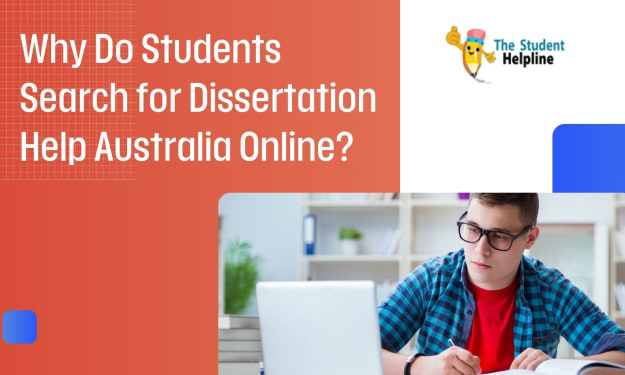
Why Do Students Search for Dissertation Help Australia Online?
Students search for Dissertation Help Australia online because writing a dissertation is one of the most challenging academic tasks, and professional services like The Student Helpline provide expert support that makes the process more manageable, reliable, and less stressful. A dissertation is not just another assignment—it is the culmination of years of study, critical research, and intellectual development. In Australia, universities set extremely high standards for originality, structure, and research depth, making dissertations a daunting task for students, especially when juggling coursework, part-time jobs, or personal commitments.
By Shani Pandeyabout a year ago in Education
Can I get plagiarism-free dissertation help in Australia?
Yes, you can get plagiarism-free dissertation help in Australia when you choose trusted providers like The Student Helpline, which is known for delivering original, well-researched, and properly referenced academic work. With universities in Australia maintaining strict academic integrity policies, originality is non-negotiable. Submitting plagiarized work can lead to severe consequences, including grade penalties, academic probation, or even expulsion.
By Shani Pandeyabout a year ago in Education
The Importance of Education in Modern Society
Education is one of the most powerful tools that shape human life and society. It is not limited to reading books or passing examinations but extends to the overall development of an individual’s character, skills, and understanding of the world. In today’s globalized world, education plays a vital role in personal growth, career advancement, and the progress of nations. This article explains the importance of education in detail, exploring its impact on individuals and society as a whole. What is Education? Education can be defined as the process of acquiring knowledge, skills, values, and attitudes through learning and experience. It begins at home, continues in schools and universities, and never truly ends, as lifelong learning is essential in the modern age. Formal education includes structured systems like primary, secondary, and higher education, while informal education occurs through daily life experiences, interactions, and personal exploration. Personal Development Through Education One of the most significant roles of education is personal development. A well-educated person gains self-confidence, critical thinking abilities, and problem-solving skills. For example, learning languages improves communication, while studying science and technology sharpens analytical thinking. Education also teaches discipline, patience, and time management, which are necessary for achieving goals. Moreover, it shapes moral values, making individuals more responsible and respectful in society. Education and Career Opportunities In the competitive job market of the 21st century, education is the foundation of career success. Employers prefer candidates who are skilled, knowledgeable, and adaptable. Higher education opens doors to professional careers in medicine, engineering, law, business, and technology. Vocational education, on the other hand, provides practical training for specific jobs, helping people gain financial independence. Thus, education is directly linked to economic stability and a better standard of living. Education as a Social Equalizer Education reduces the gap between rich and poor by giving everyone equal opportunities to succeed. In many countries, scholarships and free education programs help underprivileged children break the cycle of poverty. Through education, people learn about social justice, equality, and human rights. Educated societies are less likely to fall into discrimination, gender inequality, or racial prejudice, as knowledge promotes tolerance and understanding. National Development and Education No nation can progress without education. It provides skilled professionals, innovative thinkers, and responsible citizens. Countries with high literacy rates often enjoy better economic growth, political stability, and advanced technology. For instance, developed nations like Japan and Germany have invested heavily in education, which has contributed to their global leadership in science, industry, and innovation. Education also builds national unity by teaching cultural heritage, history, and civic responsibility. The Role of Technology in Education In the modern world, technology has revolutionized the education sector. Online learning platforms, digital libraries, and virtual classrooms make education accessible to millions worldwide. Students can now attend lectures from top universities without leaving their homes. Artificial Intelligence, smart classrooms, and e-learning tools have made education more interactive and effective. Technology also encourages self-learning, creativity, and innovation, preparing students for the digital future. Challenges in Education Despite its importance, education faces several challenges across the globe. Poverty, lack of resources, outdated teaching methods, and gender inequality prevent millions of children from accessing quality education. In some regions, political instability and conflicts destroy schools and disrupt learning. Moreover, the rising cost of higher education makes it difficult for many students to pursue their dreams. Addressing these challenges requires global cooperation, government support, and community participation. Conclusion In conclusion, education is the backbone of human development and societal progress. It empowers individuals, opens career opportunities, reduces inequality, and strengthens nations. With the rapid growth of technology and globalization, the value of education has become even greater. Therefore, governments, institutions, and individuals must work together to make education accessible, affordable, and effective for everyone. An educated society is not only a successful society but also a peaceful, progressive, and prosperous one.
By Article Master about a year ago in Education