degree
Degrees defined: PhD, Master, Bachelor, Associate–all about that expensive piece of paper called your degree.
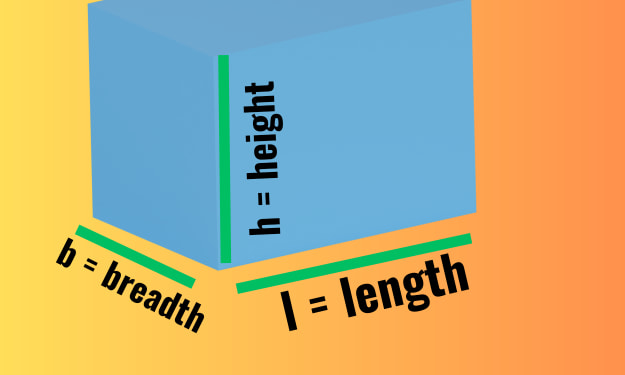
Surface Area Of Cuboid
Introduction: The world of geometry is filled with fascinating shapes and structures, each with its unique properties and characteristics. Among these, the cuboid reflects out as a fundamental and versatile three-dimensional figure. In this article, I will explain into the intricacies of Surface Area Of Cuboid, exploring its definition, formula, and practical applications.
By champak jyoti3 years ago in Education
Find the Volume of a Cylinder
Introduction Realising the volume of geometric shapes is a fundamental concept in mathematics and their practical applications in various fields. One such shape is the cylinder, a three-dimensional figure which has two parallel circular bases connected by a curved surface. How to calculate the volume of a cylinder is a crucial skill, especially in fields like engineering, physics, and architecture. In this article, I will try to delve into the intricacies to Find the Volume of a Cylinder, exploring its mathematical derivation, practical applications, and providing step-by-step examples for a better understanding.
By champak jyoti3 years ago in Education
PHP Online Compiler for Learning Web Development
With the help of our comprehensive reference to PHP online compilers, explore the world of web programming. Gain knowledge quickly, solve problems with ease, and maintain your edge in the dynamic world of web development.
By micahgreen3 years ago in Education
White Blood Cells | Types and functions:
White Blood Cells are otherwise called as Leukocytes. The name leukocyte derived from Greek word leuk means ‘white’, cyte means ‘cell’. WBC main role is to protect the body against microbes. WBC surround microbes, engulf and destroy the foreign particles by phagocytosis mechanism.
By Sathishkumar3 years ago in Education
Anatomy and Physiology of the Human Body
In this lesson on anatomy and physiology, we will discuss the relationship between these two subjects. While they can be studied separately, I believe they are best understood when studied together. Anatomy focuses on the form, structure, and location of bodily parts. For example, let's consider the pericardium, which is the sac that surrounds the heart. The term "pericardium" is derived from "cardia" or "cartium," which means heart, and "per" which usually means around or surrounding. The pericardium is made of connective tissue and is slightly larger than the heart itself. It is located right here, providing some anatomical facts about the pericardial sac. On the other hand, physiology is more concerned with the function of bodily parts and the processes involved. It explores how different organs are connected and what each organ is doing in relation to others. Taking the pericardium as an example again, it serves as a protective and lubricating layer for the heart. The fluid inside the sac acts as lubrication for the beating heart, similar to how oil is necessary for the proper functioning of moving engine parts. The pericardial sac plays a vital role in maintaining the health and function of the heart.
By Millicent mary3 years ago in Education