degree
Degrees defined: PhD, Master, Bachelor, Associate–all about that expensive piece of paper called your degree.
How US Plans To Beat China
Gigantic amphibious tanks with dual purpose launch onto an antagonist shore riven with rocky segments, retaliation fire pours from defensive emplacements laid out on the rough sand. The shells fired by cannons and the bullets from the machine guns try to get an aim at the rubber container of the LCACs. If it succeeds, it causes casualties that should be real among the American troops. A buzzing sound is all over with strength grows louder until a Chinese one tender an explosion. Fully aware of their situation, defenders try to aim at the future of the drones, but particles are too small and movement nimble to be defeated by explosive weapons. Tactically heated and destructive multi-level strikes hail down, cutting their lines in pieces. Even dug-in positions and bunkers cannot stand as drones, despite being small, can easily get through those firing slits of guns and shoot oblique hitting mass parts.
By Amine Oubih3 years ago in Education
Balanced diet
A balanced diet is crucial for maintaining good health and overall well-being. It provides the body with the necessary nutrients in the right proportions to function optimally. A balanced diet typically consists of a variety of foods from different food groups, including fruits, vegetables, grains, protein sources, and dairy or dairy alternatives. In this comprehensive guide, we'll explore the components of a balanced diet, their importance, and how to achieve dietary balance for a healthy lifestyle.
By Mithun Gain3 years ago in Education
Why So Many Countries Are Abandoning the Dollar
Recent headlines paint a worrying picture for the future of the dollar: "The day of the dollar is over," "The post-dollar world is about to emerge," and "The age when the dollar was dominating will also be the end of the U. S. hegemonic rule. "" As the phrase “dedollarisation” seems to trigger a panic among you, changing your dollars into something else, take a moment and explore the situation and reasons behind it, which have gained extreme popularity. ”
By Amine Oubih3 years ago in Education
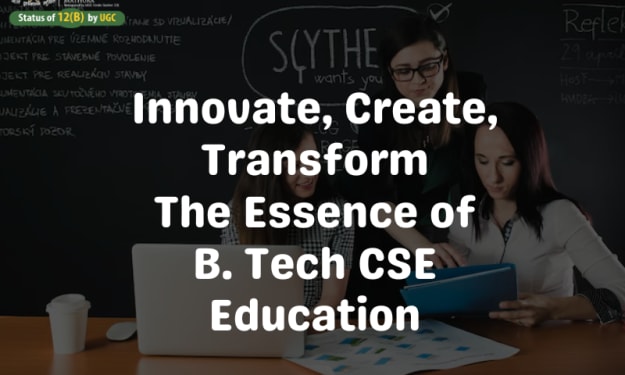
Innovate, Create, Transform - The Essence of B. Tech CSE Education
Innovation, creation, and transformation are the pillars that uphold the essence of Bachelor of Technology (B.Tech) in Computer Science and Engineering (CSE). In today's dynamic digital space, where technology evolves at a rapid pace, B. Tech CSE programs play a pivotal role in shaping future tech leaders and innovators. Let's delve into how these programs encapsulate the spirit of innovation, creation, and transformation.
By GLA University3 years ago in Education
Animal DNA
Animal DNA is the blueprint of life for countless species inhabiting our planet. It's a complex and fascinating topic that delves into the intricacies of genetic code, heredity, evolution, and much more. In this exploration, we'll uncover the basics of animal DNA, its structure, function, and significance in the animal kingdom.
By Mithun Gain3 years ago in Education
Beauty Beyond Apearance.
Some time ago, in a curious little town settled between moving slopes and rich vegetation, there carried on with a young man named Jasper. Jasper was not normal for some other youngster in the town. While different youngsters played cheerfully in the roads, Jasper favored the isolation of his little loft room concealed in his family's cabin.
By borsha afrin303 years ago in Education
Good and Bad Decomposition in DBMS
What's Decomposition in DBMS? Decomposition in database management systems (DBMS) is dividing a large table into smaller tables to increase data storage. The process of decomposition helps in keeping the storage efficient.
By Pushpendra Sharma3 years ago in Education
Investigating ChatGPT And The Force of GPT-4o
The Development of Computer-based Intelligence: Investigating ChatGPT and the Force of GPT-4 In the steadily developing scene of man-made consciousness, one name has reliably stood apart for its weighty headways: OpenAI's ChatGPT. The most recent cycle, fueled by the GPT-4 engineering, addresses a huge jump forward in the capacities of conversational simulated intelligence. In any case, what precisely makes GPT-4 so extraordinary, and how can it vary from its ancestors? How about we plunge into the interesting universe of ChatGPT and investigate the wonders of GPT-4?
By Rony Sutradar3 years ago in Education
Top five Islamic Researchers ever: Work and Effect
1. Ibn Sina (Avicenna) (980-1037) Ibn Sina, otherwise called Avicenna, was a Persian researcher who lived during the Islamic Brilliant Age from 980 to 1037. He was an exceptionally powerful figure in Islamic grants. Ibn Sina made critical commitments to different fields like medication, theory, stargazing, math, and writing. His renowned work, "The Standard of Medication," turned into a crucial clinical course book in Europe and the Islamic world for a long time. The book covers points like life systems, pharmacology, and sicknesses, influencing clinical practices all through the archaic period. Also, Ibn Sina's book: The Book of Recuperating investigated mysticism, morals, and brain research. His thoughts made a significant imprint on both Islamic and Western philosophical customs. His impact arrived past his time, adding to the advancement of the logical technique in the later archaic period. His works were converted into Latin, becoming fundamental texts for researchers in European colleges until the seventeenth hundred years. All things considered, His works filled in as a scaffold between traditional Greek information and the Renaissance in Europe. It encouraged a rich scholarly legacy that rose above geological and social limits. 2. Al-Farabi (872-950) Al-Farabi lived from 872 to 950 and was an Islamic logician and researcher during the Islamic Brilliant Age. Al-Farabi made significant commitments to theory, political theory, music, and brain science. He expected to mix the Greek way of thinking, especially Aristotle's lessons, with Islamic ideas. One of his key works, "The Book of Letters," turned into an essential message in concentrating on rationale and language. In the political way of thinking, Al-Farabi investigated the ideal city-state and the job of the rationalist lord in "The Political System,". He impacted later Islamic political scholars like Avicenna and Averroes. He likewise essentially affected the music hypothesis, examining the philosophical underpinnings of music and its impacts on the spirit. With everything taken into account, Al-Farabi's heritage lives on through the transmission of his works, adding to the safeguarding and spread of the Greek way of thinking in the Islamic world. 3. Ibn Rushd (Averroes) (1126-1198) Ibn Rushd, otherwise called Averroes, was a conspicuous Islamic logician. He was brought into the world in 1126 in Cordoba, Al-Andalus (advanced Spain), during the Islamic Brilliant Age. He zeroed in on the way of thinking, attempting to combine Aristotle's thoughts with Islamic ideas. Averroes composed broad discourses on Aristotle's "Nicomachean Morals" and "Power," making these mind-boggling ideas more reasonable to a more extensive crowd. These works became powerful in middle age European way of thinking. Notwithstanding confronting introductory contention over his accentuation on reason and sanity, Averroes' effect stretched out past the Islamic world. His compositions assumed a significant part in once again introducing the Aristotelian way of thinking to middle-age Europe. He molded Western scholasticism and added to the Renaissance. The past way of thinking, Averroes lastingly affected Islamic regulation and medication. His lawful works, including "The Recognized Law Specialist's Groundwork," exhibited how he might interpret legitimate standards. Furthermore, his clinical abridgment, "Kitab al-Kulyat fi al-Tibb" (General Standards of Medication), featured his commitment to medication. 4. Ibn Khaldun (1332-1406) Ibn Khaldun was brought into the world in 1332 and was a prominent Islamic researcher and antiquarian who lived during an urgent time in Islamic history. Initially from Tunis, he made critical commitments to the fields of history and social science. His most well-known work is the "Muqaddimah" or "Presentation," where he laid the preparation for the way of thinking of history. In this weighty piece, he investigated how social orders rise and fall in a repeating design. His thoughts regarding social elements and the existence patterns of civilizations were progressive for his time. Ibn Khaldun's effect arrived past his period, impacting Western masterminds like Auguste Comte and Arnold Toynbee in their way of thinking and humanism. Besides his verifiable work, Ibn Khaldun stood firm on significant footings in administration, showing a profound comprehension of the associations between authentic occasions and cultural designs. His heritage lives on through his significant effect on verifiable techniques and sociologies, making him a vital figure in the scholarly history of Islam and the world. 5. Al-Ghazali (1058-1111) Al-Ghazali was brought into the world in 1058. He was a huge Islamic researcher known for his impact on Islamic ideas during the Brilliant Age. He started from Persia and turned into a vital figure in the Islamic way of thinking. His striking work, "The Disjointedness of the Scholars," investigated the thoughts of Greek-impacted savants. He argued that a portion of their perspectives went against Islamic lessons. This work significantly influenced the Islamic way of thinking, starting conversations on the interchange between reason and disclosure. Al-Ghazali's philosophical investigations provoked an individual profound change, recorded in his self-portrayal, "Liberation from Mistake." Known as the "Verification of Islam," Al-Ghazali's impact reached out to philosophy, magic, and law. His reconciliation of Sufi's supernatural quality with universal Islam added to a more adjusted strict methodology. With everything taken into account, his accentuation on the internal elements of confidence and the agreeable connection between reason and disclosure made him a venerated figure in Islamic scholarly history.
By Zohirul Islam Ovi3 years ago in Education
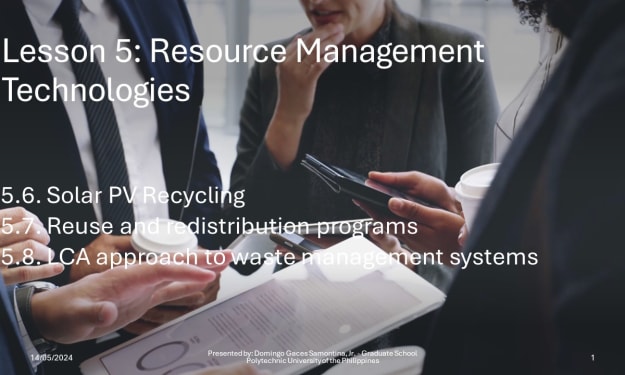
Resource Management Technologies - Solar PV Recycling, Reuse and Redistribution Programs, and LCA Approach to Waste Management Systems
5.6 Solar PV Recycling The global installation of an estimated 500,000 solar panels per day in 2015 reflects the rapid growth of solar power. In terms of residential usage, a typical American home may require 28 to 34 solar panels to meet its power needs. Looking ahead, the U.S. Department of Energy projects a cumulative installation of 700 GW of solar power by 2050, equivalent to hundreds of billions of PV modules (Mulvaney, 2015).
By Domingo Añasco-Gaces Samontina, Jr.3 years ago in Education
Robot and girl's Adventures.
In the clamoring city of Neo-City, where high rises penetrated the mists and neon lights moved across the night sky, there existed a little robot named Flash. Flash wasn't similar to some other robot in Neo-City; he wasn't worked for everyday assignments or modern work. All things considered, he had an inquisitive brain and a heart loaded up with dreams.
By borsha afrin303 years ago in Education
Google Discloses Gemini, A Straightforward Reply To GPT - 4 With Conversational Video Capacities
Google Discloses Gemini, a Straightforward Reply to GPT-4, with Conversational Video Capacities In the quickly developing scene of computerized reasoning, Google has recently taken critical action. The tech goliath has disclosed "Gemini," a noteworthy man-made intelligence model intended to challenge the predominance of OpenAI's GPT-4. What separates Gemini is its consistent joining of conversational capacities with video content, denoting another period in human-simulated intelligence cooperation.
By Rony Sutradar3 years ago in Education