degree
Degrees defined: PhD, Master, Bachelor, Associate–all about that expensive piece of paper called your degree.
The Great Gatsby
The Great Gatsby is a famous American novel written by F. Scott Fitzgerald and published in 1925. Though it wasn’t very popular when it first came out, today it’s considered one of the greatest novels ever written. The story is about love, dreams, money, and the search for happiness. It takes place in the 1920s, a time in America known as the Roaring Twenties, when people were celebrating, partying, and trying to live the “American Dream.”
By Muhammad Hayat2 years ago in Education
In the early universe, monstrous black holes may have formed with the assistance of ultralight dark matter.
Scientists have long been baffled by the origins of the most monstrous black holes in the universe. In the heart of galaxies less than a billion years after the Big Bang, supermassive black holes (SMBHs) that are billions of times larger than the Sun have been discovered. The inquiry is: how did these cosmic giants expand in such a short amount of time? One possible solution is being revealed by a brand-new theoretical model, and it involves ultralight dark matter (ULDM), one of the universe's most elusive elements. The Problem of Black Hole Growth Smaller "seed" black holes, which form when massive stars collapse, are thought to grow into supermassive black holes. However, even under the most favorable circumstances, it seems implausible that standard accretion—the gradual feeding of gas and matter—can form black holes of billions of solar masses in less than a billion years. Because of this inconsistency, physicists and cosmologists have looked into bizarre possibilities, such as the influence of alternative forms of dark matter, a mysterious substance that only weakly interacts with light and normal matter but makes up about 85% of all matter in the universe. What exactly is ultralow dark matter? Particles of ultralight dark matter have masses on the order of 10⁻²²electronvolts, or roughly 10⁻⁵⁰times that of an electron. In some models, this wave-like structure of matter is referred to as a Bose-Einstein condensate because these particles exhibit quantum behavior on galactic scales due to their small mass. In contrast to the clumpy, halo-like distributions associated with conventional cold dark matter (CDM), these quantum fluctuations produce interference patterns and structures. One intriguing result is that ULDM could naturally result in dense regions that could much more effectively seed black hole formation than CDM. Accelerating the Growth of Black Holes These dense regions created by ULDM, according to recent simulations and theoretical work, can accelerate the formation and growth of black holes in two main ways: Solitonic cores, stable, dense regions in the center of dark matter halos, can be formed as a result of the wavelike nature of ULDM. These regions can quickly collapse or funnel gas toward a central seed, giving black holes a head start in their growth.
By Md. Shafiqul Islam2 years ago in Education
Future-Proof Careers.
This is one of the biggest career decisions students will make. With technology (and the environment) and global markets changing rapidly, the future job market will be very different from today. To play it out safe, students must focus their choices on industries that are predicted to expand and adapt over the next 10 years. Here are some of the industries that are most likely to have the best future jobs.
By Pranta Bhowmik2 years ago in Education
The True Purpose of Education: Shaping Minds, Not Just Careers
In the modern world, education is often reduced to a means to an end — a stepping stone to a job, a career, or financial stability. From early schooling to higher education, the focus is frequently placed on grades, degrees, and competitive exams. But this narrow perspective misses the essence of what education truly stands for. At its heart, education is a process of enlightenment — a journey that transforms not only the intellect but also the character. It is not just about acquiring knowledge; it's about learning how to think, how to ask questions, how to empathize, and how to act with integrity. Education as a Lifelong Process Education does not begin or end in the classroom. While formal institutions like schools and universities play a crucial role, true education is a lifelong process. It continues through our experiences, interactions, reflections, and the choices we make every day. From learning how to resolve conflicts to understanding the needs of our communities, education shapes the way we live and interact with the world. It builds the foundation for responsible citizenship, ethical decision-making, and personal growth. Moving Beyond Rote Learning One of the most common criticisms of traditional education systems, especially in South Asia and many other parts of the world, is the emphasis on rote learning. Students are often trained to memorize facts and repeat them in exams, with little focus on understanding concepts or applying them in real-life situations. This method may help in achieving short-term academic results, but it fails to develop critical thinking, creativity, and problem-solving — skills that are essential in the modern world. An educated individual should not only know the "what" but also understand the "why" and "how." Education and Character Building True education is as much about character building as it is about academic achievement. Values such as honesty, discipline, compassion, and responsibility must be an integral part of the educational experience. Nelson Mandela once said, "Education is the most powerful weapon which you can use to change the world." But to change the world positively, we must first change ourselves. This internal transformation is only possible when education nurtures both the mind and the soul. Teachers, parents, and community leaders all play vital roles in this process. A kind word from a teacher, an encouraging conversation at home, or exposure to community service can leave lasting impressions on a young mind. These are the lessons that often shape a person's values far more than textbooks ever will. Education as a Tool for Social Change An educated society is more likely to be peaceful, just, and progressive. Education reduces inequality, promotes gender equity, and empowers marginalized communities. It equips individuals with the tools to challenge injustice and build more inclusive systems. In regions like ours, where poverty, illiteracy, and lack of awareness remain significant challenges, quality education has the potential to break the cycle. When a girl is educated, her whole family benefits. When youth are educated with purpose and direction, crime rates drop, economies strengthen, and societies become more resilient. However, this requires more than just increasing access to schools. We need to ensure quality education that is relevant, inclusive, and forward-thinking. The Future of Education With technology rapidly reshaping our world, the future of education must adapt to prepare students not just for jobs that exist today, but also for those that will exist tomorrow. This includes digital literacy, emotional intelligence, global awareness, and adaptability. Online learning, blended classrooms, and personalized education pathways are becoming more common. But regardless of the mode, the core purpose remains the same: to develop informed, thoughtful, and responsible human beings. Moreover, we must also invest in the emotional and mental well-being of students. Education must teach not just how to succeed, but also how to fail, how to cope, and how to keep going. In a world full of pressures and distractions, students need to learn resilience and inner strength as much as they need technical skills. Conclusion Education is not just a tool for earning a living; it is the foundation for living a meaningful life. It shapes the way we think, feel, and interact with the world. A truly educated person is not only knowledgeable but also kind, curious, humble, and driven by purpose. As individuals, educators, and policymakers, we must strive to restore the true purpose of education — to build minds that seek truth, hearts that embrace empathy, and hands that work for the betterment of society. Only then will education fulfill its promise — not just to create professionals, but to nurture responsible, conscious, and capable human beings.
By Clarity Press2 years ago in Education
Study MBA in Singapore: Perks, Fees, Scholarships & More
The popularity that the city-state of Singapore enjoys for higher education and employment is unparalleled. The world-class national and international Universities, affordable cost of education, and practical skill-oriented teaching methods attract thousands of international students each year. Many international students prefer Master’s degrees in Singapore, given that the country offers several intensive 1-year Master’s courses. Pursuing an MBA in Singapore is particularly popular, being sought after for the globally recognized qualifications and strong industry involvement during the courses.
By Study Aboard Education2 years ago in Education
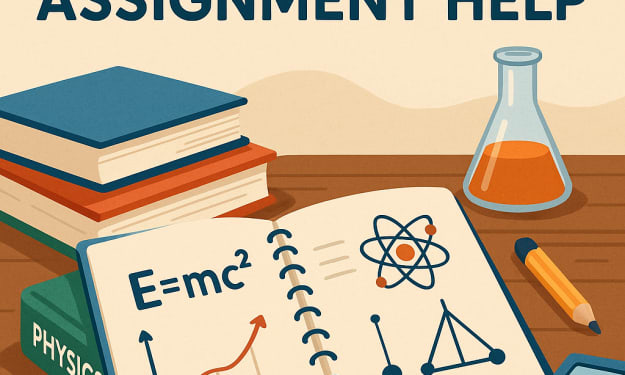
The Hidden Patterns in Physics Assignments: What Every Student Should Know
Physics is often described as the study of the universe’s most fundamental principles — from the motion of planets to the behavior of subatomic particles. But for many students, tackling physics assignments can feel more like navigating a maze than unlocking the mysteries of nature. If you've ever found yourself overwhelmed by complex equations, obscure terminology, or mind-bending concepts, you're not alone. Beneath the surface of every physics assignment lies a set of hidden patterns that, once recognized, can make your academic journey smoother and more productive.
By Robert Smith2 years ago in Education
Unlocking the MBA Code: Admission, Eligibility, Fees & Placement
In the fast-evolving corporate jungle, an MBA isn’t just a degree—it’s your passport to leadership, innovation, and long-term career success. Whether you want to spearhead your own startup, step into the shoes of a corporate strategist, or simply climb the ladder in your current organization, an MBA can be the game-changer.
By GLA University2 years ago in Education
Top Pharmacy Courses in Bangalore: B Pharma and Pharm D Explained
As the healthcare industry continues to expand, so does the need for qualified professionals who can bridge the gap between medicine, science, and patient care. Pharmacy has emerged as a strong career path for students who want to be involved in healthcare but prefer a science and technology-driven approach over direct clinical roles like doctors or nurses.
By Raksha Singh2 years ago in Education