courses
Tackle that seemingly endless selection of course offerings; a roundup of helpful resources and sound advice for selecting the best courses and acing them.
5 Surprising Ways Learning a New Language Rewires Your Brain. AI-Generated.
Most people pick up a new language for practical reasons — travel, career advancement, connecting with family. But what if I told you the biggest payoff isn't the language itself, but what happens inside your head while you're learning it? Neuroscience research over the past decade has revealed that learning a second (or third, or fourth) language physically changes the structure of your brain. We're not talking about vague "brain training" claims — we're talking about measurable, lasting changes that affect everything from how you make decisions to how you age. Here are five of the most surprising ways language learning reshapes your mind. 1. Your Brain Literally Gets Bigger A landmark study from Lund University in Sweden found that military interpreters who underwent intense language training showed measurable growth in their hippocampus and cerebral cortex — the areas responsible for memory and higher thinking. The control group, who studied equally hard but in non-language subjects, showed no such growth. Think about that: learning a language doesn't just fill your brain with new information. It physically builds more brain. Researcher Ellen Bialystok at York University has spent decades documenting these structural changes. Her work, published through the National Institutes of Health, shows that bilingual brains develop denser grey matter in regions associated with executive function — the mental skills that help you plan, focus, and juggle multiple tasks. 2. You Become a Better Decision-Maker Here's a counterintuitive finding: people actually make more rational decisions when thinking in their second language. A study from the University of Chicago found that using a foreign language reduces cognitive biases — those mental shortcuts that lead to poor choices. Why? Researchers believe it's because thinking in a non-native language creates slight emotional distance. You process information more deliberately rather than relying on gut reactions. It's like having a built-in pause button for impulsive thinking. This has real-world implications. If you're weighing a major financial decision or navigating a complex negotiation, doing it in your second language might actually lead to a better outcome. 3. Your Brain Becomes an Expert Multitasker Bilingual people constantly manage two (or more) language systems running simultaneously in their heads. Even when speaking one language, the other is still active in the background, and your brain has to continuously filter and select the right one. This constant mental juggling strengthens what neuroscientists call "executive control" — your brain's ability to manage attention, switch between tasks, and filter out irrelevant information. Research highlighted by NPR's education coverage shows that this advantage extends well beyond language, making bilinguals better at everything from driving in complex traffic to managing competing priorities at work. The best part? You don't need to be perfectly fluent to start seeing these benefits. Even intermediate learners show improved cognitive flexibility compared to monolinguals. 4. You Can Delay Dementia by 4-5 Years This might be the most compelling finding of all. Multiple studies, including a major one published in the journal Neurology, found that bilingual individuals developed dementia symptoms an average of 4.5 years later than monolinguals — even after controlling for education, income, and other health factors. Four and a half years. No pharmaceutical drug on the market comes close to that kind of delay. The theory is that bilingualism builds "cognitive reserve" — essentially a buffer of mental capacity that helps the brain compensate for age-related decline. It's like having a savings account for your brain health that you contribute to every time you practice your second language. 5. It Rewires How You Perceive the World This one goes beyond pure neuroscience into something almost philosophical. Research in linguistic relativity — the idea that language shapes thought — shows that multilingual people literally perceive reality differently depending on which language they're using. German-English bilinguals, for example, tend to focus more on the goals of actions when thinking in German but focus more on the actions themselves when thinking in English. Speakers of languages with different color terms can actually distinguish colors that others cannot. Learning a new language doesn't just give you new words for the same thoughts. It gives you genuinely new ways of thinking. So Where Do You Start? The science is clear: learning a language is one of the best investments you can make in your cognitive health. But knowing that and actually doing it are two different things. The good news is that getting started has never been easier. Between apps, online tutors, and structured courses, there are options for every budget and learning style. If you're looking for affordable ways to begin, platforms like Class Coupon (ClassCoupon.com) curate discounts on language courses from providers like Preply, LTL Language School, and Cambly — which can make one-on-one tutoring and structured programs much more accessible. Sites like these are worth checking before you commit to full-price courses. The key is consistency. Even 15-20 minutes a day can trigger the neurological changes described above. Whether you're learning Spanish through a tutor, picking up Japanese through immersion content, or working through a Mandarin textbook, your brain is physically changing with every session. The best time to start was ten years ago. The second best time is today. --- Sources: Research cited from Lund University, University of Chicago, York University (Ellen Bialystok), and studies published in Neurology and through the National Institutes of Health.
By Class Coupon7 months ago in Education
The Valet
“I didn’t go to the lectures. My valet, who was more distinguished than I, went instead”. After the Butler and the Housekeeper, the Valet and the Lady’s Maid were the two most senior “domestic servants” during the Victorian and Edwardian Eras. They had the ‘ear’ of their Master and Mistress which gave them some influence with the Lord and Lady of the House. This was either a good thing or a bad thing with the other staff within the household. The valet answered only to his master but still worked closely with the butler.
By Ruth Elizabeth Stiff7 months ago in Education
Digital Education Content Market to hit USD 249.17 Billion By 2034. AI-Generated.
The global digital education content market is projected to reach approximately USD 249.17 billion by 2034, rising from USD 24.51 billion in 2024, reflecting a strong compound annual growth rate of 26.1% during the forecast period from 2025 to 2034. This growth is being driven by the rapid shift toward digital learning platforms, increasing internet penetration, and the growing demand for flexible and personalized education solutions. In 2024, North America held a dominant position with more than 35% share, generating around USD 8.5 billion in revenue, supported by advanced digital infrastructure and widespread adoption of e-learning technologies.
By Roberto Crum7 months ago in Education
NCLEX Exam Questions Explained: What to Expect in 2026. AI-Generated.
Preparing for the NCLEX can feel confusing at first, especially when you’re not sure what the questions will actually look like. A lot of nursing students spend months studying content, memorizing facts, and still walk into the exam feeling unprepared. Not because they didn’t study enough, but because the exam doesn’t really test you the way you expect.
By Sulcus Learning7 months ago in Education
Wearable Tech in Education Market to hit USD 34 Billion By 2034. AI-Generated.
The global wearable technology in education market is projected to reach approximately USD 34 billion by 2034, increasing from USD 5.62 billion in 2024, reflecting a compound annual growth rate of 19.80% during the forecast period from 2025 to 2034. This growth is being supported by the increasing integration of digital tools in education systems and the rising demand for immersive and interactive learning experiences. In 2024, North America is expected to dominate the market with a share of 43.7%, generating around USD 2.4 billion in revenue. The United States is projected to reach approximately USD 1.96 billion, supported by a strong growth rate of 18.7%, driven by advanced educational infrastructure and high adoption of digital technologies.
By Roberto Crum7 months ago in Education
How to Choose the Right Legal Transcription Course in the U.S.
Legal transcription is quickly becoming one of the most flexible and in-demand remote careers in today’s digital economy. From court hearings and depositions to legal dictations, transcriptionists play a vital role in maintaining accurate legal records. As more professionals look for work-from-home opportunities, this field continues to grow.
By Mahesh Kumar7 months ago in Education
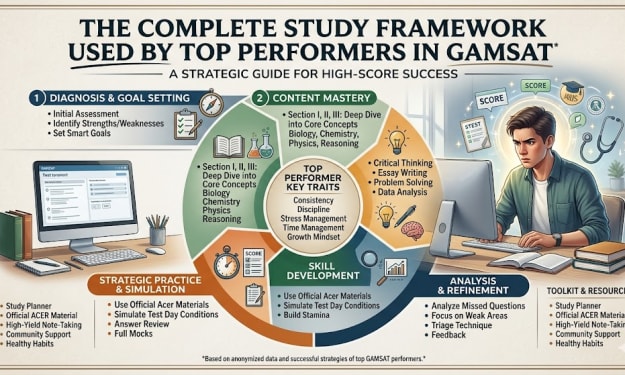
The Complete Study Framework Used by Top Performers in GAMSAT
Most students preparing for GAMSAT are busy all the time. Notes, videos, and question banks are just some of the things that they use to prepare for the GAMSAT. Still, even after all that practice, the score stays the same. It makes them wonder what top performers do differently that they are missing.
By Abbasi Publisher7 months ago in Education
Why Outsourcing Graphic Design Boosts Business Growth. AI-Generated.
There comes a point in every growing business when things start piling up. Marketing needs visuals, social media demands consistency, and branding suddenly becomes more important than ever. That’s when many teams realize design is no longer a side task—it becomes a core part of how the business communicates.
By Lisa Hurley7 months ago in Education
Why Stellar Lifetimes Vary: How Star Mass Determines the Life and Death of Stars
Why Stellar Lifetimes Vary: The Secret Lives of Stars On a clear night, the stars look eternal. They shine with steady light, unchanged for thousands of years of human history. Ancient civilizations saw the same constellations we see today and believed the stars were permanent fixtures of the universe.
By shahkar jalal7 months ago in Education
Why Stars Vibrate: The Science of Stellar Pulsations and Star Quakes
Why Stars Vibrate Listening to the Music of the Stars Imagine looking up at the night sky and realizing that the stars are not silent. Not only are they burning, spinning, and moving through space, but they are also vibrating—expanding and shrinking rhythmically like cosmic musical instruments.
By shahkar jalal7 months ago in Education
How Star Motion Is Measured: The Science Behind Moving Stars in Space
How Star Motion Is Measured The Stars Look Still — But They’re Not On any clear night, the stars look completely still. The constellations appear exactly the same as they did thousands of years ago. Orion still stands in the winter sky, and the Big Dipper still points toward the North Star. To the human eye, the stars appear fixed in place, like lights attached to a giant celestial sphere.
By shahkar jalal7 months ago in Education
Why Binary Stars Are Common: The Hidden Truth About Star Systems in the Universe
Why Binary Stars Are Common The Star That Wasn’t Alone For most of human history, people believed that stars were solitary objects like our Sun—alone in space with planets orbiting around them. When early astronomers began observing the sky with telescopes, they noticed something strange. Some stars appeared to have tiny companions next to them. At first, scientists thought these were just chance alignments, stars that looked close together but were actually far apart.
By shahkar jalal7 months ago in Education