courses
Tackle that seemingly endless selection of course offerings; a roundup of helpful resources and sound advice for selecting the best courses and acing them.
What is Business Accounting and Taxation Course: Syllabus, Fee, Eligibility, Salary 2022
The Business Accounting and Taxation course aims to provide students with the knowledge of the vital concepts of accounting, taxes, wage policies, and also about the important disciplines in economics. Taking a BAT course can prepare students with the essential knowledge and skills to lead an organization that encompasses various sales, accounts and tax departments. To understand what this BAT course is all about, it is crucial to explore the business accounting and taxation concepts which form an important part of this course. So, let's get started and check out some of the important features of the Business Accounting and Taxation course.
By tanya sharma4 years ago in Education
Top Facts About TESOL Course Sydney
The main objective of Cert IV TESOL is to produce knowledgeable and skilled teachers of the English language. TESOL course Sydney is meant for teachers of English as a Foreign Language (EFL) or English as a Second Language (ESL), English tutors, and teaching assistants.
By Amara Gomez4 years ago in Education
Review: Is MasterClass Worth a Subscription?
In a world of free trials and monthly subscriptions, signing up for MasterClass’ $180 annual pass feels like quite a big commitment. I signed up in January and have watched 20 of the courses so far. Though it’s not quite what I expected from the myriad of advertisements it sent my way, it’s certainly still a valuable service.
By Olivia L. Dobbs4 years ago in Education
History of Python Programming - Intellipaat
The late 1980s saw the creation of the Python language. At the Netherlands' Centrum Wiskunde & Informatica - CWI (National Research Institute for Mathematics and Computer Science), Guido van Rossum began implementing Python in December 1989. The language, which was initially developed as a hobby, was finally published in 1991.
By Nathan Martin4 years ago in Education
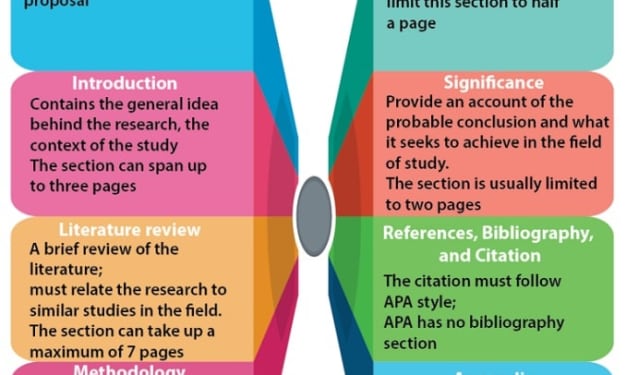
A Research Proposal In APA Style Writing Help
American Psychological Association published their writing style and format for academic writings in their first edition of Publication manual for American Psychological Association in 1944. The manual has since spanned six editions, with the sixth and latest version published in 2009. The APA style refers to the guidelines set by APA in their manual to guide a standard for journals and scientific papers. The style guide was created to enhance precise understanding of academic and scientific articles published in their journals by avoiding bias in language with an emphasis on the usage of unambiguous language.
By Tutors India4 years ago in Education
5 College Classes I Wish I Took. Top Story - July 2022.
In May 2022, I graduated from the University of Illinois at Urbana-Champaign with a degree in journalism with minors in political science and journalism. It’s one of my life's greatest accomplishments to date, and it led me to thinking about my degree.
By Noah Nelson4 years ago in Education
The Art of Product Marketing: How to Bring Your Product to Market Successfully
The Art of Product Marketing: How to Bring Your Product to Market Successfully Perhaps you have thought about creating your online physical project or product. And I created this project, and it's ready for marketing on websites, for example, But you don't know the right ways and steps to market products. The products have not received much popularity, and therefore you are watching your project on the way to failure.
By Lpc London4 years ago in Education
Capital Investment Risks Analysis
If you were given a choice between two projects with the same return, you almost certainly would choose the project with less risk. The higher-risk project could be justified only by a higher return. This is why you must make some provision for assessing the risk in a proposed capital project. Without knowing the risk, you are not in a position to judge whether the project is suitable. At the outset, you should recognize that risk analysis is a difficult job. No method of risk analysis is entirely satisfactory, and each requires a good deal of expertise and judgment on the part of management. Moreover, many risks are difficult to reduce to numbers. For this reason, you should regard the risk analysis methods discussed below as tools. They are not substitutes for sound business judgment. They do, however, force you to view the various projects in the same light, which highlights risk and permits you to compare all of them. In this type of analysis, you attempt to isolate those factors that would have the most impact on cash flow if they were altered. You can identify any number of key variables, such as a sales downturn, the time it takes to put the project into place, increased costs, an economic slowdown and marketing difficulties. After each key variable has been identified, it is changed slightly and NPV is recalculated on the basis of the different cash-flow assumptions. Then the effect of the change is noted and ranked. Illustration: The ABC Company is considering the introduction of a new product that has a net present value of $40,000 over five years. It determines that the most critical variables in its NPV calculations are anticipated sales, pre-production costs and distribution costs. The company then assumes a 10 percent change in each of these variables and recalculates NPV in all three cases. Assuming the following NPV figures, its weighted-risk analysis might look something like this: Change in Variable Change in NPV Sales –10% –30% Distribution costs +10% –25% Pre-production costs +10% –15% In this case, a sales slowdown produces the greatest risk and trims the company’s NPV by 30 percent, or $12,000 on a 10 percent sales dip. Also, it had better keep a watchful eye on distribution costs if the company does go ahead with the project. A 10 percent rise there will cut the NPV by $10,000. Pre-production costs are important but exert less impact than the first two variables. ➤ Observation: Weighted-risk analysis can be very informative, particularly if you are astute enough to isolate the key variables. However, this method also has some limitations. First, there is no provision for measuring the probability of changes in the key factors. Also, changes in a combination of less influential factors could result in a substantial change in cash flows. Adjusting for Probabilities Turn back once again to the ABC Company’s illustration (pages 62–64). We have already demon¬strated that the project would be profitable at both 9 percent and 10 percent discount rates, but would produce only a marginal profit at 11 percent. Your company’s finance department has likely developed estimates of the probability for each cost of capital, based on the outlook for your industry and economic projections. Obtain these estimates from the department. A company estimates the probability of each discount rate for each year that the project will be in force. Then, NPV for each year is adjusted for the probability. Example: Refer to the table below. In Year 1, ABC estimates only a 10 percent chance of a 9 percent discount rate. Therefore, the 9 percent NPV of $13,755 becomes $1,375 ($13,755 x .10). Similarly, the 80 percent probability of a 10 percent discount rate translates into $13,635 x .80, or $10,908. Add to that the $1,351 from the 11 percent column ($13,515 x .10), and the adjusted NPV for Year 1 becomes $13,634. After adjusting for all five years, NPV is a positive $1,759 for the project—an indication that the ABC Company should proceed. Year Discount Rate of 9% Discount Rate of 10% Discount Rate of 11% Adjusted Present Value 1 10% 80% 10% $13,634 2 20 70 10 12,417 3 30 60 10 11,329 4 20 60 20 11,955 5 20 60 20 12,424 Total Cash Flow $61,759 Capital Cost 60,000 Adjusted NPV $ 1,759 The attempt to measure the probability of different scenarios adds a new dimension to risk analysis and can be quite helpful. But remember that it is difficult to assign probability levels four or five years into the future. Alternate Scenarios Measure Risk With this method, you develop three separate NPV or IRR studies for each project. You assume that (1) everything will go exactly as planned, (2) nothing will go right, and (3) things will go more or less as expected, with some bugs. Then you compare the varying degree of risk in each project. For instance, you find two projects with the same midpoint NPV, but one with much more risk if nothing goes right. In that case, you would probably choose the project with the lower risk. It is relatively easy to compare different projects with this method. However, it is also unre¬alistic in that there are few projects launched where everything goes right, and just as few where everything goes wrong. Moreover, there is no adjustment for the various probabilities.
By Daniel Joseph 4 years ago in Education
DEEP FAKE
What is a deep fake? Deepfake is a type of artificial intelligence used to create convincing images, audio and video hoaxes. Deepfake uses deep learning which is also a type of artificial intelligence. It uses deep learning to manipulate the image in such a way that the person won’t be able to differentiate that image from the real one. Along with images, audios can be deep faked too. The audio will be identical to the original one.
By Shrushti Nikam4 years ago in Education
Secrets of Hair Growth!
Hair is comprised of a protein called keratin. The hair that we see as well as care a lot concerning is really only dead cells. The component that is living is listed below the scalp as well as is called the follicle. Near the hair follicle are the sebaceous glands that make the hair look lively and shiny. These sweat glands make the hair look oily or dry depending on the sebum manufacturing.
By Susanna Flavius4 years ago in Education