college
Maximize your university experience with these tips for all things collegiate–how to achieve a perfect GPA, select the right major, finance your college education and more.
THE PHIILOSOPHY OF MEDITATION - ALEXIS KARPOUZOS
The Paradox of Non-Striving in the Philosophy of Meditation: Agency, Awareness, and the Limits of Intentionality Meditation, a practice rooted in contemplative traditions, presents a paradoxical challenge for philosophical inquiry. In meditation, practitioners often aim for a state of effortless awareness—a state free from striving and intentional effort. Yet, meditation as a practice seems to require intentional effort to reach such a state. This paradox raises crucial philosophical questions about the nature of agency, intentionality, and selfhood. This paper explores the paradox of non-striving by examining the philosophical implications of meditation across different traditions, including Buddhist, Daoist, and phenomenological perspectives. The paper argues that the paradox invites a rethinking of agency as a dynamic, non-dualistic skill and suggests that non-striving is not the negation of effort but the cultivation of an effortless, fluid relationship to the present moment. The study of meditation, therefore, offers new insights into the nature of conscious experience, intentionality, and the self, challenging traditional distinctions between effort and non-effort. Meditation has become an object of both popular interest and philosophical inquiry, particularly in recent years. Beyond its applications in therapeutic and mindfulness practices, meditation has a long tradition as a path to self-awareness and liberation. A central theme across many contemplative traditions is the cultivation of effortless awareness, a state in which the practitioner is present in the moment without striving or attachment to goals. This ideal of non-striving is, however, paradoxical: in order to achieve such a state, one must often engage in deliberate effort. This tension forms the central paradox of meditation: how can one strive to reach a state of non-striving? This paradox is not just a theoretical curiosity; it points to fundamental questions about the nature of agency, intentionality, and the self. In particular, it challenges the dominant Western conception of agency as intentional, goal-directed, and willful. By examining the paradox from a variety of philosophical perspectives, this paper aims to illuminate the deeper philosophical issues at play and to reconsider how meditation might offer a new understanding of agency, intentionality, and the nature of consciousness itself.
By alexis karpouzos11 months ago in Education
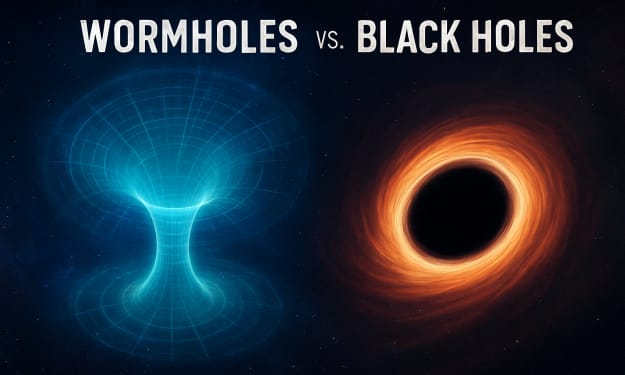
Wormholes vs. Black Holes: Understanding the Key Differences
What Is a Black Hole? Definition A black hole is an extremely dense region in space where gravity is so strong that nothing—not even light—can escape. This boundary around it is called the event horizon, and anything that crosses it is permanently trapped.
By shahkar jalal11 months ago in Education
Understanding Black Holes: Definition, Formation, and Their Role in the Universe
What Is a Black Hole? A black hole is a region of space with gravity so intense that nothing—not even light—can escape its pull. Because they emit no light, black holes are invisible. Astronomers detect them by observing the effects they have on nearby stars, gas, and light.
By shahkar jalal11 months ago in Education
Understanding Galaxy Clusters: The Cosmic Neighborhoods of the Universe
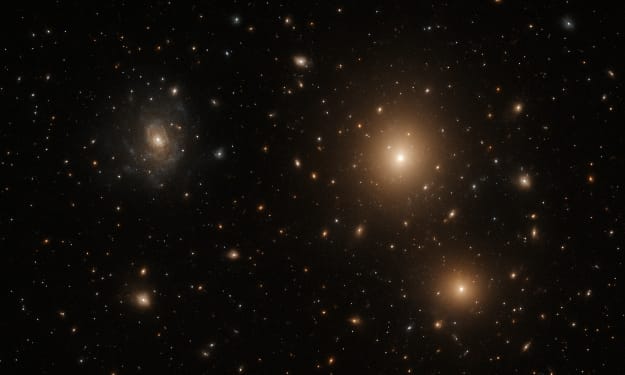
What Are Galaxy Clusters? A galaxy cluster is a gravitationally bound collection of galaxies. These clusters can contain anywhere from a handful of galaxies to thousands packed into the same region of space. Because the galaxies are located so close together, clusters act as cosmic communities where interactions and transformations occur.
By shahkar jalal11 months ago in Education
The Real Reason So Many People Are Choosing to Learn Portuguese Today. AI-Generated.
Introduction In recent years, more and more people around the world have decided to learn Portuguese, turning it into one of the fastest-growing languages among international students. Although Portuguese has always been culturally rich and widely spoken, its global influence is now stronger than ever. Today, learners are discovering not only its beauty but also the countless opportunities it brings for travel, career, and meaningful human connection.
By Portuguese Native11 months ago in Education
The Formation of Planets: How Worlds Are Born in the Cosmos (universe)
How a Solar System Begins 1. The Birthplace: A Nebula Every solar system begins inside a nebula—a huge cloud of dust and gas left over from older stars. These clouds contain hydrogen, helium, and trace elements that will eventually become planets, moons, and even new stars.
By shahkar jalal11 months ago in Education
AI in Education: The Tools That Actually Matter in 2025
Remember when the news about ChatGPT just blew up? Teachers were freaking out and saying it was the end of education and that tech people were shouting that it would fix schools problems with a wave of the wand. That was exhausting.
By Aurang Zeb11 months ago in Education
Burj Khalifa: Where Human Ambition Touches the Sky – A Journey Beyond Limits
Introduction In the heart of Dubai, piercing the skies at a breathtaking height of 828 meters, stands more than just a building—it stands a statement. A statement of what humanity is capable of when dreams meet dedication and vision aligns with innovation. The Burj Khalifa is not merely the world’s tallest building; it is a global symbol of persistence, architectural mastery, and the timeless human pursuit to break boundaries.
By Ashen Asmadala11 months ago in Education
🇦🇪 The Sands That Dreamed: A Human Story of UAE National Day
Introduction: A Morning in the Emirates When the sun rises across the Arabian skies on 2nd December, its golden rays sweep across cities still half-asleep and deserts stretching endlessly into history. The air feels different—proud, silent, yet full of meaning. Flags flutter from balconies, children rehearse their school performances, and expatriates smile softly, remembering the day they first stepped into this land of opportunity.
By Ashen Asmadala11 months ago in Education
How Stars Form: A Stunning Journey From Cosmic Clouds to Brilliant Light
The Birthplace of Stars: Molecular Clouds Every star begins its life inside a massive region of gas and dust known as a molecular cloud or stellar nursery. These clouds are mostly made of hydrogen, along with helium and traces of heavier elements. Despite their size, they are extremely cold—often around −250°C (−420°F).
By shahkar jalal11 months ago in Education