college
Maximize your university experience with these tips for all things collegiate–how to achieve a perfect GPA, select the right major, finance your college education and more.
"The Evolution of E-Learning: Online Education in the Digital Age"
The Evolution of E-Learning: Online Education in the Digital Age In recent years, e-learning has emerged as a transformative force in the field of education. As technology continues to advance, the way we learn and teach has undergone a massive shift. The evolution of e-learning, from its humble beginnings to its current role as a cornerstone of modern education, has brought with it numerous innovations that have reshaped the educational landscape. Today, online education offers a dynamic, accessible, and globally connected learning environment that empowers both students and educators. This article will explore the journey of e-learning, analyze the technologies that have driven its evolution, and examine its advantages, challenges, and the future of digital education.
By Shamshair Khan Hasan Zaiabout a year ago in Education
"The Future of Technology: Robotics and Automation"
"Revolutionizing the world as we know it, robotics and automation are no longer the future—they are the present, rapidly transforming industries, economies, and the very nature of human labor."
By Shamshair Khan Hasan Zaiabout a year ago in Education
The Lives Behind the Fortunes: Stories of America’s Most Famous Millionaires
1. Andrew Carnegie: The Steel King with a Generous Heart (Died August 11, 1919) Andrew Carnegie was born in 1835 in Scotland and came to America as a poor immigrant. Carnegie's family moved to Pennsylvania, where he started working as a bobbin boy in a cotton factory when he was 13 years old. He made just $1.20 a week.
By Shahidul islamabout a year ago in Education
"Mastering Active and Passive Voice"
In English grammar, one of the most important distinctions in sentence structure is between active voice and passive voice. Understanding the difference not only enhances your writing style but also helps you express thoughts more clearly and effectively. Whether you’re writing an academic paper, business email, or creative story, knowing when and how to use each voice can make a big difference.
By Mukhtiar Ahmadabout a year ago in Education
Steel on Tracks: The Everlasting Journey of Trains
When the world was slower, quieter, and smaller, a deep whistle broke the silence — and everything changed. That whistle belonged to a train, and it signaled the beginning of a journey not just for passengers, but for humanity itself. Trains, often called the steel giants of the land, are more than just a mode of transport. They are history in motion — a symbol of progress, industry, and the undying human desire to connect. The Dawn of a Revolution The story of trains begins in the early 19th century, during the Industrial Revolution. In 1804, Richard Trevithick built the first full-scale working railway steam locomotive. However, it was George Stephenson's "Rocket" in 1829 that truly launched the age of steam locomotion. Early trains were powered by steam engines, belching smoke and sparks as they rolled across new tracks laid across Europe, the United States, and eventually the world. These iron machines opened new frontiers, carrying coal, goods, letters, and lives to places never reached before. A Moving Machine of Wonders The design of a train is deceptively simple — wheels on tracks — but the engineering behind it is brilliant. Trains move with minimal friction, which allows them to carry tons of weight over long distances. A single train can replace hundreds of trucks, making it one of the most efficient and eco-friendly transport options even today. There are various types of trains: Steam Trains: The pioneers, driven by coal-fired boilers and pistons. Diesel Trains: Introduced in the 20th century, using internal combustion engines. Electric Trains: Cleaner, quieter, and faster — now dominate most modern rail networks. Bullet Trains (High-Speed Rail): Japan’s Shinkansen and France’s TGV reach speeds over 300 km/h, shrinking continents with speed and comfort. The Romance of the Rails Beyond speed and mechanics, trains have always carried a romantic charm. Unlike planes or cars, a train ride offers time — to look outside, to think, to feel. The gentle rocking, the rhythmic click-clack, the scenery sliding by like a moving painting — it’s travel with soul. Writers, poets, and filmmakers have long been fascinated by trains. From Agatha Christie’s “Murder on the Orient Express” to the Hogwarts Express in Harry Potter, trains often become characters themselves — mysterious, magical, and memorable. Changing Landscapes and Lives Trains did not just move people — they shaped nations. In America, the transcontinental railroad united east and west. In India, railways became the backbone of administration and economy during British rule and continue to serve millions daily. In Europe, rail travel connects countries faster than air in many cases. Trains brought villages into cities, and cities into economies. They became lifelines for workers, merchants, students, and dreamers. Technology Meets Tradition Today’s trains are marvels of modern design. Maglev Trains: These use magnetic levitation to float above the tracks and glide silently at 600+ km/h. Smart Trains: Equipped with AI, sensors, and predictive maintenance systems. Green Trains: Hydrogen-powered and solar-assisted models are being tested to make future rail travel carbon-free. Yet, while technology advances, the essence remains — a train is still a long, steel creature that comes alive with a horn and carries lives within its belly. The Human Side of the Tracks At every station, there are stories. A child waves at a passing engine. A mother cries as her son departs. Lovers meet at platforms. Travelers sleep, read, and dream as landscapes roll by. For some, a train is just transport. For others, it’s freedom, escape, or even home. Railway stations themselves are cultural icons — from the grand chandeliers of New York’s Grand Central to the buzzing life of Lahore Junction or the speed and silence of Tokyo’s Shinkansen terminals. Challenges and the Road Ahead Trains face challenges too: aging infrastructure, urban congestion, and rising costs. Yet governments across the world are investing in railways as part of climate goals and sustainable future plans. Smart cities of the future will have high-speed metros, automated trains, and integrated ticketing. Railways are not just surviving — they’re evolving. --- Conclusion The story of the train is the story of human progress — of rails laid across deserts and mountains, of stations that never sleep, of people moving together toward a shared tomorrow. Whether it’s the thunder of a steam engine, the hum of an electric motor, or the whisper of a maglev, trains remind us that life is a journey — and every journey deserves a track.
By Noman Afridiabout a year ago in Education
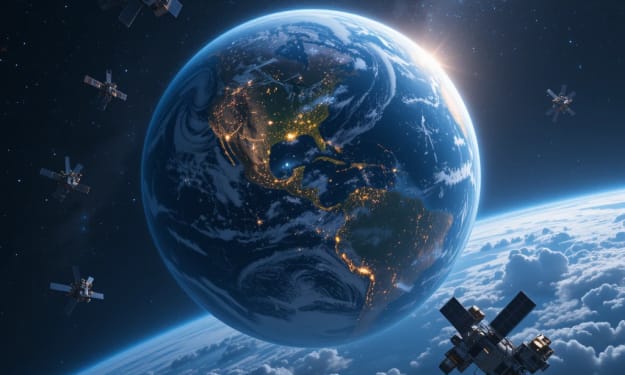
Satellites: The Silent Watchers of the Sky
Far above the blue skies, beyond the reach of birds and airplanes, silent machines float endlessly in orbit. These are satellites — one of humanity’s most powerful tools, quietly transforming life on Earth without making a sound. We rely on them more than we realize. When you check the weather, use GPS, watch international news, or make a video call — a satellite is working for you. These man-made marvels orbit the Earth 24/7, capturing data, relaying signals, and helping us understand, communicate, and survive in a fast-moving world. But what exactly is a satellite? How do they work? And why are they so vital to our lives? What Is a Satellite? In simple terms, a satellite is any object that orbits another. The Moon is Earth’s natural satellite. But in modern language, "satellite" usually refers to artificial satellites — machines launched into space by humans to serve specific purposes. The first artificial satellite was Sputnik 1, launched by the Soviet Union in 1957. It was a small, beeping metal sphere that marked the beginning of the space age. Today, there are more than 7,000 active satellites orbiting our planet, each with a unique mission — from communication and navigation to climate monitoring and military surveillance. How Satellites Work Satellites orbit Earth due to the perfect balance between gravity and speed. Once launched into space, a satellite moves fast enough to avoid falling back to Earth, but not fast enough to escape its gravity. This creates a continuous falling motion around the planet — what we call orbit. There are different types of orbits: Low Earth Orbit (LEO) for closer, faster satellites like those used for imaging; Medium Earth Orbit (MEO) for GPS satellites; and Geostationary Orbit (GEO) for communication satellites that appear stationary from the ground. Each satellite is equipped with solar panels for power, antennae for communication, and sensors or cameras to perform its tasks. Uses of Satellites: Changing Earth from Space 1. Communication: Satellites are the backbone of modern communication. Whether it's mobile networks, internet connectivity in remote areas, live television broadcasts, or long-distance phone calls — satellites transmit signals across the globe. 2. Navigation: Every time you use Google Maps or a car’s GPS, you’re connecting to a network of satellites in MEO. These satellites send timing signals, which help calculate your exact location on Earth. 3. Weather and Climate Monitoring: Satellites equipped with special sensors monitor clouds, storms, ocean temperatures, and more. They help predict weather patterns, warn about natural disasters like hurricanes and floods, and track long-term climate change. 4. Earth Observation: High-resolution cameras on satellites take images of Earth’s surface. These are used in agriculture, forestry, mining, urban planning, and environmental protection. They help us monitor deforestation, pollution, water levels, and even wildlife migration. 5. Defense and Security: Satellites play a crucial role in military operations. They are used for spying, surveillance, missile tracking, and secure communication. In modern warfare, space is the high ground. The Silent Heroes: Unseen but Essential Despite their importance, satellites are rarely noticed. They work quietly, without needing human presence, tirelessly orbiting day and night. Their benefits are vast, but their visibility is limited — and that’s part of their magic. From the farmer using satellite data to predict rainfall, to the airline pilot guided by satellite navigation — these floating machines are silently making our lives easier and safer. Challenges and Concerns With thousands of satellites in orbit, space is becoming crowded. Old, unused satellites and broken parts — known as space debris — pose a threat to active satellites and future missions. Moreover, increasing military satellites raise concerns about the weaponization of space. Global cooperation is needed to ensure that space remains peaceful and sustainable. The Future: Smarter, Smaller, Swarming The satellite industry is evolving fast. New trends include: Miniaturized satellites (CubeSats) that are cheaper and quicker to launch. Satellite constellations, like SpaceX’s Starlink, which aim to provide global internet coverage. AI-powered satellites that can analyze data in real time without sending it back to Earth. In the future, satellites will become even more embedded in our lives — helping us manage cities, protect nature, respond to disasters faster, and explore distant planets. --- Conclusion Satellites are not just machines in the sky. They are extensions of human curiosity, intelligence, and ambition. Orbiting quietly above us, they observe, connect, and protect. They are the silent guardians of Earth — watching over us, guiding us, and preparing us for the future. Every time we look up at the stars, remember: among them, man-made stars are working for you — lighting the path forward.
By Noman Afridiabout a year ago in Education
Could Subatomic Wormholes Be Responsible for Universal Expansion?
The accelerating expansion of the universe is one of the biggest mysteries in modern cosmology. Scientists attribute this expansion to dark energy, a mysterious force making up about 68% of the universe’s energy density. However, the true nature of dark energy remains unknown. One speculative but fascinating hypothesis suggests that subatomic wormholes—tiny tunnels in spacetime—could be driving cosmic expansion.
By Niranjon Chandra Royabout a year ago in Education
Top Reasons Students Search "Do My Assignment for Me Australia"
The academic journey in Australia is both rewarding and demanding, with universities like the University of Sydney, Monash, and UTS setting high standards. Students often face intense pressure to excel in their coursework while balancing part-time jobs, extracurriculars, and personal lives. It’s no surprise that many turn to Google, typing do my assignment for me Australia in search of relief. This phrase, along with “coursework help Australia” and “coursework writing service,” reflects a growing need for professional support. But why are these searches so common? Let’s explore the top reasons students seek coursework help Australia and how a reliable coursework writing service can transform their academic experience.
By Andersan Smithabout a year ago in Education
Oprah Winfrey: From Poverty to Power
Start writing...The Beginning Wasn’t Easy Oprah Winfrey was born in 1954 in a small town in Mississippi, USA. Her early life was full of struggle and pain. She lived with her grandmother in a tiny house that didn’t even have running water. They were so poor that little Oprah had to wear potato sacks as clothes because they couldn’t afford to buy real ones. Life was very hard for Oprah. By the age of nine, she had already faced abuse and many personal challenges. Most people would feel hopeless in such a situation, but not Oprah. Even as a young girl, she had a dream. She believed that her life could be better one day. Deep inside, she told herself, “This is not the end of my story.” A Love for Learning Despite her hard childhood, Oprah found comfort in books. She loved reading and learning. Her grandmother taught her to read at a very young age, and that became a turning point in her life. She was smart and spoke well, and this helped her do well in school. Later, Oprah won a scholarship to Tennessee State University, where she studied communication. She had a strong voice and a special way of speaking that made people want to listen to her. While still in college, she got a job at a local radio station. That was the beginning of her media journey. Climbing the Ladder After working in radio, Oprah got a job as a television news anchor. But things didn’t go smoothly at first. In fact, she was fired from one of her TV jobs because the producers thought she was "too emotional." They didn’t like that she showed feelings while reporting stories. But Oprah didn’t let that stop her. She believed in herself and didn’t give up. Instead of trying to hide her emotions, she used them to connect with people. She got a new job hosting a daytime talk show in Chicago — and that changed everything. The Oprah Winfrey Show In 1986, Oprah launched The Oprah Winfrey Show. It wasn’t just another TV program — it was something special. Oprah talked to everyday people, as well as famous guests. She covered serious topics like health, family problems, and life struggles, but also had fun, joyful episodes. People loved her honesty and kindness. The show ran for 25 years and was watched by millions around the world. Oprah didn’t just entertain people — she inspired them. She made her viewers feel heard, seen, and understood. More Than a Talk Show Host As Oprah’s fame and success grew, she began building her own business empire. She started her own company, Harpo Productions (which is “Oprah” spelled backward), and later created her own television network called OWN (Oprah Winfrey Network). She didn’t stop there. Oprah became a powerful voice in books, movies, and education. She supported many causes, including girls' education and health care. She built a school for girls in South Africa and has given millions of dollars to help people in need. A True Billionaire with a Big Heart Today, Oprah Winfrey is one of the richest and most respected women in the world. She is a billionaire, but more importantly, she is a role model. Her life story is not just about money and fame. It’s about never giving up, no matter how hard life gets. Oprah’s journey from a poor child in Mississippi to a global media queen shows what’s possible when you believe in yourself. She didn’t let her past define her future. She worked hard, stayed kind, and used her voice to help others. The Lesson We Can Learn Oprah’s story teaches us that where you start doesn’t matter as much as where you’re going. Even if you face pain, poverty, or failure, you can still succeed if you stay strong, believe in yourself, and keep going. She once said, “Turn your wounds into wisdom.” That’s exactly what she did — and that’s what we can all try to do, no matter our background. --- Final Thought: Oprah Winfrey’s life is proof that dreams can come true. She is living evidence that anyone — even a little girl in a potato sack — can grow up to change the world. All it takes is belief, hard work, and the courage to keep moving forward.
By Qaseem Ahmadzaiabout a year ago in Education
MBBS Admission in India 2025: Complete Guide for NEET Aspirants
Becoming a doctor is one of the most respected and rewarding career choices in India. Every year, over 20 lakh students appear for NEET (National Eligibility cum Entrance Test) to compete for MBBS seats in government and private medical colleges across the country. With such high competition, it's crucial for aspirants to understand the complete admission process, eligibility criteria, fee structures, and top medical colleges.
By Meta Education Indiaabout a year ago in Education