bullying
React
In the ever-evolving landscape of web development, React has emerged as a powerhouse library, transforming how developers build user interfaces. Created by Facebook in 2013, React has become a cornerstone technology for front-end development. Its rise to popularity is not coincidental — it offers a unique approach to building interactive, efficient, and scalable web applications. This blog post explores React’s core concepts, advantages, architecture, and its enduring relevance in the modern tech ecosystem.
By Mayank Parmarabout a year ago in Education
Galactic Nomad: Astronomers Discover Rogue Supermassive Black Hole Feasting on Stars
In a faraway galaxy, a rogue supermassive black hole of unusual size is devouring stars. Astronomers have made a startling discovery—a rogue supermassive black hole, unlike any other observed before, is rampaging through a distant galaxy, tearing apart and consuming stars in its path. This cosmic behemoth, which defies typical black hole behavior, challenges our understanding of how these mysterious objects form, evolve, and interact with their galactic environments.
By Niranjon Chandra Royabout a year ago in Education
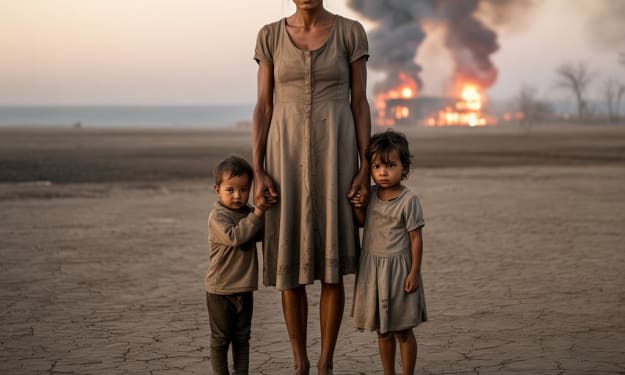
Beyond the Fire: A Mother's Silent Vow
The Night Everything Changed In the heart of Aleppo, Syria—once a city of laughter, prayer, and ancient stone—the air now echoed with sirens, shattered glass, and the constant hum of warplanes overhead. For Hanan, a 33-year-old widow, these sounds had long become background noise. But that night, something was different. She was setting plates of lentils and bread on the floor of their one-room flat when the windows exploded inward. Her daughter Salma, just 9, dropped her spoon and screamed. The building shook as if the earth itself had flinched. “Come here!” Hanan yelled, pulling her daughter to the wall furthest from the blast. The bombing wasn’t close—but in Aleppo, close was a relative term. Fire lit up the sky like an orange storm cloud. The smell of gunpowder and burning metal crept in through the cracks in the walls. Salma buried her face into her mother's dress. Hanan whispered, “We’ll be okay. I promise.” She had whispered it a hundred times before. But this time, her voice trembled. --- Living Among Ruins Their building had three floors once. Now only two stood. They shared it with four other families, most of whom had children. They slept side by side like sardines, taking turns watching the streets below. At night, they covered the windows with thick blankets to hide the flicker of candlelight. Hanan worked as a janitor in what was left of the local hospital. It was more of a morgue now, where the wounded often came only to die. She scrubbed blood off floors, carried stretchers, and once helped deliver a baby during a blackout, using a flashlight held between her teeth. But her real work began and ended with Salma. Ever since her husband had been killed—shot at a checkpoint while trying to buy bread—Hanan lived for only one thing: to keep her daughter alive. It wasn’t just love. It was survival with a heartbeat. --- The Smuggler's Deal Word spread quietly, like embers carried on wind: a smuggler named Omar was helping families cross into Turkey. The trip was dangerous, expensive, and often ended in prison—or death. But those who made it found shelter, work, a sliver of peace. Hanan hesitated for days. How could she trust a stranger with her child’s life? How could she stay, knowing tomorrow might be their last? When she sold her wedding ring, her father’s antique radio, and even her daughter’s only doll to pay the fare, Salma asked, “Where are we going?” Hanan smiled, brushing the child’s hair away from her face. “Somewhere the sky doesn't fall.” That night, they met Omar in an alley. He looked at Salma, then at her. “She’s small. It’ll be hard.” “She’s strong,” Hanan replied. “And I’ll carry her if I have to.” He said nothing, just nodded toward the waiting truck. --- Through the Shadows They rode in silence—17 people stuffed in the back of a delivery van like crates. There were babies, old men, teenagers, women in torn hijabs. The air stank of sweat and fear. The journey north took six days. By the second day, the food was gone. By the fourth, water was rationed to drops. At night, they walked on foot through barren fields, avoiding roads, avoiding lights. Twice, militants stopped them. Omar paid them off with wads of cash. Each time, Hanan’s grip tightened on Salma’s wrist. By the fifth day, Salma’s feet bled through her shoes. Hanan carried her on her back for hours, whispering, “Just a little more, sweetheart. We’re almost safe.” They reached a forest near the Turkish border. Trees whispered secrets above them. Hanan allowed herself, for the first time, to believe they would make it. And that’s when gunfire cracked the air. --- The Cave A second smuggler in the group had betrayed them. Government forces opened fire as people scattered in every direction. In the chaos, Hanan grabbed Salma and ran. She didn’t look back. They found a cave deep in the hills. For three days, they hid there, surviving on rainwater and a few pieces of dry bread she had hidden in her waistband. Salma grew weaker. Her lips cracked. Her breathing became shallow. Hanan held her close every night, praying over her silently, begging God to take her life instead. On the third day, Salma whispered, “Mama… are we going to die?” Hanan wiped a tear from her cheek and said, “No, my love. We are going to live. I promised you that.” And with her daughter on her back once more, Hanan set out through the woods. --- The Fence of Freedom The border fence was less than she imagined—a twisted mess of wire and metal, rusted in places. But beyond it, she saw movement. Turkish guards. She waved her scarf, screamed in Arabic, stumbled forward with her daughter clutched in her arms like a newborn. They fired warning shots—but she didn’t stop. She screamed, “Help us! She’s dying!” A moment later, a soldier pulled her through. Another scooped up Salma. --- A New Beginning At the Turkish border clinic, Salma was treated for dehydration, exhaustion, and severe malnutrition. Doctors said she was lucky—hours later, and she might not have made it. Hanan sat beside her hospital bed for days, refusing to sleep, refusing to eat, watching her daughter’s chest rise and fall. When Salma finally opened her eyes, she reached for her mother’s hand. “I told you we’d make it,” Hanan whispered, tears sliding down her face. “Didn’t I?” --- The Future They Built They were resettled in Istanbul. Hanan worked as a cleaner in a school, learning Turkish at night. Salma healed, thrived, studied hard. She learned the language in six months. By 16, she was tutoring other refugees. By 22, she was a nurse. Whenever someone asked her why she chose medicine, she smiled and said, “Because I was saved once by someone who never gave up on me.” They never returned to Syria. Their country remained in ruins. But their hearts were no longer afraid. --- A Legacy of Quiet Bravery Years later, at a refugee conference, Salma gave a speech. Her words were simple: “My mother didn’t rescue me with armies or wealth. She saved me with her hands, her feet, and her promises. She is the quiet strength this world forgets to see.” In a world that tried to break her, Hanan remained unbroken. And in doing so, she carried not just her child—but hope itself.
By Doctor marwan Dorani about a year ago in Education
Can Non-Muslims Teach Islam? A Critical Look at Al-Azhar’s Controversial Appointment
A Critical View on Non-Muslim Professors Teaching Islamic Curriculum: A Case of Christine Hanna In the Islamic world, knowledge of religion holds a sacred status, particularly the sciences of the Qur’an, Hadith, Fiqh, and Arabic. These subjects are not merely academic but deeply spiritual and sacred. The notion that someone who does not believe in the foundations of Islam is teaching Islamic subjects at a prestigious religious institution like Al-Azhar University raises numerous legitimate concerns. Christine Hanna, a Coptic Christian woman, has been teaching Islamic sciences at Al-Azhar’s Faculty of Islamic Studies in Port Said, Egypt, for over 23 years. This development is often portrayed in the media as a symbol of tolerance and inclusivity. However, from a critical Islamic perspective, this situation raises serious theological, ethical, and educational concerns that cannot be overlooked. The Seriousness of Islamic Knowledge Islamic knowledge is not merely academic or theoretical; it is a sacred trust (amanah) passed down from generation to generation through authentic chains (isnads) and pious scholars. The Prophet Muhammad (peace be upon him) emphasized that scholars are the inheritors of the prophets. So how can someone who does not believe in the finality of Prophethood or in the Qur’an as divine revelation be entrusted with its explanation and instruction? Islamic knowledge demands not only intellectual effort but also faith (iman), reverence (ta’dheem), and spiritual connection. Teaching Qur’an, Hadith, and Islamic jurisprudence (fiqh) requires belief in its divine origin. When a person who does not share this belief teaches it, it reduces these sacred sciences to mere academic subjects, devoid of their spiritual sanctity. The Precedent and Its Dangers Allowing a non-Muslim to teach Islamic subjects sets a dangerous precedent. It opens the door for relativism and liberal reinterpretations of religion. What is the guarantee that such a teacher will deliver the content with the reverence and accuracy it requires? What is the guarantee that their ideological orientation will not influence the understanding of impressionable Muslim students? Even if the individual adheres to the curriculum, their mere position as a teacher of Islam without faith can blur the lines between belief and unbelief (iman and kufr) in the minds of students. It sends the message that Islamic sciences are open to interpretation and instruction by anyone, regardless of belief, which contradicts the traditional framework of Islamic pedagogy. Theological Inconsistency From a theological perspective, Islamic sciences can only be fully understood and conveyed by someone who has embraced the core tenets of Islam. The Qur’an itself warns against taking knowledge from people who do not follow the truth. For example, in Surah Al-Ma’idah, verse 44, Allah says: "And whoever does not judge by what Allah has revealed – then it is those who are the disbelievers." If disbelief disqualifies one from implementing the Shari‘ah, how can it qualify one to teach it? Misunderstanding of Tolerance Promoting such appointments in the name of tolerance is misleading. Islam commands justice and respectful treatment of non-Muslims, but this does not equate to placing them in authoritative religious positions. Just as Muslims would not be allowed to teach theology in a Catholic seminary or preach from a church pulpit, non-Muslims should not be teaching in a mosque-based or Islamic seminary system. True tolerance lies in peaceful coexistence and mutual respect, not in the dilution of religious boundaries. When non-Muslims are assigned roles within Islamic scholarship, it creates confusion, weakens the sanctity of knowledge, and dilutes the message of Islam. Diminishing the Role of Believing Scholars The appointment of Christine Hanna also brings into question the neglect of qualified Muslim scholars. In a world where thousands of believing Muslim women scholars are actively pursuing Islamic studies, why is preference being given to a non-Muslim? What message does it send to those who have dedicated their lives to Islamic education out of love and belief? The Symbolism of Al-Azhar Al-Azhar is not just any university; it is historically one of the highest seats of Islamic learning. To allow non-Muslims to teach Islam within its walls undermines its identity and mission. The pride of Al-Azhar lies not in superficial inclusivity but in preserving the purity and sanctity of Islamic knowledge. Final Thoughts Christine Hanna’s long tenure as a teacher of Islamic subjects is not a success story; rather, it is a reflection of the academic secularization of religious sciences. Instead of being celebrated, it should prompt serious introspection within the Muslim world about who is entrusted with sacred knowledge. The duty of Muslims is to protect their religious legacy and ensure that the light of Islam is spread by those who believe in it wholeheartedly—not merely through qualification, but through faith and conviction. Muslim communities, institutions, and scholars must critically assess such practices and reassert the importance of faith-based transmission of Islamic sciences. The Qur’an, Hadith, and Shari‘ah are not open to interpretation by those who reject them. Upholding the integrity of religious knowledge is not extremism—it is a necessary duty upon the Ummah.
By Ikram Ullahabout a year ago in Education
Soviet-Era Spacecraft Crashes Back to Earth After 53 Years Stuck in Orbit
A piece of Cold War space history has finally met its fiery end as Kosmos 482, a Soviet-era spacecraft stranded in orbit since 1972, has re-entered Earth’s atmosphere after 53 years. The derelict probe, originally intended for a Venus landing, spent over half a century circling Earth before succumbing to gravity. While most of the spacecraft likely burned up upon re-entry, experts suggest that some fragments—designed to survive Venus’s extreme conditions—may have reached the ground.
By Niranjon Chandra Royabout a year ago in Education
A Summary of HSOA's Illinois Online High School
The Illinois Online High School page on High School of America offers a richly detailed, user-focused resource for anyone in Illinois considering a fully online K–12 education. Titled “Illinois Online High School: An Ultimate Guide,” the page opens by framing online learning as a flexible, personalized alternative to traditional brick-and-mortar schools, highlighting access for students whether they live in Chicago, Springfield, Peoria, or more rural parts of the state
By High School of Americaabout a year ago in Education
Best Universities for International Students in the United Kingdom
Best Universities for International Students in the United Kingdom The United Kingdom has long established itself as a primary destination for international students. Its world-class universities, rich culture, and exceptional teaching methods attract numerous students from all corners of the globe each year for higher education. Universities in the UK not only provide academic excellence but also offer students the opportunity to develop in an international and multicultural environment. Here is a detailed discussion of some of the best universities for international students:
By MD Mehedi Hasan fans of Alam Sir.about a year ago in Education
Best Universities for International Students in Germany
Best Universities for International Students in Germany Germany has long been known as a popular destination for international students, and for good reason. The country's world-class education system, tuition-free universities (for many), rich culture, and student-friendly environment make it an attractive choice for higher education. Every year, numerous students from all corners of the world come to Germany to pursue their academic dreams.
By MD Mehedi Hasan fans of Alam Sir.about a year ago in Education
How the World’s Largest Atom Smasher Turned Lead into Gold—Then Destroyed It Instantly
The Large Hadron Collider (LHC), the most powerful particle accelerator ever built, has achieved something straight out of an alchemist’s dream: turning lead into gold. But unlike the mythical quest for the Philosopher’s Stone, this transformation wasn’t about creating wealth—it was a fleeting byproduct of one of the most extreme experiments in modern physics.
By Niranjon Chandra Royabout a year ago in Education