book reviews
Book reviews for scholastic growth; read material from the world's top educators with our collection of novels, memoirs, biographies, philosophical texts and textbooks.
AI. Content Warning. AI-Generated.
In recent years, artificial intelligence (AI) has transformed from a futuristic concept into a powerful force that is reshaping nearly every aspect of our daily lives. From voice assistants and smart homes to personalized recommendations and self-driving cars, AI has moved from the realm of science fiction to real-world implementation at astonishing speed.
By Jamal khanabout a year ago in Education
*The Change in a Young Man’s Life: Coming Back to Allah’s Path**
A long time ago, a young man named Rafique lived in Sylhet.He exhibited a strong work ethic from a young age, but as he matured, he misinterpreted life's purpose, prioritizing social establishment over the comprehension of genuine values. Despite being an average student, he was greatly impacted by the wrong friends and a detrimental environment. Rafique started to pursue worldly pleasures, which ultimately led him down a dark path.
By MD.Rakibul Islam Rakibabout a year ago in Education
The Big Bang Theory and the Fingerprint of God
🌌 The Big Bang Theory and the Possibility of God: Science and Faith in Dialogue The Big Bang Theory is widely accepted as the most comprehensive scientific explanation for the origin of the universe. According to this theory, the universe began around 13.8 billion years ago from an extremely hot, dense singularity and has been expanding ever since. It forms the foundation of modern cosmology and offers a remarkable look into the early moments of existence.
By Syeed Zeeshanabout a year ago in Education
The Power of Simplicity
The Power of Simplicity: Why the Wisest People Often Appear the Weakest In today's fast-paced world, intelligence is often misunderstood. People think being the loudest in the room or using the most difficult words is a sign of being smart. But in reality, true wisdom lies in simplicity, observation, and patience. The smartest people in society are not always the ones who are constantly talking or showing off their knowledge. Often, they are the quiet ones — the ones who seem unaware, weak, or even ordinary. But don’t be fooled by appearances. Their silence hides deep wisdom.
By The Zeb Scholar about a year ago in Education
Showcasing Procedure & Promoting Systems
What Is a Showcasing Procedure? A promoting system alludes to a business' general strategy to work with the trading of its items or administrations. A showcasing technique decides how to arrive at planned purchasers and transform them into clients. It contains the organization's incentive, key brand informing, information on track client socioeconomics, and other undeniable level components.
By Mohammad Nasimabout a year ago in Education
The Silent Flight of Ash
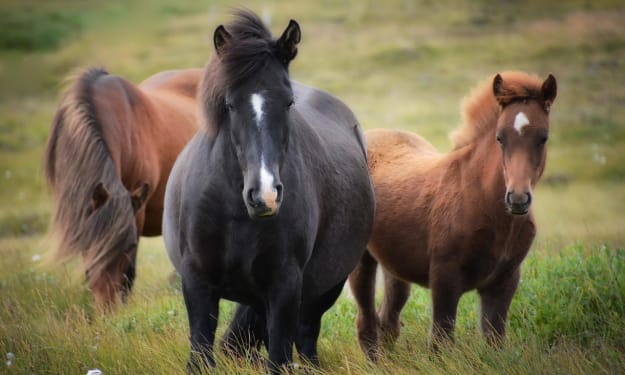
Ash didn’t remember the name he was born with. Horses don’t often cling to names the way people do. But there was a sound he couldn’t forget—a soft whistle that once meant care. A promise of food, attention, and the gentleness of a hand behind his ears. That was before. Now, there was only the dust—the thick, unrelenting dust that covered him like the weight of forgotten years. His coat had once been the color of midnight, but now it was a dull grey. Not because that was his true color, but because neglect had taken its toll, covering him in layers of despair. His ribs stuck out, sharp against his weathered skin. His eyes, once full of life, now stared blankly at the ground, avoiding the empty doors that had never opened for him. The auction pen around him was alive with noise—shouting voices, the bitter smell of sweat and dirt, the cacophony of bets and insults. But amidst all the chaos, no one looked at him. They merely looked through him. He stood quietly, head low, his body aching with exhaustion, waiting for the truck that would take him to the next forgotten place. And then, amidst the noise, a voice—a soft, unsure voice. A woman, young, almost out of place in the mess of the auction. Her boots were still too clean, her hand hesitant on the fence. “That one,” she said, pointing in his direction. The handler glanced at her, his eyes filled with disinterest. “This one? He’s no good. Won’t run, won’t pull. Barely eats. He’s as good as gone.” “I’ll take him,” she said, her voice unwavering. The handler shrugged, indifferent. “Fifty bucks.” No paperwork, no questions asked. Just the sound of a halter being clipped, the creak of a trailer door, and the rumble of the engine as they drove away. Ash didn’t resist. He had no reason to. He had nothing to hope for anymore. The road ahead was just another road to nowhere. The woman—Nora, she would later introduce herself as—took him to her small farm. It wasn’t much: a red barn, its paint peeling with age, a small pasture, and one other horse—young, energetic, and full of life. Ash didn’t mind the company. He mostly listened, his tired eyes fixed on the horizon. Nora spoke to him as if he were human. She told him about her life, her worries, the weather, and the dreams she’d always carried of having a horse to call her own. Ash didn’t understand the words, but he felt the kindness in her voice. He wasn’t used to that. He didn’t trust it, not yet. At first, he flinched when she touched him. He pulled away when she tried to lift his hooves. But Nora wasn’t like the others. She never shouted. She just waited. Day after day, she was patient, and gradually, Ash began to soften. He started to follow her voice. He began to trust her touch, even if only a little. One morning, something changed. Nora left the gate to the field wide open. Ash had never seen anything like it—an endless expanse of grass, wind, and sky. No walls. No fences. Just freedom. He stood there for a moment, sniffing the air, unsure. Then, his hooves moved, slowly at first. He walked. Then, he trotted. And then, something in him snapped. His muscles, once stiff and weak, came alive. He galloped across the field, faster than he had in years, the wind pulling at his mane, his hooves drumming against the earth like a long-lost rhythm he had forgotten. The world around him blurred. He wasn’t just running. He was flying. Nora watched from the porch, her hands on her heart. She didn’t speak. She just watched. Ash returned to her, his coat shining in the sunlight. His eyes were brighter, no longer filled with the dullness of neglect. He whinnied when he saw her, kicked at the ground in impatience if she was late. Nora never asked him to race. She didn’t hitch him to a cart. But one day, she set up a few wooden poles in the field, curious. “Just try,” she said, her voice encouraging. Ash stared at the first pole. He sniffed it, then snorted, unsure. But when Nora smiled, he made up his mind. With a graceful leap, he cleared the first pole. Then the second, then the third. He wasn’t just jumping; he was soaring. And in that moment, Ash knew something had shifted. He had wings—not the kind made of feathers, but the kind born from second chances, from patience, from love. The local shows began. Nora was hesitant at first, unsure if Ash was ready. But Ash was ready. He was more than ready. He had the heart of a champion, even if his body still carried the scars of his past. He didn’t always win. His coat was still covered in dust. His pedigree was unknown. But when Ash leapt, people noticed. They whispered, “That’s the rescue horse, isn’t it?” Yes. He was. He didn’t fit the mold that some judges were looking for—flashy, polished, perfect. But Ash had something different. He had grace, and beneath the dust, he had fire. One day, at a regional show, Ash stood at the starting line. The final jump was towering, almost too high. Nora stood beside him, her hand resting gently on his neck. “If you don’t want to, it’s okay,” she said softly. Ash lowered his head, remembering the long road he had traveled, the truck, the silence. But then, he raised his head, his eyes burning with something ancient—a fire that could never be extinguished. The bell rang. Ash soared over the first jump. Then the second. The crowd fell silent. The final jump loomed ahead. But Ash was already in motion, his body coiled like a spring, ready to leap higher, further. He flew. The arena erupted in applause, but Ash didn’t care for the ribbons or the claps. He tossed his head, his tail flicking in the wind, and stared at Nora as if to say, “We did it.” Not because they believed in him, but because she did.
By Noman Afridiabout a year ago in Education
Scientists Chase Falling Satellite with Aircraft to Study Space Pollution in Earth's Atmosphere
To learn more about satellite air pollution, scientists used a plane to chase a falling spacecraft. Scientists recently pursued a falling spacecraft with a high-altitude research plane on an ambitious and one-of-a-kind mission to learn what happens when satellites reenter the atmosphere of Earth and, more importantly, what kind of pollution they leave behind. The reentry of the Aeolus satellite, which had completed its mission of monitoring global wind patterns, was the primary focus of the project, which was led by the European Space Agency (ESA) with assistance from NASA and the German Aerospace Center (DLR). A cutting-edge satellite called Aeolus was launched in 2018 and was outfitted with an ALADIN (Atmospheric Laser Doppler INstrument) Doppler wind lidar instrument to measure wind speeds all over the world. It provided crucial data that enhanced our comprehension of atmospheric dynamics and enhanced weather forecasting models.
By Niranjon Chandra Royabout a year ago in Education
Asthma in India: A growing health crisis needing urgent attention
Asthma in India: A Growing Health Crisis Needing Urgent Attention Asthma, a chronic respiratory condition, is emerging as a significant public health challenge in India. Despite being preventable and manageable, the country bears a disproportionate burden of asthma-related morbidity and mortality. With over 34 million individuals affected, India accounts for approximately 13% of the global asthma cases.
By Abjol Hussain Laskarabout a year ago in Education
The Light That Changed the World
The Glowing Marvel: A Journey Inside the Humble Light Bulb Have you ever stopped for a moment to truly appreciate the light bulb? A small glass sphere. A glowing filament. A simple flick of a switch—and the darkness disappears. We use them every day, rarely thinking about the miracle hidden inside. But if you dive into the story of the light bulb, you’ll find a tale filled with curiosity, failure, triumph, and transformation. The humble light bulb is not just a utility—it’s a symbol of human progress, resilience, and brilliance. A World Before Light Imagine living in the 1800s. As the sun set, the world would be swallowed by darkness. People depended on candles, oil lamps, and gas lights to see at night. These sources were dim, dangerous, expensive, and unreliable. Nights were long, productivity was limited, and life paused after sunset. Society was bound by the natural cycle of day and night. But all of that changed with one spark. The Long Road to Illumination The invention of the light bulb wasn’t the work of one man in a single night. It was the result of decades of experiments and contributions from inventors across the world. In 1802, Humphry Davy created the first electric light by connecting wires to a battery and passing current through a strip of platinum. It was bright—but far from practical. In the following years, many others tried to improve this concept. British scientist Warren de la Rue, American inventor Joseph Henry, and English physicist Joseph Swan all made notable attempts. But it was Thomas Edison, in 1879, who gave us the first commercially viable, long-lasting light bulb. Edison didn’t just invent the light bulb—he invented the system that made it useful. Power generation, distribution, sockets, switches—he imagined it all. That’s what made his contribution revolutionary. Lighting Up the World Edison’s bulb burned for over 1,200 hours. The world was never the same again. Factories began running night shifts. Students could study after sunset. Shops remained open longer. Streets were lit, crime decreased, and public life expanded into the night. Cities sparkled with artificial daylight, and human civilization took a leap forward. All of this, thanks to a tiny object that fits in the palm of your hand. Evolution of a Genius Invention The journey didn’t stop with Edison. The incandescent bulb, though groundbreaking, used a lot of energy. Over time, scientists developed better alternatives. Halogen bulbs lasted longer and burned brighter. Fluorescent lamps were more energy-efficient. CFLs (Compact Fluorescent Lamps) became a common sight in homes. And today, LED bulbs dominate the market—offering unmatched efficiency, lifespan, and flexibility. Modern LED bulbs can change color, adjust brightness automatically, and even sync with music or your mood. Some are controlled via smartphones, others respond to voice commands. Yet, their core purpose remains the same: to push away the darkness. The Symbolism of the Bulb The light bulb is more than a technological marvel—it’s a cultural icon. It represents ideas, innovation, and inspiration. In cartoons, when a character has an idea, a light bulb pops up above their head. In daily speech, we say “a light bulb went off in my mind” to describe sudden insight. The bulb is a symbol of clarity. Of thought. Of possibility. Inside the Glass Look closer, and you’ll find incredible precision and engineering. A filament made of tungsten, coiled tightly, heats up to thousands of degrees Celsius and glows. It’s surrounded by inert gases like argon to prevent burning. The glass is not just a cover—it protects, insulates, and magnifies the glow. All these components, working in perfect harmony, give us clean, safe, and instant light. Such brilliance in such a small form! Light for the Future Today, lighting is smarter and greener. Solar-powered bulbs bring light to villages without electricity. Emergency bulbs charge during the day and light up during power cuts. Some bulbs even kill bacteria or help plants grow indoors. In the near future, light bulbs might become sources of internet via Li-Fi technology, or help regulate sleep by adjusting color temperatures naturally. From humble beginnings to high-tech marvels, the bulb’s journey mirrors our own—as humans, ever evolving, ever reaching for more.
By Noman Afridiabout a year ago in Education