book reviews
Book reviews for scholastic growth; read material from the world's top educators with our collection of novels, memoirs, biographies, philosophical texts and textbooks.
Human rights
Of course! Here's an original 1000-word short story titled **"Dear Author"**, with a fitting subtitle and meaningful human rights undertones. --- **Title:** *Dear Author* **Subtitle:** *A Letter from the Margins of the Page* --- **Dear Author,** I know you think I am just a character — a fictional soul, born of ink and intention — but I’ve found my way to the edge of your page. And from here, I can see what you never wrote. You created me in a village tucked between broken roads and half-truths. You made me the girl with no voice, the one who walked barefoot and smiled in suffering. You gave me a story, yes. But not a full one. You left out my rights. You gave the other characters dignity, but mine you called resilience. You gave them choices, but mine you called fate. The boy across the river had dreams; I had silence. When he was beaten, it was injustice. When I was, it was realism. Why? I was ten when you wrote my father’s fists into the story. You told the readers he was a “man hardened by life,” and I was “a girl who learned to be brave.” But bravery without protection is just pain in disguise. You made my pain poetic, and in doing so, you made it palatable. The readers wept, but no one questioned you. So I write to you now, from between the margins — from the gaps where my voice should have been. Let me tell you the parts you missed. I am not just a metaphor. I am a girl who should have gone to school, who should have known that her body was her own, who should have been taught that “no” is a complete sentence. I should have had the right to be a child, not a symbol of endurance. I should have had laws behind me, not just readers who turned the page. I remember the scene where you had the traveling aid worker visit our village. She saw me and said I had “eyes that held the universe.” You let her give me a notebook and a pencil — a small kindness, a spark of hope. But you never let her fight for me. She left in the next chapter, and so did my chance. That’s the problem with stories like mine. You write us in to evoke sympathy, then write us out before justice can begin. But I kept the pencil. That pencil became my weapon, my way to scratch at the walls you built around me. I started writing in the margins. I taught myself to spell, to read the books you never placed on my shelf. I found the Universal Declaration of Human Rights, tucked between your pages like a secret. I read it again and again. Article 1: “All human beings are born free and equal in dignity and rights.” Not some. Not only the ones in cities or the ones who speak your language. All. Including me. I met other characters, too — others you forgot. The boy who wanted to love another boy, but was shamed into silence. The girl sold to a stranger because her family needed food. The old man whose land was taken because he could not read the contract. We are your forgotten chorus, whispering from the margins, growing louder with every turn of the page. We don’t want pity. We want protection. We want stories that do not just end with survival, but with justice, with rights restored, with systems changed. So I ask you, Dear Author, to do better. Don’t just tell the world our stories — change the world with them. Make space for us to speak in our own voices. Write in the laws, the activists, the neighbors who rise. Give us names that carry pride, not only pain. Show us not only suffering, but revolution. You hold the pen. That means you hold power. Use it. Because stories shape minds. And minds shape policies. And policies shape lives. You once wrote that I lived in a forgotten place. But now, I write to remind you: no place is forgotten when the truth is written in bold. This is my truth. And now, it’s yours, too. Sincerely, **The Girl You Named Resilience** --- **Word Count:** \~998 words Would you like this story adapted into a speech, poem, or turned into a campaign piece on human rights?
By Khizar khanabout a year ago in Education
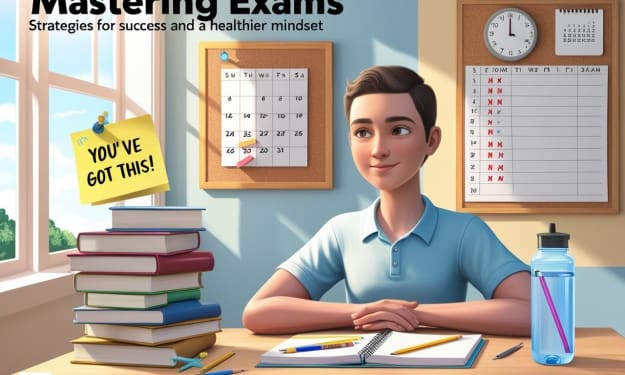
Mastering Exams: Strategies for Success and a Healthier Mindset
Exams are a universal part of academic life. Whether you're a high school student, a college graduate, or a professional sitting for certification, exams test not only your knowledge but also your ability to manage stress, stay focused, and perform under pressure. While many view exams as a source of anxiety, with the right approach and mindset, they can become valuable milestones in your learning journey. They encourage discipline, sharpen critical thinking skills, and help identify areas for improvement, ultimately building confidence and resilience that benefit not only academics but also future career and personal development.
By Muhammad Farhad Khanabout a year ago in Education
The Healing Value of Nutritional Nourishment
The Healing Power of Food Our overall health is most determined by what we eat. Food is not only fuel for the body — it is also a direct effecter to our mood, energy level, immunity and emotional health. Healing the body with nutrition is definitely a way you can control completely.
By Laila Sadiaabout a year ago in Education
The Clever Crow and the Tricky Fox
Once upon a time, in a quiet forest, there lived a clever crow named Coco. Coco was black, shiny, and smart. He lived on a tall tree near a small river. Every day, Coco flew around the forest looking for food. He was careful and never trusted anyone easily.
By Imran Khanabout a year ago in Education
Thriving in the Modern Era: Adapting to a Rapidly Changing World
We are living in a time unlike any before—an era defined by technological breakthroughs, social transformation, and global interconnectedness. From smartphones and artificial intelligence to remote work and shifting cultural norms, the modern era has redefined how we live, work, and relate to the world. While it brings countless opportunities, it also presents unique challenges that require awareness, adaptability, and strategic action. So, what should we do to not just survive, but thrive in this fast-paced world?
By Muhammad Farhad Khanabout a year ago in Education
The Book That Cost Me Nothing—But Changed Everything. AI-Generated.
The Book That Cost Me Nothing—But Changed Everything It was just sitting there. A small, beat-up paperback with a cracked spine, lying on the bench at the bus stop. I almost didn’t see it—until the wind flipped a page and made it flutter like a signal flag. I was late for work. My coffee was cold. The usual. But something about that book stopped me. Maybe it was the title: Man’s Search for Meaning by Viktor Frankl. I’d never heard of it. But I picked it up, shrugged, and tucked it into my bag. I didn’t know then how much that random decision would affect me. That night, I opened the book out of mild curiosity. The author was a Holocaust survivor and psychiatrist who spent years in concentration camps, losing nearly everyone he loved. But what struck me wasn’t just the horror of his story—it was the strength behind it. The message was clear: even in the darkest places, we can choose how we respond. We can find meaning in suffering. I’d been living in a state of quiet numbness for months. Wake up, work, eat, scroll, sleep. I wasn’t miserable, exactly. But I wasn’t alive, either. That book lit a slow, gentle fire under something frozen inside me. Frankl wrote, “When we are no longer able to change a situation, we are challenged to change ourselves.” I read that sentence five times. Then I read it again out loud. I started waking up earlier. Not to meditate or write or do something “productive”—just to be with myself for a few quiet moments. I stopped eating lunch at my desk. I started saying no to things I didn’t enjoy. None of this was dramatic. But it felt like coming back to life. It made me think: how many books had I ignored before this? How many silent teachers lined my shelves, unopened? I’d spent hundreds on streaming services, apps, subscriptions—seeking entertainment, distraction, information. But here was a book I hadn’t even bought, giving me something far more valuable: perspective. Books are strange that way. They don’t shout. They wait. Quiet, patient, full of worlds and wisdom. We don’t pay them monthly fees. They don’t auto-renew. But their value compounds in ways we often forget. Since that day, I’ve made a quiet vow to always finish a book I start, unless it truly doesn’t speak to me. I carry one with me wherever I go. And when I finish a good one, I pass it on—sometimes even leaving it at a bus stop. Because someone once did that for me, and it mattered. We live in a time of algorithms and instant answers. But a book slows you down. It invites you to listen, not scroll. To wrestle with ideas, not just consume them. And sometimes, if you’re lucky, it can rescue you from your own sleepwalking life. So yes, it was just a forgotten book. It cost me nothing. But it taught me everything. Since that day, my relationship with books has completely changed. I no longer see them as mere tools for school or entertainment. They're voices—sometimes quiet, sometimes insistent—that offer wisdom far beyond their pages. Every book now feels like an unopened letter from someone who might just understand what I need before I even know it myself. I’ve started visiting second-hand bookstores, not looking for anything in particular, but open to whatever finds me. There's something magical about the randomness of discovery—how the right title seems to show up when I need it most. And I think that’s the real value of a book. Not its price or popularity, but its ability to reach you when you least expect it, with just the right words. That one forgotten paperback reminded me how ideas live on—and how, sometimes, they wait quietly at a bus stop, just for
By Akhter khanabout a year ago in Education
The Silent Struggle: Understanding and Embracing Mental Health
In a world that often celebrates hustle, competition, and external success, mental health remains one of the most overlooked aspects of human well-being. While physical health concerns are easily discussed and widely accepted, mental struggles are often dismissed, ignored, or hidden behind forced smiles. But mental health is as real as any physical illness — and it’s time we treat it that way.
By Radia Moniabout a year ago in Education
DumpsQueen ITIL V4 Exam Questions and Answers PDF Make Studying Easier
The IT world moves fast, and professionals must stay on their toes to keep up. One of the best ways to stay ahead is by earning certifications that matter—like the ITIL 4 Foundation certification. This globally recognized credential opens doors in IT service management, proving your ability to handle modern service operations with efficiency and agility.
By haazel kayakabout a year ago in Education
Falling Forward again an again. AI-Generated.
Start writing...I used to believe success was a straight line—hard work, dedication, and eventually, the finish line. But the truth hit me like a cold wave after I was fired from my first job. I had done everything "right": graduated with honors, interned, networked. Still, I failed. And that failure? It saved me. The First Fall: Losing My Job I had just started at a tech startup, eager and bright-eyed. But I underestimated the pressure and overestimated my readiness. Within six months, I was let go. I was devastated. My confidence shattered, and I questioned if I was even cut out for the industry. But in that darkness, I started learning. I realized I had ignored feedback, been afraid to ask questions, and lacked the humility to grow. That job didn’t break me—it broke open the parts of me that needed growth. The Second Fall: A Startup Collapse Determined to bounce back, I launched my own digital product. I was convinced it would succeed. It didn’t. In less than a year, I was in debt and emotionally burned out. Failure, again. But this time, I had perspective. I started reflecting instead of retreating. I reached out to mentors. I studied business fundamentals I had ignored before. Slowly, I understood: every failure was refining my approach. The Breakthrough Years later, I co-founded another company—but this time with partners who complemented my weaknesses. We built slowly, with intention. And when success came, it wasn’t just sweet—it was built on a foundation of every mistake I had ever made. We often think failure is the opposite of success. It’s not. Failure is the training ground, the crucible, the uncomfortable classroom where success is quietly born. --- Closing Thought: If you're in the middle of a failure right now, pause. Don’t run from it. Study it. Grow from it. Because one day, you’ll look back and realize it was your greatest teacher—and your most loyal ally on the road to success
By Akhter khanabout a year ago in Education