
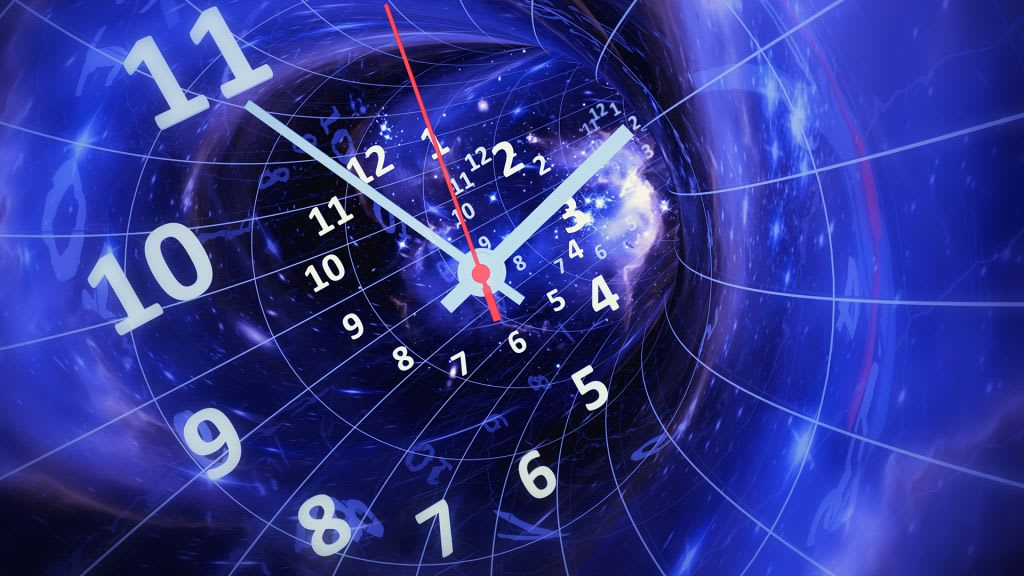
Space and time are two fundamental concepts in physics that have fascinated scientists and philosophers for centuries. These concepts are closely related, as space and time are often considered together as a four-dimensional space-time continuum.
In physics, space is defined as the three-dimensional extent in which objects and events occur, while time is defined as the measure of duration between events. Together, they form the fabric of the universe in which everything exists and moves.
One of the most fascinating aspects of space and time is their relativity. According to Einstein's theory of relativity, space and time are not absolute, but instead are relative to the observer's frame of reference. This means that the way we experience space and time depends on our position and velocity relative to other objects in the universe.
This concept of relativity has led to some fascinating predictions and discoveries. For example, it predicts that time passes more slowly in stronger gravitational fields. This phenomenon, known as gravitational time dilation, has been observed in experiments involving atomic clocks placed at different altitudes.
The closer an object is to a massive body such as a planet or a star, the stronger the gravitational field, and the slower time passes. This means that time passes faster for objects farther away from massive bodies. For example, if one person stays on Earth and another person travels to space and orbits the Earth for some time, the person in space will age slightly less than the person on Earth. This effect has been confirmed in experiments involving synchronized atomic clocks placed at different altitudes.
Another consequence of relativity is that as an object approaches the speed of light, time appears to slow down for that object. This effect, known as time dilation, has been confirmed in experiments involving high-speed particles. It means that the faster an object travels, the slower time appears to pass for that object.
The study of space and time has also led to some of the most profound questions in physics and philosophy. For example, what is the ultimate fate of the universe? Will it continue to expand indefinitely, or will it eventually collapse in on itself? And what role does consciousness play in the perception of space and time?
In the early 20th century, it was discovered that the universe is expanding. This led to the hypothesis of the Big Bang, which states that the universe began as an infinitely small, dense, and hot point and has been expanding ever since. The expansion of the universe is still ongoing, and recent observations suggest that it may even be accelerating. The ultimate fate of the universe is still unknown, but one possibility is that it will continue to expand indefinitely until all matter is so spread out that it can no longer interact with other matter.
The study of space and time has also led to some interesting philosophical questions. For example, does time have an objective existence, or is it simply a human construct? Is the future predetermined, or do we have free will to change it? These questions have been debated by philosophers for centuries and continue to be topics of discussion today.
One of the most fascinating areas of research related to space and time is quantum mechanics, which describes the behavior of particles at the smallest scales. In quantum mechanics, particles do not have a definite location or momentum until they are observed. This means that the act of observation itself can affect the outcome of an experiment. The implications of this for our understanding of space and time are profound, and some physicists believe that it may lead to a radical shift in our understanding of the nature of reality.
In conclusion, space and time are two fundamental concepts in physics that are closely related and have fascinated scientists and philosophers for centuries. Einstein's theory of relativity has shown us that these concepts are not absolute, but instead depend on the observer's frame of reference.
About the Creator
Enjoyed the story? Support the Creator.
Subscribe for free to receive all their stories in your feed.
Comments
There are no comments for this story
Be the first to respond and start the conversation.