
Seventeen Wrong Answers and One Rule Nobody Explains Right
I read seventeen answers to the same question online. Almost all of them were wrong.

Last week I sat down and read through every answer on Quora to one recurring question: how many hours can an international student in Australia actually work?
There were seventeen answers on the most popular version of that question. I counted. Some said 20 hours a week. Some said 24. One cited a "temporary COVID relaxation" that ended back in 2023. Minimum wage figures ranged from $23 to $25 an hour — all of them stale by now.
I'm on a student visa myself, doing a Masters in AI in Melbourne, and I write about Australian visa and work rights on the side. So I didn't just close the tab. I went and pulled the actual regulation.
Here's what it really says
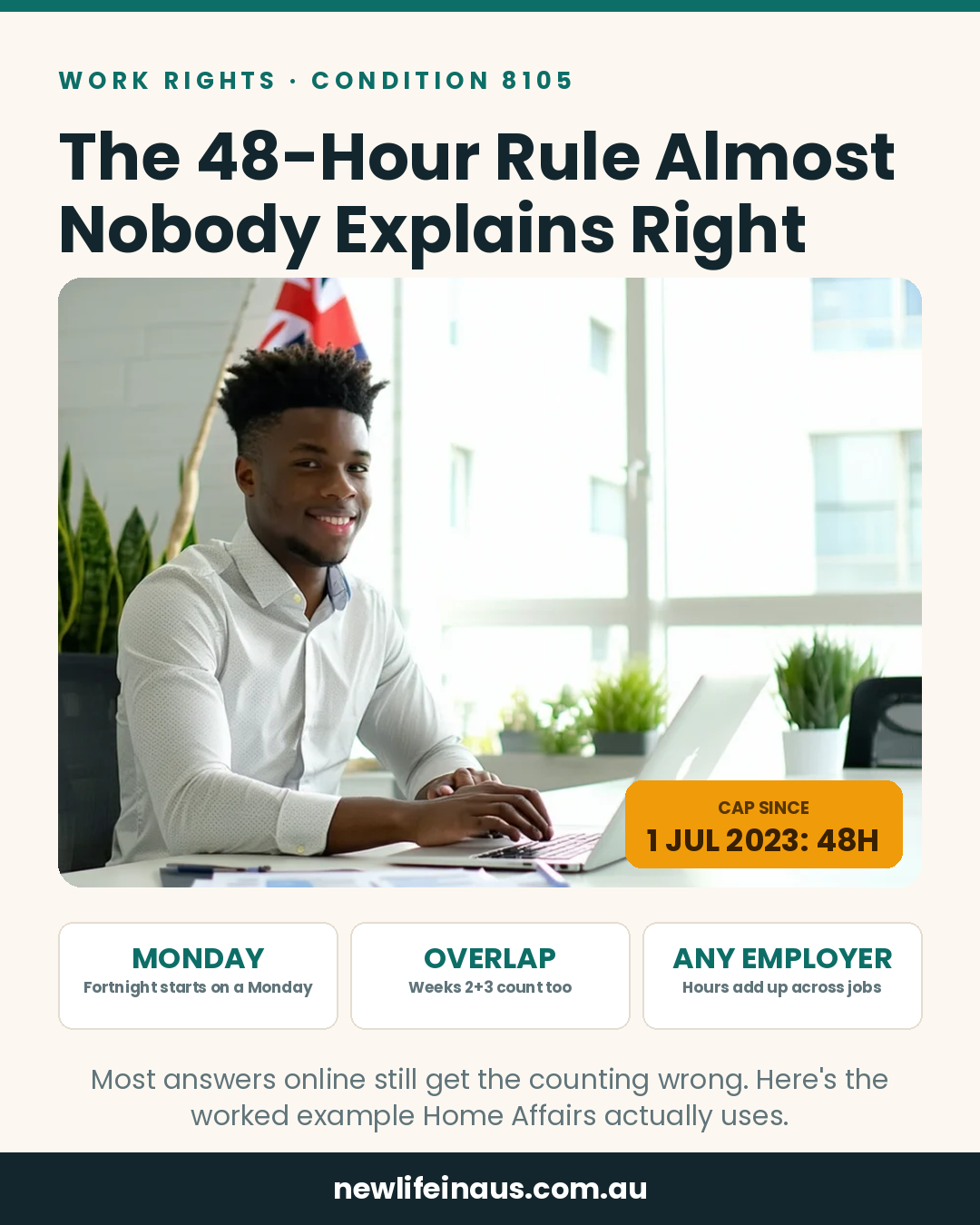
Since 1 July 2023, the cap is 48 hours a fortnight during study periods, unlimited during breaks. Not 40. Not 20 a week. And the "fortnight" part is where it gets interesting.
The part that trips everyone up
Legally, a fortnight is any 14-day stretch that starts on a Monday. Since a Monday rolls around every single week, a new fortnight technically starts every week too. That means you can't just check weeks 1-2, then weeks 3-4, and call it done — weeks 2-3 count as their own fortnight, and it has to clear the cap on its own.
The government's own example nails why this matters: 15 hours, then 25, then 25, then 10, across four weeks.
Weeks 1+2? 40 hours, fine.
Weeks 3+4? 35, also fine.
Weeks 2+3? 50 hours. That's a breach — and looking at the schedule week by week, nothing about it looks like overworking.
Nobody looking at that schedule week by week would think they'd done anything wrong. The overlap is the entire trap.
A confession
I got this wrong myself, the first time I wrote about it. I read a paraphrase that said the fortnight "starts on a Monday" and assumed that meant fixed two-week blocks, not overlapping ones. I published the wrong version. Had to go back and fix it an hour later once I actually found the worked example instead of trusting a summary of one.
That's the real lesson here, more than the hours themselves: when a rule involves counting something, chase down the worked example. A paraphrase of a rule is not the rule.
The bit that catches people out
The cap isn't per job. Twenty hours at a café plus fifteen hours of freelance design work in the same fortnight is thirty-five combined hours against the same limit — not two separate buckets. Anyone juggling two jobs, or a job and gig work on the side, is exactly who breaches this without meaning to, because no single payslip shows the full picture.
And this isn't a slap-on-the-wrist rule. Breaching it is a visa condition violation, and that can mean cancellation. With roughly 700,000 international students in the country right now, "close enough" isn't a safe place to sit.
The practical fix is simple: keep a running total of the last fourteen days, recalculated every time a new shift gets added, instead of resetting the count every two weeks like a fixed calendar block. That's the habit that catches the overlap a fixed-block method always misses. It takes maybe thirty seconds after each shift, and it's the difference between staying compliant and finding out the hard way. A simple spreadsheet or a notes app works fine — it doesn't need to be fancy, it just needs to actually look at overlapping weeks instead of clean, separate blocks.
I wrote up the full version — current wage figures, tax and super, what actually happens if you breach it — over on the site: Work Rights for International Students Australia 2026 Guide
About the Creator
Enjoyed the story? Support the Creator.
Subscribe for free to receive all their stories in your feed.
Comments
There are no comments for this story
Be the first to respond and start the conversation.