
Self-Paced vs. Instructor-Led Legal Transcription Courses: Why More Learners Are Choosing to Study on Their Own Terms
Learn at Your Own Pace or Follow a Schedule -Choosing the Legal Transcription Path That Fits Your Life
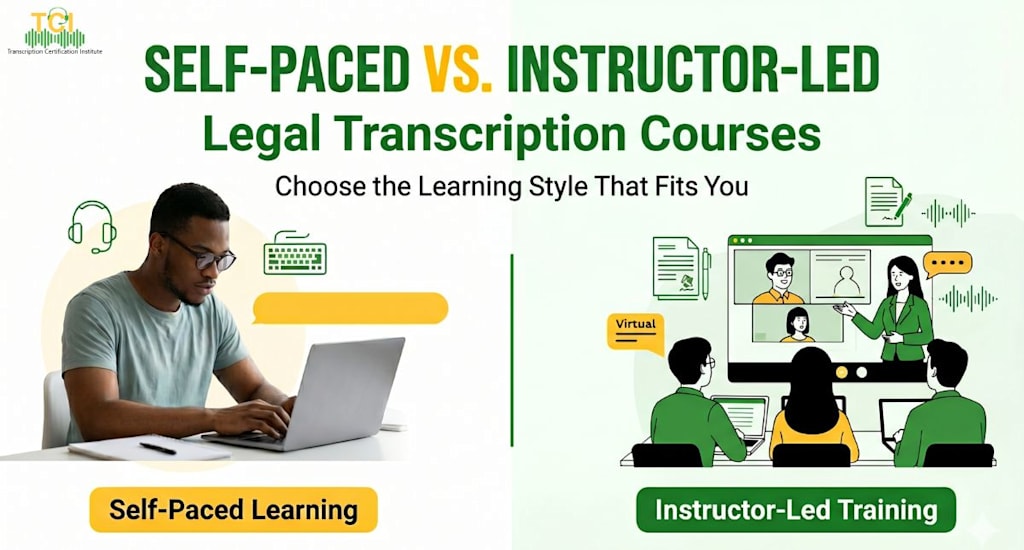
For aspiring legal transcriptionists, one of the first decisions you will face is how to train. Today, more learners than ever are choosing self-paced courses - and for good reason. Flexibility, affordability, and self-direction are not compromises; they are genuine advantages that align with how modern professionals actually learn and grow.
The more important question, beyond format, is whether your training will make you truly job-ready in a field where accuracy, terminology, and credentials all matter. A well-designed self-paced program delivers on all of these fronts - without requiring you to rearrange your life around a fixed timetable.
Employers and clients expect more than basic typing skills. They look for strong listening ability, deep legal terminology knowledge, and consistent formatting accuracy. The right training equips you with exactly that - on a schedule that works for you.
What Legal Transcription Training Must Cover
Before choosing a program, it helps to understand what any quality legal transcription course should include:
- Fluency in legal terminology — terms such as voir dire, subrogation, and writ of mandamus appear routinely in depositions and court proceedings.
- Verbatim transcription skills — capturing false starts, filler words, and speaker pauses exactly as spoken.
- Familiarity with formatting conventions and style guides that vary by jurisdiction.
- Practice with real legal audio — including multiple speakers, heavy accents, low-quality recordings, and ambiguous passages that test your judgment.
A strong self-paced program covers all of this comprehensively, with structured lessons, real-world audio practice, and meaningful feedback on your work - so you graduate confident and career-ready.
Why Self-Paced Learning Is the Right Choice for Most Learners
Self-paced legal transcription courses h
ave grown considerably in quality and depth. For the vast majority of learners, they offer clear, compelling advantages:
You set the schedule. Whether you are working full-time, raising a family, or managing other commitments, self-paced learning fits around your life. There are no fixed class times, no missed sessions, and no pressure to keep up with a group moving at the wrong speed for you.
You control the pace. Struggling with a complex legal concept? Revisit the lesson as many times as you need. Confident in a module? Move ahead without waiting. Self-paced learning respects the fact that people absorb material differently - and that is a strength, not a limitation.
You receive real, structured feedback. A well-designed self-paced program does not leave you guessing. Quality courses provide detailed feedback on your transcription work, helping you identify errors, correct habits, and improve steadily - just as you would in any structured learning environment.
The cost is significantly lower. Self-paced programs consistently deliver strong, comprehensive training at a fraction of the cost of traditional courses - making them an accessible and practical entry point for learners at every stage.
You build professional discipline. Completing a self-paced program requires personal accountability and self-management - exactly the qualities that make a successful freelance transcriptionist. You are not just learning the skill; you are practicing the mindset.
When Instructor-Led Programs Make Sense
Instructor-led courses can suit learners who prefer having their study schedule decided for them and who have a largely open calendar with few competing commitments. If a fixed timetable is the structure you need, this format can work.
However, it comes with significant trade-offs. You are locked into class times that may not align with your life, you move at the group's pace rather than your own, and the cost is typically much higher. For most working adults balancing jobs, families, and everyday responsibilities, that rigidity becomes a barrier rather than a benefit.
Self-paced learning removes those barriers entirely - without sacrificing quality, feedback, or outcomes.
Questions to Ask Before Choosing Any Program
Regardless of format, evaluate your course against these criteria:
- Does it use real legal audio, or only clean practice recordings?
- Is there genuine, detailed feedback on your work - not just answer keys?
- Is the certificate recognized by legal employers and transcription platforms?
- Does it cover verbatim rules, style guides, and jurisdiction-specific formatting?
Institutions such as the Transcription Certification Institute are built specifically around these standards, offering self-paced programs that combine flexibility with fully recognized credentials - so you finish training ready to work, not just ready to apply.
Final Thoughts
Self-paced learning is not the alternative option - for most learners today, it is the right option. It fits your life, respects your pace, provides the feedback and credentials you need, and builds the discipline that a successful transcription career demands.
Whether you are starting from scratch or transitioning from another field, what matters most is that your training reflects the real demands of legal transcription - and that it works for you, not against you.
Your format should serve your career. Self-paced learning does exactly that.
About the Creator
Mahesh Kumar
Representing Transcription Certification Institute, a Nashville, TN, based company that provides comprehensive online general transcription training certification courses.
Enjoyed the story? Support the Creator.
Subscribe for free to receive all their stories in your feed.
Comments
There are no comments for this story
Be the first to respond and start the conversation.