
Roman Empire
The Roman Empire[a] was the post-Republican state of ancient Rome. It included territory around the Mediterranean in Europe, North Africa, and Western Asia, and was ruled by emperors. The adoption of Christianity as the state church in 380 and the fall of the Western Roman Empire conventionally marks the end of classical antiquity and the beginning of the Middle Ages. The Roman Republic became severely destabilized in civil wars and political conflicts, eventually culminating in the victory of Octavian over Mark Antony and Cleopatra at the Battle of Actium in 31 BC and the subsequent conquest of the Ptolemaic Kingdom in Egypt. The Roman Senate granted Octavian overarching power (imperium) and the new title of Augustus, marking his accession as the first Roman emperor of a monarchy with Italia as the metropole and Rome as its sole capital. The vast Roman territories were organized in senatorial and imperial provinces. The first two centuries of the Empire saw a period of unprecedented stability and prosperity known as the Pax Romana (lit. 'Roman Peace'). Rome reached its greatest territorial expanse under Trajan (AD 98–117); a period of increasing trouble and decline began under Commodus (180–192). In the 3rd century, the Empire underwent a crisis that threatened its existence, as the Gallic and Palmyrene Empires broke away from the Roman state, and a series of short-lived emperors led the Empire. It was reunified under Aurelian (r. 270–275). To stabilize it, Diocletian set up two different imperial courts in the Greek East and Latin West in 286; Christians rose to power in the 4th century following the Edict of Milan. The imperial seat moved from Rome to Byzantium in 330. The Migration Period, involving large invasions by Germanic peoples and by the Huns of Attila, led to the decline of the Western Roman Empire. With the fall of Ravenna to the Germanic Herulians and the deposition of Romulus Augustus in 476 by Odoacer, the Western Roman Empire finally collapsed. The Eastern Roman Empire survived for another millennium with Constantinople as sole capital, until the city's fall in 1453.[j] Due to the Empire's extent and endurance, its institutions and culture had a lasting influence on the development of language, religion, art, architecture, literature, philosophy, law, and forms of government in its territories. Latin evolved into the Romance languages, while Medieval Greek became the language of the East. The Empire's adoption of Christianity led to the formation of medieval Christendom. Roman and Greek art had a profound impact on the Italian Renaissance. Rome's architectural tradition served as the basis for Romanesque, Renaissance and Neoclassical architecture, and also influenced Islamic architecture. The rediscovery of classical science and technology (which also formed the basis for Islamic science) in medieval Europe led to the Scientific Renaissance and Scientific Revolution. Roman law has its descendants in many modern legal systems, such as the Napoleonic Code, while Rome's republican institutions have left an enduring legacy, influencing the Italian city-state republics of the medieval period, as well as the early United States and other modern democratic republics.
Rome had begun expanding shortly after the founding of the Roman Republic in the 6th century BC, though not outside the Italian peninsula until the 3rd century BC. Thus, it was an "empire" (a great power) long before it had an emperor.[20] The Republic was not a nation-state in the modern sense, but a network of self-ruled towns (with varying degrees of independence from the Senate) and provinces administered by military commanders. It was governed by annually elected magistrates (Roman consuls above all) in conjunction with the Senate.[21] The 1st century BC was a time of political and military upheaval, which ultimately led to rule by emperors.[22][23][24] The consuls' military power rested in the Roman legal concept of imperium, meaning "command" (though typically in a military sense).[25] Occasionally, successful consuls were given the honorary title imperator (commander); this is the origin of the word emperor, since this title was always bestowed to the early emperors.[26]
Rome suffered a long series of internal conflicts, conspiracies, and civil wars from the late second century BC—Crisis of the Roman Republic—while greatly extending its power beyond Italy. In 44 BC, Julius Caesar was briefly perpetual dictator before being assassinated. The faction of his assassins was driven from Rome and defeated at the Battle of Philippi in 42 BC by Mark Antony and Caesar's adopted son Octavian. Antony and Octavian's division of the Roman world did not last and Octavian's forces defeated those of Mark Antony and Cleopatra at the Battle of Actium in 31 BC. In 27 BC the Senate made Octavian princeps ("first citizen") with proconsular imperium, thus beginning the Principate (the first epoch of Roman imperial history, usually dated from 27 BC to 284 AD), and gave him the title Augustus ("the venerated"). Although the republic stood in name, Augustus had all meaningful authority.[27] Since his rule began an unprecedented period of peace and prosperity, he was so loved that he came to hold the power of a monarch de facto if not de jure. During the years of his rule, a new constitutional order emerged (in part organically and in part by design), so that, upon his death, this new constitutional order operated as before when Tiberius was accepted as the new emperor.
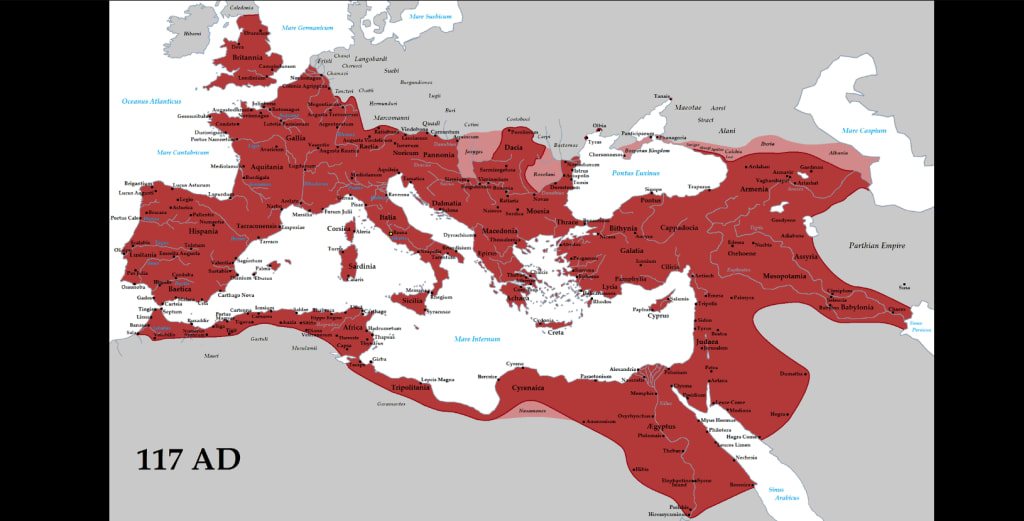
The Roman Empire was one of the largest in history, with contiguous territories throughout Europe, North Africa, and the Middle East.[43] The Latin phrase imperium sine fine ("empire without end"[44]) expressed the ideology that neither time nor space limited the Empire. In Virgil's Aeneid, limitless empire is said to be granted to the Romans by Jupiter.[45] This claim of universal dominion was renewed when the Empire came under Christian rule in the 4th century.[k] In addition to annexing large regions, the Romans directly altered their geography, for example cutting down entire forests.[47]
Roman expansion was mostly accomplished under the Republic, though parts of northern Europe were conquered in the 1st century, when Roman control in Europe, Africa, and Asia was strengthened. Under Augustus, a "global map of the known world" was displayed for the first time in public at Rome, coinciding with the creation of the most comprehensive political geography that survives from antiquity, the Geography of Strabo.[48] When Augustus died, the account of his achievements (Res Gestae) prominently featured the geographical cataloguing of the Empire.[49] Geography alongside meticulous written records were central concerns of Roman Imperial administration.[50]
A segment of the ruins of Hadrian's Wall in northern England, overlooking Crag Lough
The Empire reached its largest expanse under Trajan (r. 98–117),[51] encompassing 5 million square kilometres.[15][16] The traditional population estimate of 55–60 million inhabitants[52] accounted for between one-sixth and one-fourth of the world's total population[53] and made it the most populous unified political entity in the West until the mid-19th century.[54] Recent demographic studies have argued for a population peak from 70 million to more than 100 million.[55] Each of the three largest cities in the Empire – Rome, Alexandria, and Antioch – was almost twice the size of any European city at the beginning of the 17th century.[56]
About the Creator
Enjoyed the story? Support the Creator.
Subscribe for free to receive all their stories in your feed.
Comments
There are no comments for this story
Be the first to respond and start the conversation.