
Revolutionizing Healthcare and AI-Driven Scientific Breakthroughs
Harnessing the Power of Artificial Intelligence to Transform Medicine and Accelerate Scientific Discoveries
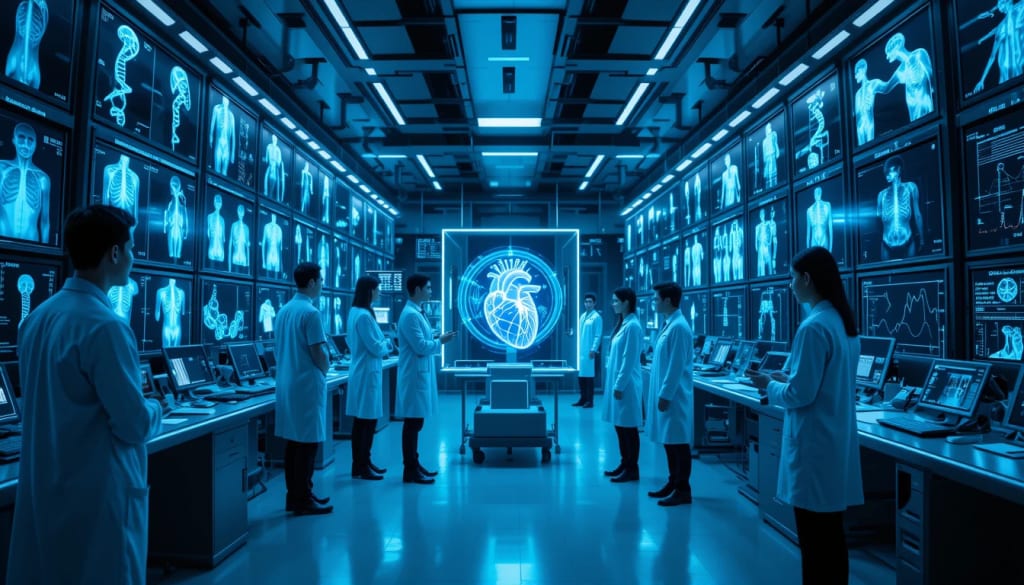
AI-Powered Healthcare: Making Accurate Information More Accessible
Artificial Intelligence (AI) is transforming the landscape of healthcare and scientific research, enabling more personalized treatments, early disease detection, and groundbreaking discoveries. With advancements in AI-powered diagnostics, multimodal healthcare models, and AI co-scientists, the potential to enhance patient care and accelerate scientific breakthroughs has never been greater.
In today’s digital age, people often turn to search engines for health-related queries. AI-driven tools are making high-quality medical information more accessible than ever. Platforms like Google Lens allow users to capture images of skin conditions and find visually similar cases, while AI-driven YouTube tools help verified medical organizations create authoritative content.
For healthcare providers, AI solutions such as MedLM and Search for Healthcare are revolutionizing medical decision-making. These tools, available through Google Cloud Vertex AI, assist clinicians in diagnosing conditions more accurately and efficiently, ensuring patients receive timely and precise treatments. Moreover, rigorous research into medical factuality ensures that AI-generated content remains grounded in reliable sources.
Personalized Healthcare Through Generative AI
Advancements in multimodal AI and conversational intelligence are reshaping patient care. Medical data, including X-rays, digital health records, and real-time patient monitoring, is inherently multimodal. Leveraging this, AI models like Med-Gemini are enhancing diagnostic accuracy by integrating superior reasoning capabilities with de-identified medical datasets. Notably, Med-Gemini has achieved 91.1% accuracy in answering U.S. medical exam-style questions and demonstrated proficiency in interpreting 3D medical scans.
In clinical settings, AI systems such as Articulate Medical Intelligence Explorer (AMIE) are emerging as virtual diagnostic assistants. These AI-driven tools can take a clinical history, ask relevant questions, and generate differential diagnoses while maintaining an empathetic conversation. Additionally, wearable devices and mobile applications powered by AI are personalizing healthcare by analyzing step counts, heart rate, and sleep patterns, leading to improved fitness and wellness recommendations.
Global Impact: AI in Early Diagnosis and Healthcare Access
Early disease detection is crucial in improving health outcomes, and AI-powered imaging models are making this possible at scale. AI applications in detecting breast cancer, lung cancer, and diabetic retinopathy are now being deployed in real-world clinical settings, benefiting millions. In India and Thailand, AI-assisted screenings aim to provide six million free diabetic retinopathy scans, while Apollo Radiology International is utilizing AI to conduct three million free screenings for tuberculosis, lung cancer, and breast cancer across India.
To address global maternal health challenges, AI is also being developed for cardiotocography, a technique used to assess fetal well-being. These efforts are particularly valuable in resource-limited regions, where AI-powered diagnostics can bridge the gap caused by a shortage of medical specialists. Furthermore, AI-driven healthcare infrastructure, such as Health AI Developer Foundations and Open Health Stack, is empowering developers to create next-generation digital health solutions, benefiting frontline healthcare workers in Africa, South Asia, and Southeast Asia.
AI Co-Scientists: Accelerating Scientific Discovery
Beyond healthcare, AI is playing a pivotal role in scientific research. AI co-scientists, developed as multi-agent AI systems, are collaborating with researchers to uncover new insights and formulate groundbreaking hypotheses. These AI-driven systems have already contributed to major scientific advancements, including drug repurposing for acute myeloid leukemia, identifying novel treatment targets for liver fibrosis, and explaining antimicrobial resistance mechanisms.
By leveraging AI's ability to synthesize information, perform complex reasoning, and propose innovative solutions, scientists can push the boundaries of discovery faster than ever before. The rapid integration of AI into biomedical research is expected to lead to life-saving innovations that will benefit billions of people worldwide.
The Future of AI in Healthcare and Science
The fusion of AI with healthcare and scientific discovery is accelerating a transformative shift. Research breakthroughs are being rapidly translated into real-world applications, enhancing patient care, improving diagnostics, and facilitating groundbreaking discoveries. As AI continues to evolve, responsible implementation and global collaborations will be key to maximizing its potential while ensuring ethical and equitable access.
With the continuous advancements in AI-powered health technologies and scientific tools, the future holds immense possibilities for improving global well-being. By harnessing AI responsibly, we can create a smarter, healthier, and more scientifically advanced world for generations to come.
About the Creator
Enjoyed the story? Support the Creator.
Subscribe for free to receive all their stories in your feed.
Comments
There are no comments for this story
Be the first to respond and start the conversation.