
Review of Ukrinform Event "The role of war journalists in documenting war crimes. Implementation of the Berkeley Protocol in Ukraine."
What is the limit of the role of journalists in wartime?

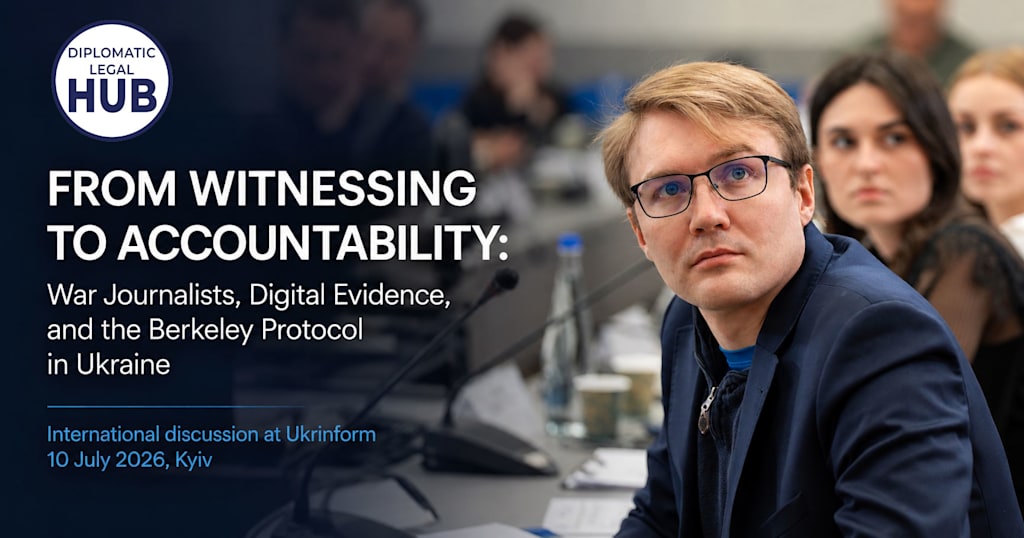
Organized by the Diplomatic Legal Hub and held at the Ukrinform News Agency; the public discussion entitled "The role of war journalists in documenting war crimes. Implementation of the Berkeley Protocol in Ukraine” occurred July 10, 2026 in Kyiv, Ukraine.
The central question for the event was the translation of information via images, video, testimony, OSINT, and frontline reporting, into reliable evidence capable of supporting potential accountability for alleged war crimes.
Our event brought together archivists, international experts, journalists, lawyers, legal scholars, military communicators, OSINT analysts, veterans under the theme of implementing the Berkeley Protocol in Ukraine.
The Event Structure and Proceedings
The event began with opening remarks from Liudmyla Kozhura, Doctor of Law and moderator who framed digital evidence as justice infrastructure, and myself, as a Canadian journalist and DLH coordinator linking Berkeley Protocol standards to accountability.
The main session moved into a speech by me connecting frontline witnessing with digital-evidence preservation duties. Liudmyla Kozhura explained how journalistic materials become instruments of justice.
Marichka Baysa, a defence communications leader, emphasized official sources, verification, and operational safety. The next session built upon these foundational elements of the presentation.
Yana But, attorney at law, analyzed admissibility risks in journalists’ digital materials. Mark McNamee, Two Ravens strategist, connected OSINT corroboration with war-crimes documentation practice.
Irina Tsukerman, national security attorney, examined disinformation’s attack on evidentiary trust. Eleonora Belei, War Archive research head, presented archiving as justice and memory infrastructure.
Finally, Giorgio Provinciali, engineer, researcher, and war journalist, discussed frontline risks and standards. Nestor Barchuk, Azov POW advocate, connected prisoner-abuse documentation with international accountability. Miro Vanadze, Georgian veteran and MMA organizer, linked military witness experience to evidence preservation.
The Berkeley Protocol in Wartime Ukraine
The broader legal context for the reportage on the war is immense. The Berkeley Protocol was issued through the OHCHR and Berkeley’s Human Rights Center. It sets international standards for identifying, collecting, preserving, verifying, and analyzing digital open-source information.
All these are relevant and of concern to alleged violations of international criminal, human rights, and humanitarian law. The International Criminal Court opened an investigation on March 2, 2022 to cover alleged crimes committed in the Ukraine situation since November 21, 2013.
Ukrainian and international institutions built digital systems to analyze, document, and preserve evidence for the core international crime allegations, at a minimum. Key to the discussion was the acknowledgement of distinct roles and expertise, and skills. War journalists are not prosecutors, detectives, or judges.
Often, they may be the first custodians of future evidence. Their decisions on the battlefield or in the first minutes after the attack. Those decisions on what to film, how to store, whether to publish, if metadata survives, and if official sources are consulted or if victims are protects, relate the Protocol to the work of wartime journalists.
Five Principal Substantive Takeaways
First, we should understand the fundamental truth about the truth: It is not self-preserving. Any audio recording, drone image, photograph, video, and witness account, is information, but not necessarily evidence. Therefore, the information must be authenticated, contextualized, preserved, and protected.
Second, digital evidence requires trust. Speakers repeatedly returned to authenticity of evidence, chain of custody, independent verification, and integrity. These track the core elements of the Protocol. Investigators and related professionals acquire a standard method.
Third, there are distinguishing elements to speed and reliability. They can overlap, but not necessarily every production. The Ministry of Defence communications perspective emphasized premature publication may endanger civilians, investigations, military operations, public trust, and soldiers,
Fourth, OSINT makes an evidentiary architectural ecosystem. Open-source materials alone do little. Together, and cross-checked via geolocation, metadata, official information, other public records, and satellite imagery, they become potentially substantial through such corroboration.
Fifth, any documentation should be centered on human beings as most effects of violations of human rights and international humanitarian law happen to human beings, rights-bearing persons.
One Moral Consideration
The basic moral takeaway is wartime evidence exists for people, not the other way around. The Protocol provides frame and process to make the ethical violations against people as rights-bearing persons as substantive and enforceable.
Scott Douglas Jacobsen is a blogger on Vocal with more than 200 publications on the platform. He is the Founder and Publisher of In-Sight Publishing (ISBN: 978–1–0692343; 978–1–0673505) and Editor-in-Chief of In-Sight: Interviews (ISSN: 2369–6885). He writes for International Policy Digest (ISSN: 2332–9416), The Humanist (Print: ISSN, 0018–7399; Online: ISSN, 2163–3576), Basic Income Earth Network (UK Registered Charity 1177066), Humanist Perspectives (ISSN: 1719–6337), A Further Inquiry (SubStack), Vocal, Medium, The Good Men Project, The New Enlightenment Project, The Washington Outsider, rabble.ca, and other media. His bibliography index can be found via the Jacobsen Bank at In-Sight Publishing, comprising more than 10,000 articles, interviews, and republications across more than 200 outlets. He has served in national and international leadership roles within humanist and media organizations, held several academic fellowships, and currently serves on several boards. He is a member in good standing in numerous media organizations, including the Canadian Association of Journalists, PEN Canada (CRA: 88916 2541 RR0001), Reporters Without Borders (SIREN: 343 684 221/SIRET: 343 684 221 00041/EIN: 20–0708028), and others.
Image Credit: Diplomatic Legal Hub.
About the Creator
Scott Douglas Jacobsen
Scott Douglas Jacobsen is the publisher of In-Sight Publishing (ISBN: 978-1-0692343) and Editor-in-Chief of In-Sight: Interviews (ISSN: 2369-6885). He is a member in good standing of numerous media organizations.
Enjoyed the story? Support the Creator.
Subscribe for free to receive all their stories in your feed.
Comments
There are no comments for this story
Be the first to respond and start the conversation.