
Real Toys that were Banned for being so Dangerous
29 Banned Toys by the Government
Let’s start with the kitchen play set’s predecessor, The Easy-Bake Oven, which enables kids to make small baked goods using cake mix and molds safely, comes in first place on our list. Oh, sort of safely. Although the toy had been available since 1963, it suddenly became very difficult to locate in 2007. Hasbro voluntarily removed it from the market after receiving numerous reports of children getting their fingers burned or caught in the front-loading door. In the end, it was re-released, but with additional safety features and a much smaller entry that prevented children from getting close to the heating element. Kids, bake away, but be careful.
Even the most straightforward toys occasionally pose a risk. Nothing was more basic than Clackers. Played with by swinging a pair of connected spheres back and forth, they produced a loud clacking sound when they collided. The worst that could happen when a clacker went in the wrong direction was a bruise, right? It seemed like a fun game to play to irritate mom or dad. Wrong! The original material for clackers was tempered glass, which would eventually break. Shrapnel is the epitome of playtime, right? Soon after their 1968 release, they were taken off the market and replaced with a plastic version.
Sometimes a small mistake can result in a major issue. Play sets with a young girl who can shrink were part of the Polly Pocket toy line, which enjoyed popularity in the 1990's and beyond. And one toy's demise was brought on by minute details. Children could quickly accessorize Quick-Click Polly Pocket with magnetic-enabled outfits, but the magnets weren't properly glued on. Regular play was causing them to loosen, rendering the toy useless and increasing the possibility that children or their younger siblings might ingest the magnets and require emergency surgery. Children would then have to accessorize their dolls using traditional methods.
This next product probably made teachers everywhere happy to see it go away. Slap bracelets were one of those odd fads that was only popular among youth in the 1990's. It didn't look like much until you slapped it against your wrist; it was a flat strip of layered, flexible metal covered in a vibrant coating made of fabric, silicone, or plastic. The impact would cause the bracelet to curl into a bracelet in an instant, and it quickly became a must-have accessory for young people worldwide. The issue was that not every slap bracelet was made equal. Many employed steel that was too thin or had subpar covers, and as a result, the metal would tear or break, cutting the user. Bandages were not a stylish accessory, which resulted in recalls and bans at schools.
The following one seems like a poor choice. You would probably want it to be fairly secure if you were going to build a flotation device for small children, especially babies. That's why it was so unexpected that Aqua Leisure's Inflatable Baby Boat fell short in precisely that department. The adorable, vibrant inflatables made for irresistible mommy blog photos, but the leg straps were defective, making it possible for the baby to fall out of the boat and into the water at any time. Although, thankfully, no children drowned, there were enough near-drowning incidents for the government to recall four million boats and fine the company more than $500,000 for the incident.
Fans of movies may be familiar with this one. Describe Flubber. It is best known as the title of a Robin Williams movie from 1997 about a crazy scientist who creates bouncing goo, but it was actually a toy decades earlier. Slime-obsessed children worldwide were sold the bouncing goo in the 1960's, but it didn't live up to its claims of being non-toxic and safe. It was discovered that it caused inflammation of the hair follicles after children who played with it began experiencing sore throats and rashes. Although the product was recalled, there was so much of it that Hasbro was unable to burn it because of the harmful fumes it would release. Its fate is unknown, but urban legend has it that it was interred at one of their warehouses.
The following one was quickly taken off the shelves, but it also sent children flying. Who among the children wouldn't want to leap like Shaq? That was one of the key selling points of Moon Shoes, a type of novelty footwear with a base full of springs that resembled trampolines. The original models from the 1970's had strong springs that sent children flying down the street. They sent kids flying into objects head-first and caused more serious injuries, as well as numerous broken legs and ankles, which undoubtedly increased orthopedists' business. After being eventually taken off the shelves, the moon shoes made a safe comeback in the 1980's with a model that had significantly less jumping ability. Although you don't often see kids wearing them, the danger may have been the appeal of these items, which are still on the shelves.
Water toys are perennially popular, but some of them end disastrously. Wham-O is one of the most recognizable toy manufacturers in the country, but one of their innovations from the 1960's had disastrous effects. The Water Wiggle was a straightforward toy that consisted of a hose with a plastic face and an aluminum jet nozzle. On a hot day, it would flop around and shower kids with water when connected to the main hose. Kids putting things where they shouldn't be is the issue. Two young children drowned as a result of the extra hose's nozzle fitting perfectly into their mouths in the 1970's. In the end, Wham-O made the decision to remove more than 2.5 million Water Wiggles from sale. Later, a new soft plastic one was released, but most reviews claim it simply doesn't function.
They did have backup products, but they weren't without issues. What child doesn't have fond memories of the Slip-and-Slide from their youth? On a hot day, you and your siblings are sliding away, and while you might bump into a few things, young bodies are designed to take it. The operative phrase here is "young bodies." The recognizable Wham-O toy is merely a plastic sheet that gets incredibly slippery when wet. It was popular when it first appeared in the 1970's, but when teenagers and adults used it, some of them were thrown out and suffered severe neck injuries. As a result, the Consumer Product Safety Commission issued warnings that it should not be used by adults, and it was taken off the market and redesigned. Even so, thirty million slides were sold in 2011 alone, proving that it hasn't stopped.
The next one most likely contributed to the development of a standard warning. You'll blow out your eye! Not only is it a famous quote from a classic film, but kids have heard it every time they even glance at a toy gun. That was probably the Wham-O Air Blaster Gun's main draw. Without ammunition, you can't shoot your eye out because the gun uses compressed air to make a loud noise and blast items off the shelf. Maybe a little dramatic, but reports suggested that kids were injuring each other's eardrums by aiming the gun at close range. The gun not only infuriated parents to no end, Finally, Wham-O decided to voluntarily recall the item. Will you shoot out your ear?
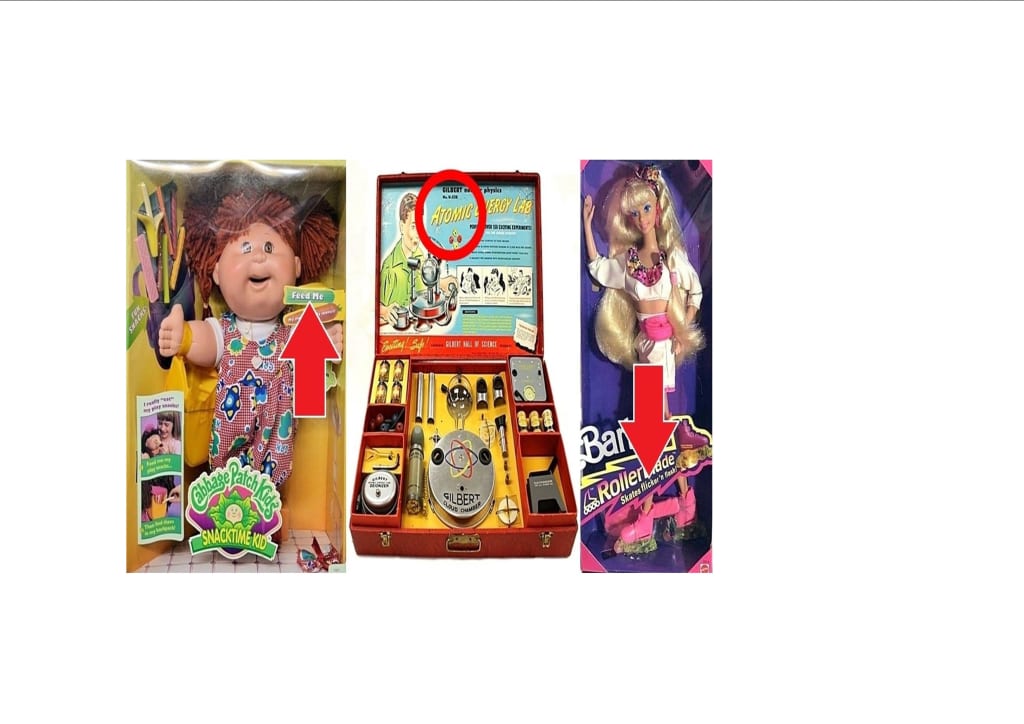
There are health risks associated with even some of the biggest franchises. Barbie is capable of doing anything! Despite being about nineteen for fifty years, she can dance, operate on people, and even run for president. But things turned dangerous when she made the decision to start rollerblading. A 1991 variation, Rollerblade Barbie, capitalized on the growing in-line skate craze. With built-in LED lights that flashed as kids pushed them, her skates had a cool feature. These skates, however, also produced sparks when they were rolled over a flat surface, which proved to be a fire hazard. The toy was swiftly pulled from stores, and now the only places to purchase it are from extremely expensive second-hand vendors who were able to secure a vintage Arson Barbie.
The next famous toy made eating a little risky. Children enjoy acting out scenarios with their toys, and caring for baby dolls is a frequent pastime. However, it's uncommon for the dolls to actually consume the food that is provided! When the Snack time Kids Cabbage Patch Kids were introduced in 1996, that situation changed. They could consume plastic snacks that were shoved into their mouths, with the toy being pulled in by their mechanical jaws and released into a backpack that was fastened to them. The issue was that the jaws were quite powerful—powerful enough to pull in and crush tiny fingers that got caught inside! Although there were no reports of serious injuries and the toy did have a release mechanism, Mattel and the government decided to recall it less than a year after it was first sold.
The next toys spread danger like wildfire. In the 1990's, there was probably a toy line associated with any cartoon that was airing on television. This was the case with the television program Sky Dancers, which featured young heroes with flying abilities. When you released a pull-string base, the foam-winged dolls would actually take off into the sky and fly in any direction, which attracted a lot of attention to the toy line in 1994. They were strong and difficult to control, and they occasionally flew into people's faces and eyes, which was a problem. The toys were recalled by the manufacturer Galoob after a flurry of ER visits and numerous broken vases revealed they were hazardous, leading to any animator's worst nightmare: a cartoon with no related merchandise.
Danger can occasionally be found in the most unexpected places. When they see their children playing cards, parents are probably quite relieved. What could possibly go wrong—little Billy using his sister's allowance to play poker, for example? However, one card game contained a secret danger. named after a well-liked TV program. A hidden danger was present in this 2007 spin-off of the card game Hannah Montana, a Miley Cyrus Disney Channel sitcom, as a result of manufacturing inefficiencies. The cards contained shockingly 75 times the advised amount of lead! It was a component of a widespread investigation into the lead content of toys, which resulted in the recall of more than six million toys.
A toy can typically only be banned for one reason, but what if there were three? In the 1990's, Yo-Yo Water Balls were still popular, but they were more of a novelty than a beloved toy. They were plastic balls that were neon-colored and filled with liquid that were typically used by children tossing them around and hitting each other with. But there was a lot of concealed danger in these tiny novelties. Stretchy cords that could entangle around necks, a chemical solution that could poison users, and highly flammable elastic material were all features of these contraptions. A single product has the potential to burn, poison, and strangle children! It's understandable why some states outright banned them, forcing the company to eventually redesign them.
A well-known franchise introduced an iconic toy, but the results were fatal. Children adored Battlestar Galactica's vibrant spaceships, despite the show being a cult favorite. The Colonial Viper Ship of 1978 was popular not only for its design but also for its missile-launching capabilities. This turned out to be its downfall, though, as a young child could easily swallow the tiny plastic missiles. Upon shooting a missile into his mouth, a four-year-old boy choked to death. The toy was taken down from the racks. The original ship not only never surfaced again, but it also changed into the reason why choking warnings are usually printed on the boxes of toys with small parts like projectiles.
Toys can, however, sometimes seem harmful right away. Who wouldn't want to see a young child operating a car? When Fisher-Price introduced the Power Wheels toy, a battery-operated mini-car that could transport kids around the neighborhood in style, they weren't worried. Many parents were already concerned about the possibility that their children might drive into traffic or into another dangerous situation, but it soon became clear that there was another issue: brakes in a 1991 model had the potential to fuse together, rendering the vehicle immobile. Then, starting in 1998, the cars had the unlucky propensity to catch fire. Nevertheless, despite these unsuccessful models, the company still sends young people zipping around.
The following toys were even free for parents to purchase: When you're a kid, is there anything more exciting than finding out what toy you're getting in your fast food meal? In 1999, Burger King increased the stakes by opening one of the most well-known franchises of the day: Pokemon. Parents found themselves purchasing a lot more nuggets and burgers as a result of kids opening plastic balls to discover plastic figures of arbitrary animals. The danger came from the shell rather than the figures themselves. Two babies lost their lives as a result of the plastic ball's halves being the ideal size to fit over infant mouths and become suctioned on. In one of the largest toy recalls in history, the company reacted swiftly and recalled 25 million of these fast food toys.
Rewinding the clock, many toys in the 1940's and later were incredibly hazardous. Even though the Easy-Bake Oven occasionally presented an unintentionally dangerous situation, the Little Lady Stove did not. No, this one was made to be risky! This was a fully functional electric stove with a heated top for simmering rather than baking and two cooking compartments. It could therefore become hot. Very warm. Needless to say, this resulted in a lot of burns, but ultimately, the Little Lady Stove wasn't destroyed by the numerous risks. Many children's fingers were saved by the World War II shortages of metal.
Is cooking not risky enough for kids? How about making glass? During the first half of the 20th century, Gilbert was a toy and craft company best known for its erector sets and toy trains. But many of its craft supplies, beginning with the Glass-Blowing Kit, contained a secret danger. Glass must be heated to about 1,000 degrees Fahrenheit in order to be blown, which makes it dangerous even for professionals. However, glass blowing used to be a necessary skill for students taking chemistry because they had to make their own test tubes! Early instruction in this skill was decided upon by Gilbert, with predictable outcomes. The toy, which included a carry-on torch for heating the glass, caused numerous cuts and burns and was quickly removed from stores. Gilbert simply couldn't stop allowing children to intentionally harm themselves.
Why not allow kids to create model figurines instead of glass blowing, which is quite dangerous? The Gilbert Kaster Kit Jr. Set's objective was to make something that sounded nice and secure. The issue was that kids would make figures from molten lead poured into molds rather than just painting them! Little kids playing with hot flames was one of the issues with this, which also existed with the glass-blowing kit. And to make matters worse, this was done in an era when nobody fully understood the dangers of lead poisoning in children. Not surprisingly, this kit was also quickly taken off the market. Simply telling your child to stop playing and watch some TV will suffice.
Gilbert, however, was about to surpass them with their most hazardous equipment ever. In 1950, both as a source of domestic energy and as a weapon of war, nuclear technology was the talk of the planet. But that doesn't mean that adults should let kids join in the fun. Gilbert still went ahead and set up the U-238 Atomic Energy Laboratory, which allowed kids to conduct tests to see if various objects were radioactive. And you guessed it, that meant that the toy actually contained minute amounts of uranium, one of the planet's most dangerous elements. Less than 5,000 kits were sold before the toy was quickly taken off the market as soon as word of this spread.
With goods like these, it's understandable why Gilbert closed its doors in 1967. However, dangerous play kits aren't just a relic of the distant past. What could be a better playset for children than CSI? In the early 2000's, CBS was obsessed with gory detective thrillers, which gave rise to numerous spinoffs. The CSI Fingerprint Examination Kit was introduced by the network in an effort to pique the interest of potential new viewers. Thanks to a special fingerprint-dusting powder that the toy company advertised as being exactly like the one real crime scene investigators use, this allowed kids to get a close-up look at their own fingerprints. There was only one issue: toxic asbestos was a bonus ingredient. The non-profit Asbestos Disease Awareness Organization fortunately raised the alarm early, so no budding detectives were hurt in this toy heist.
The following toy appeared innocent, but it was anything but! A straightforward craft tool called Aqua Dots featured tiny colored beads that could be arranged and then covered with water to create artwork. The beads became permanently fused when the water triggered glue within them. An excellent craft for a rainy day, but why are the kids puking? Even though the beads were too small to pose a choking risk, kids will always try to eat small objects, so it soon became apparent that there had been a significant manufacturing error. The beads were produced by Chinese subcontractors using chemicals that combined to form gamma-hydroxybutyrate, also known as the potent drug GHB. The companies rushed to recall the entire product line in 2007 after discovering that they had been accidentally dosing children. After one rebrand, they were re-released as Pixos and Bindeez, and they continue to be sold today despite missing one essential ingredient.
This next toy's name alone ought to have provided some guidance. A Creepy Crawlers' Thingmaker would be welcome in any home. In addition to having a slightly ominous name, the 1964 Mattel playset also contained a number of health risks. In the past, it was one of those "toys" that included a functioning oven, giving kids the opportunity to burn themselves on an element that could reach almost 200 degrees Celsius. Perhaps they were being covertly funded by the burn center. However, this one used "plastigoop," a synthetic substance that, when heated in the oven, releases harmful fumes, to create its plastic animals. It was removed from the shelves as soon as children started getting sick, but Mattel was never one to let a bad idea die, so ten years later they released a safer version.
The following example demonstrates that not all strategies used by adults also apply to children. Is there anything more enjoyable than unwinding in a hammock after a long day of work? When they saw their father relaxing, many children said, "I would love a hammock of my own." The toy industry responded, "I would love the money from them having their own hammock." The spreader bar that kept the kids' small bodies apart was removed from the mini-hammocks by many companies, which were then released. This went horribly wrong because it turned out that the hammocks could easily twist up without this feature. Many young children got the hammocks twisted around their necks, in addition to the countless others who became entangled in them or were unceremoniously thrown out. After twelve strangulation deaths, the companies swiftly removed nearly three million mini-hammocks from toy store shelves.
And now, we're starting off with the most notoriously outlawed toys in history. As any parent who has stepped on a Lego in the middle of the night can attest, construction toys are among the most popular toy categories. The magnet-based tubes and blocks from Magnetix were a huge success when they first hit the market in the early 2000's. Nevertheless, where magnets go, pain and recalls follow, just like the Polly Pocket set. The Magnetix sets, unlike Polly Pocket, had hundreds of attached magnets instead of just a few that could be detached. both to the individual balls that could be used to connect the pieces and to the pieces themselves. Naturally, young children began swallowing the loose magnets, which led to serious stomach problems. Magnetix was quickly taken off the market but eventually made a comeback with a safer model after one toddler died and other kids needed emergency surgery.
What specifically did you anticipate would occur in this subsequent instance? Jet-skiing is a dangerous sport on its own, so it only makes sense that some creative toy manufacturer wondered, "What if you could jet-ski and fly at the same time?" This prompted the development of the We Go Kite-Tube, a plastic disc that could be launched into the air quickly by being towed behind a speedboat and catching air there. It was an exciting activity, but everything that rises must also fall. The kid riding behind the boat was at the mercy of the wind and the driver's skill because the kite tube lacked any means of control. Naturally, this quickly led to terrible mishaps that resulted in two fatalities. The manufacturer soon issued a recall for the product, but no one could definitively attribute the problem to a flaw in the toy. Simply put, it was a terrible idea all the way through.
However, no toy was more dangerous than this one. The 1940's were a dangerous era for children's toys. Heck, they could just shoot each other with BB guns, and their parents would be more likely to scold them for making so much noise. The Austin Magic Pistol was the result of toy manufacturers realizing they needed to step up their game. Why, then, did toy guns need them? powerful weapons, and perhaps some fire. A real combustion engine was included in the Austin Magic Pistol. What about the "magic crystals" that the box advertised? They were made of calcium carbide, a dangerous substance that, when combined with water, could explode. All of these factors worked together to propel a plastic ball more than 70 feet in the air with an explosive force that could gravely hurt or kill a child within close proximity. Even in the wild and wooly 40s, it was too dangerous, and by the 1950s, it was no longer available. It would not make a comeback and was ultimately recognized by the government as a legal firearm.
When buying for your kids, always remember that their safety is your top priority. Don’t put your child’s safety at risk.
About the Creator
Jogemar Pinongan
Wordsmithing my way through life. Sharing stories and insights to bring joy, knowledge, and understanding.
Enjoyed the story? Support the Creator.
Subscribe for free to receive all their stories in your feed.
Comments
There are no comments for this story
Be the first to respond and start the conversation.