
Primary School Grades Don’t Lie. They Just Stop Predicting High School.
A first-year high schooler freezes at a function problem, and the pause explains more about learning than an elementary school report card.
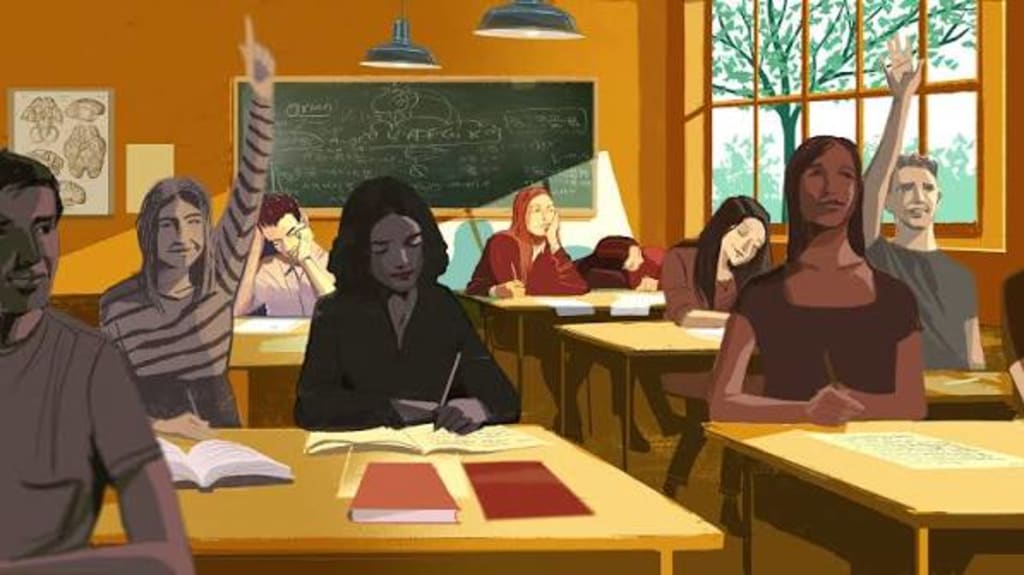
During second period of evening self-study, a first-year high school boy read a function problem three times. His scratch paper was full of formulas. The domain line was blank. He asked the teacher, “Which formula do I plug in?” The teacher pointed to the word “function”: “First look at what x can take.” He froze, pen on paper.
That pause is common. It does not start in high school. It becomes visible there.
People say primary school grades are deceptive. The sentence explains a pattern: some strong primary students cannot follow high school. If we take it too literally, we get a worse claim: primary grades mean nothing, or doing well early is a trap.
Better: primary school grades show current learning. They do not show future learning. Grades do not lie. They measure mastery at one stage, in one subject range, under one evaluation method. The mistake is treating a stage result as a permanent forecast.
If temporary grades could forecast everything, then middle school grades would also be deceptive, college grades deceptive, adult achievements deceptive. Only a final verdict at death would count. That logic fails.
The real question: why do some strong primary students fall behind in high school? Why is the top-student gap sharper between middle and high school than between other stages?
I. Primary grades show current state
Primary knowledge is shallow, concrete, factual. It leans on memory, repetition, fluency. Arithmetic, pinyin, characters, words, sentences, poems, stories: the work is to make rules fluent, writing fluent, surface meaning clear, simple ideas expressible.
Children at this stage have not fully developed. Their experience and knowledge are limited. They cannot handle high-intensity abstract and logical training. Primary education accumulates knowledge and experience while protecting healthy growth. Compulsory education exists because everyone needs basic knowledge to live in society.
Rote memory, practice, and broad exposure are useful and necessary here. A child willing to memorize, practice, repeat can get good grades. That is not strange. Trouble comes when students, parents, or teachers treat this low-stage strategy as universal and rely on it later.
Many strong primary students cannot keep up in middle school. Most keep their lead in middle school. Some decline in high school, and some hit a cliff: they cannot follow the lesson. The main cause is a way of thinking that still fits primary school: memorization, repetition, formula-plugging, formula-twisting. It has not upgraded to abstract and logical thinking. Higher knowledge is more abstract and more logical.
II. High school is not middle school continued
High school already touches higher knowledge. It works like a college prep year. The thinking gap between middle and high school is larger than the gap between other stages.
In high school and college, knowledge becomes abstract concepts and complex relations that need logical reasoning. A high school function is a correspondence between sets. Sets and correspondences are abstract constructions, not everyday objects. Displacement, velocity, and force in physics need vectors, not intuitive distance and path length. High school Chinese needs language logic: relations between paragraphs and sentences, conclusions and counterarguments from statements, reference and metaphor, not plain description.
Most primary top students remain top students in middle school. Most high school top students keep advancing in college. The sharp gap sits between middle and high school. News reports about middle school high scorers choosing integrated vocational pathways or vocational high schools, routes that serve lower-performing students, point to one cause: compulsory education and higher education ask for different thinking.
High school is not compulsory. It sits in a blurry zone, closer to higher education. High school and college content are not essentially different. High school has not yet learned enough advanced math tools, and it covers details less systematically, but the thinking demand is similar. Many top high school students can study advanced textbooks alone. Primary and middle school students almost always need a teacher to study ahead. That difference is visible.
Thinking upgrades take training and accumulation. They do not happen in one jump. They also do not happen only in textbooks and exercises. Life tasks and play offer many chances. Tasks a student cares about often push active thinking and logic harder than unwilling study.
III. Rote memory plus drilling works early and fails later
Many primary top students, pushed by parental approval or class status, treat learning as a tool. They are not interested in what knowledge means or does. This mindset rewards quick methods: rote memory, mindless drilling, formula recitation. Those methods block thinking training when relied on too long.
They work in primary school, where knowledge is simple and problem types repeat. They can work in middle school through extra effort. In high school, which demands abstract and logical thinking, the student hits a wall: cannot follow class, cannot read the problem, cannot move. It is like a person used to eating with hands meeting food that requires chopsticks.
Memory and fluency are not the enemy. Primary memory and fluency are foundations. The problem is relying only on them in high school. Lower-order strategies lose value in higher-order tasks. In primary school, remember the type, plug the formula, drill again, covers most exams. In high school, types vary, relations are complex, and problems demand conceptual understanding and reasoning chains. Templates fail.
Middle school should be the bridge from concrete to abstract, from common sense to theory. Middle school math leaves everyday arithmetic. Students meet irrational numbers, points on a line matching real numbers, points in the coordinate plane matching ordered pairs, lines and hyperbolas matching linear and inverse functions. Euclidean geometry trains thinking through an axiomatic system.
Many primary top students keep using rote memory, practice, and broad exposure. These worked in primary school and were necessary then. They still drill hard and memorize problem templates instead of asking what knowledge means, how the logic fits, and how to build a flexible method. Some students who did not focus on school early but liked strategy games, detective stories, and logic puzzles can, if they focus in high school, use those habits and become strong students.
None of this means primary school does not matter or that reasoning games replace study. Abstract and logical ability can move across settings. A student used to reasoning, induction, abstraction, and checking in games, life, and interests can upgrade thinking more easily in high school. A student who treats learning only as a short-term task and relies on lower-order strategies will hit a bottleneck.
IV. Training abstract thinking: start with the soccer goal
The upgrade needs abstract thinking and logical thinking.
Abstract thinking pulls a concept out of concrete things and states it clearly. I use the soccer goal example because I loved soccer as a child. Conditions were poor. The school had one playground and a few simple goals. We could not go often. When the goals were not set out, we played on open ground. Two piles of schoolbags made the goal. We set a height limit at the waist. In the corridor, a few bricks on a wall became the goal. On the basketball court, the frame under the hoop became the goal.
As a child, I just played. Later I saw the concept: mark an area, and a ball entering that area scores. The material did not matter: schoolbags, bricks, or a basketball frame. The abstract parts were the area and the scoring rule.
Courses teach many abstract concepts: number line, coordinate plane, linear function, quadratic function. They are not as plain as counting or division with remainder. They need direct study of meaning and properties. A number line is a line with a positive direction, an origin at 0, and a unit length at 1. Every point matches a real number. A coordinate plane puts two number lines perpendicular with matching origins. Every point matches an ordered pair of real numbers. Coordinates then express geometric relations.
Abstract ability needs training. Through talk and thought, clarify concepts in life. Widen them. Generalize them. Pull one concept from as many different things as possible. Extend it as far as the conditions allow. Take “cup.” Clarify and generalize it to “a container for holding and drinking water.” A bowl is a cup. A pot is a cup. A bucket is a cup. A water-holding block is a cup. Do the same with knowledge and concepts already learned.
This training looks simple. It matters. It trains a student to pull a shared structure from different objects and define it in clear language. High school math, physics, chemistry, and biology need this. A student who only remembers “this formula looks like this” but cannot say “what relation this concept describes” fails when the problem changes.
V. Training logical thinking: from plugging formulas to deriving conclusions
Logical thinking analyzes, reasons, induces, and summarizes. Slightly complex problems need reasoning.
To train it, drop the “plug into formula, transform formula” habit. Use “what conclusion follows from the conditions.” Derive new conclusions step by step. Use “to find the answer, what conditions do I need.” Work backward to the given conditions. Sometimes work from both ends and connect in the middle. Train the layered feel of reasoning. Drop the shortcut thinking: “this fits formula X” or “that fits theorem Y.”
Plane geometry, especially Euclidean geometry, is strong training material. Hardcore detective novels, films, TV series, animation, computer games, board games, and murder mystery games also work. Pick what interests you. Play something new. Reason. Do not replay the same thing. Do not rely on experience. Do not rely on illogical convention, as in Werewolf. Logic training is not about winning by routine. It is about deriving unknown conclusions from known information.
The value is not just exam problems. It slowly changes a student’s default response to complex problems. The first question becomes “What is known, what follows, what is missing?” not “What problem does this look like?” When that response becomes a habit, high school learning goes more easily.
VI. Textbooks and knowledge structure matter too
Another reason high school feels hard: unified textbooks sometimes explain concepts and principles thinly, and the knowledge system looks messy. Textbooks still matter. But some students cannot easily understand the basic meaning, principles, and logic of science from textbooks alone. They cannot build the logical thread and structure for deriving main conclusions.
To help, I shared my high school math, physics, chemistry, and biology notes on Zhihu. They start with cases close to the real world and daily life. They explain concepts and formulas in plain language, with attention to meaning and principle. They connect conclusions through logic and relations. They show how to analyze, reason, and solve with general, reliable logic, not flashy formulas.
The notes can be downloaded and printed from the cloud drive. No follows, no electronic payment. The Zhihu articles have the links. The access code is abcd. The full set of basic notes and problem-solving ideas is in those articles. With support from Peking University Press, the math and physics notes are now books. The content has been proofread, optimized, simplified, and laid out. Buying the books costs less than printing. Titles: The Logic of Mathematics: High School Mathematics Can Be Learned This Way; The Logic of Physics: High School Physics Can Be Learned This Way; The Logic of Chemistry: High School Chemistry Can Be Learned This Way. Major online stores carry them. Search the titles. The biology notes are in progress.
Ending
The dismissal bell rang. The boy turned his scratch paper over and copied the problem again. Under “function,” he drew a line. Beside it he wrote: what can x take. Outside, a ball hit the iron gate. Bang. He looked up once, then down. He put his bag by his feet and left a gap between two piles of schoolbags. The ball rolled in and stuck. He reached out, flicked it away, raised a hand for the score, sat back down, and turned the page.
About the Creator
Jin
Writer of reamstories
https://reamstories.com/jin
Enjoyed the story? Support the Creator.
Subscribe for free to receive all their stories in your feed. You could also become a paid subscriber, letting them know you appreciate their work.
Comments
There are no comments for this story
Be the first to respond and start the conversation.