

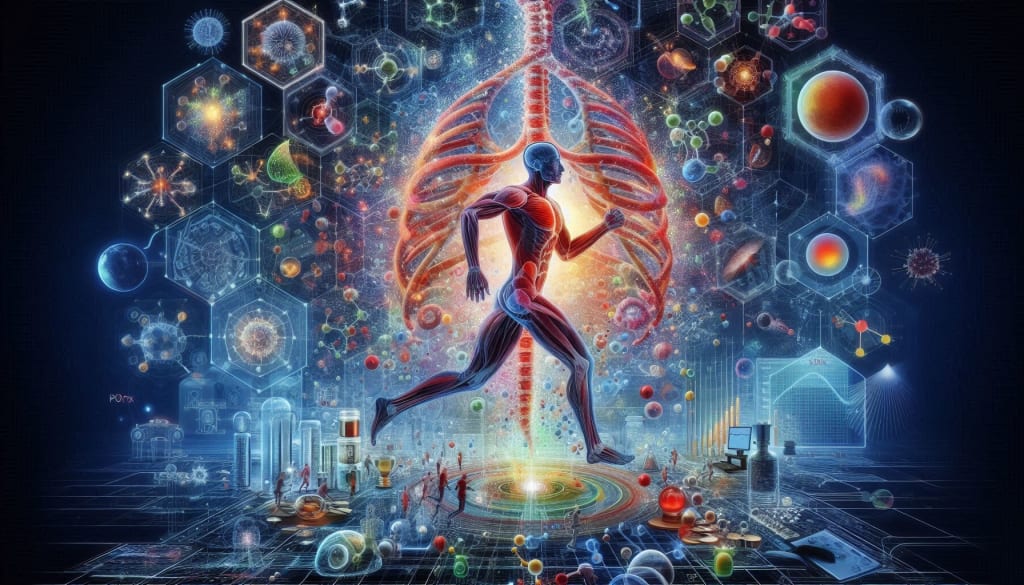
NOTE: The following content is created by artificial intelligence
Introduction
At its core, physiology is the study of how living organisms function, an exploration into the intricate processes that keep us alive and well. It’s like dissecting the complex and fascinating machinery that works tirelessly behind the scenes, allowing us to move, breathe, digest, think, and respond to our environment. Physiology provides us with an understanding of life at the most fundamental level, diving deep into how every part of our body operates in harmony. Here are some intriguing aspects that highlight the wonders of this science:
Body
**Internal Workings:**
Physiology delves into the nitty-gritty of our organs and systems, revealing how each component contributes to the whole. For instance, how does the heart manage to pump blood consistently throughout our lives, without ever taking a break? It’s not just a simple pump, but a highly sophisticated organ that responds to various signals to adjust its rate and strength depending on our needs, whether we’re running a marathon or just sitting on the couch. Similarly, how do our lungs efficiently exchange gases, ensuring that oxygen enters our bloodstream and carbon dioxide is expelled? The lungs are a marvel of design, with their branching airways and millions of tiny alveoli that facilitate this crucial gas exchange.
What about our digestive system—what kind of "sorcery" happens there? The digestive tract is an incredibly well-coordinated system that breaks down food into nutrients, absorbs them into the bloodstream, and eliminates waste. It’s a process that involves not only mechanical actions, like chewing and the churning of the stomach, but also a complex interplay of enzymes, acids, and bacteria that help in breaking down what we consume. These questions lead us down the rabbit hole of life’s inner workings, showing us how our body is a well-oiled machine, finely tuned to keep us going.
**Communication Networks:**
Another fascinating aspect of physiology is the way our body communicates internally. Our body is essentially a bustling metropolis of communication systems, constantly transmitting messages and instructions. Neurons fire electrical signals, hormones are released into the bloodstream to carry messages to distant organs, and cells communicate through chemical signals. Physiology unravels these intricate networks, revealing how these different types of signals travel through our body, how cells "talk" to each other, and how our body orchestrates its symphony of functions.
Take, for example, the nervous system—a lightning-fast communication highway. Neurons transmit electrical impulses that allow us to react almost instantaneously to stimuli. Whether it’s pulling your hand away from a hot surface or blinking when something approaches your eyes, the speed at which these signals travel is mind-blowing. On the other hand, the endocrine system, which involves hormones, acts at a slower pace, but its effects are far-reaching and long-lasting. Hormones regulate everything from growth to metabolism to mood. This careful coordination between fast and slow communication systems ensures that our body responds appropriately to both immediate challenges and long-term needs.
**Survival Strategies:**
Physiology also reveals how our body is a master of survival strategies. Imagine our body as a survival artist, always adapting and responding to maintain balance, or homeostasis, in the face of constantly changing conditions. One of the main focuses of physiology is studying how our systems collaborate to maintain this equilibrium. For example, our body regulates temperature through sweating or shivering, keeping our core temperature within a narrow range, even in extreme environments. Similarly, the balance of electrolytes, such as sodium and potassium, is carefully monitored to ensure proper nerve and muscle function.
Think about how our body reacts when we’re dehydrated—it signals thirst, slows down urine production, and retains more water in the kidneys. This is just one of the many survival tactics our body employs to ensure that vital processes continue uninterrupted. It’s all about maintaining a delicate balance, allowing us to thrive even when external conditions threaten to disrupt our internal stability.
Conclusion
In conclusion, physiology is not just about the study of bodily functions; it is a celebration of life’s complexity. From the microscopic to the macroscopic level, physiology helps us appreciate how every organ, tissue, and cell works in tandem, keeping us alive and healthy. Through understanding physiology, we gain a deeper appreciation for the intricate systems and survival mechanisms that make life possible.
About the Creator
Enjoyed the story? Support the Creator.
Subscribe for free to receive all their stories in your feed.
Comments
There are no comments for this story
Be the first to respond and start the conversation.