
Part-Time PhD in Physics
A Flexible Approach to Advanced Research

Introduction
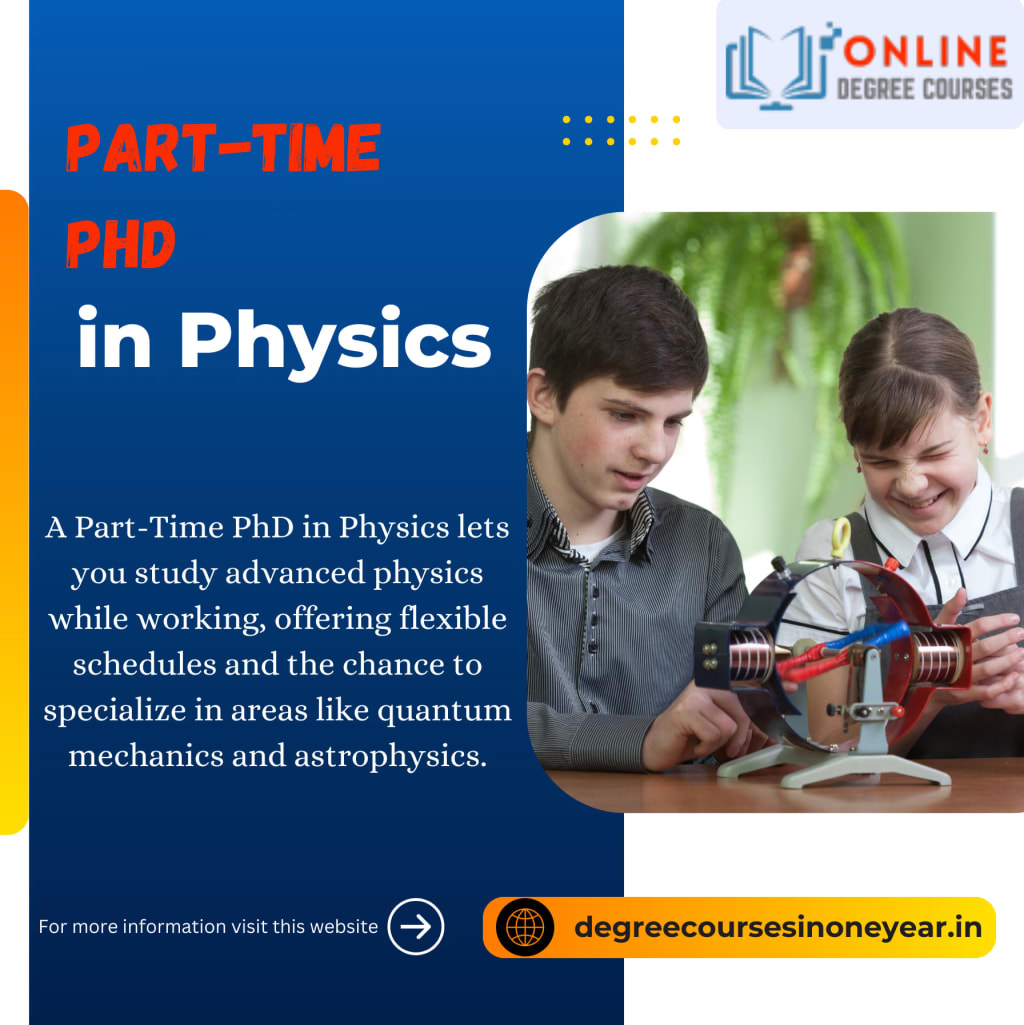
A Part-Time PhD in Physics is an excellent opportunity for working professionals, researchers, and academicians who want to pursue a doctorate while managing other responsibilities. This program allows candidates to explore various physics domains without the constraints of a full-time commitment. In this blog, we will discuss the benefits, eligibility criteria, admission process, research areas, challenges, and career prospects associated with a part-time PhD in Physics.
Why Choose a Part-Time PhD in Physics?
A part-time PhD program is ideal for those who wish to earn a doctorate without stepping away from their current job or personal commitments. Here are some key benefits:
- Flexible Schedule – Candidates can balance their research work along with professional or personal duties.
- Career Growth – Holding a PhD in Physics enhances job prospects in academia, industry, and research institutions.
- Practical Application – Professionals working in physics-related fields can directly implement their research findings into their job roles.
- Financial Stability – Since candidates can continue working, they can finance their education without financial stress.
Eligibility Criteria for a Part-Time PhD in Physics
To enroll in a part-time PhD program in Physics, candidates must typically meet the following eligibility requirements:
- A Master’s degree (MSc/MPhil) in Physics or a related field with at least 55% marks.
- Some institutions may require relevant work or research experience.
- Candidates might need to qualify for an entrance examination conducted by the university.
- Submission of a research proposal demonstrating their area of interest and study objectives.
Admission Process for Part-Time PhD in Physics
The admission process for a part-time PhD in Physics generally includes:
- Application Submission – Candidates must submit their academic records, research proposal, and work experience details.
- Entrance Examination – Some universities conduct an entrance test to evaluate research aptitude.
- Interview Round – Shortlisted candidates may be called for an interview to discuss their research interests and feasibility.
- Proposal Approval – Universities assess the research proposal before granting admission.
- Coursework and Research – After admission, candidates complete coursework and commence research under a supervisor.
Research Areas in Part-Time PhD in Physics
Physics is a vast field with numerous research opportunities. Some of the most common areas for a PhD in Physics include:
- Quantum Mechanics – Studying the behavior of matter and energy at atomic and subatomic levels.
- Astrophysics – Researching celestial bodies, space, and the universe’s fundamental properties.
- Condensed Matter Physics – Exploring the properties of solid and liquid matter at microscopic and macroscopic levels.
- Theoretical Physics – Formulating models and theories to explain physical phenomena.
- Material Science – Investigating the structure and applications of different materials in physics.
Duration of a Part-Time PhD in Physics
A part-time PhD in Physics typically takes 4 to 6 years, depending on the research complexity, institution requirements, and the scholar’s pace. Some universities may allow extensions in special cases.
Challenges of Pursuing a Part-Time PhD
While a part-time PhD offers flexibility, it comes with its own set of challenges:
- Time Management – Managing work, personal life, and research can be difficult.
- Extended Duration – Part-time PhDs usually take longer to complete compared to full-time programs.
- Resource Limitations – Part-time scholars may have restricted access to laboratories and university facilities.
- Maintaining Focus – Staying motivated over a long duration requires dedication and discipline.
Career Opportunities After a Part-Time PhD in Physics
A PhD in Physics opens up diverse career options across various sectors, including:
- Academia – Teaching positions in universities and colleges.
- Scientific Research – Working as a researcher in government and private institutions.
- Industry Roles – Employment in aerospace, semiconductor, and energy sectors.
- Public Sector – Opportunities in space research centers, defense organizations, and national laboratories.
Conclusion
A Part-Time PhD in Physics is an excellent choice for those passionate about advanced research while maintaining their existing commitments. Although it requires perseverance, time management, and dedication, the rewards in terms of career growth, knowledge enhancement, and professional recognition make it a worthwhile pursuit. If you are eager to contribute to the field of physics and achieve academic excellence, a part-time PhD is a perfect choice for you.
About the Creator
Online GraduationCourse
Onlinegraduationcourses offer individuals the opportunity to pursue their graduation studies through a variety of online courses.
https://onlinegraduationcourses.in/
+91 - 7042 23456 9
Enjoyed the story? Support the Creator.
Subscribe for free to receive all their stories in your feed.
Comments
There are no comments for this story
Be the first to respond and start the conversation.