
Online Mystery Puzzle Book Ideas for Adults: Beyond Word Searches
The growing appeal of detective books, spy missions, and code-breaking challenges.
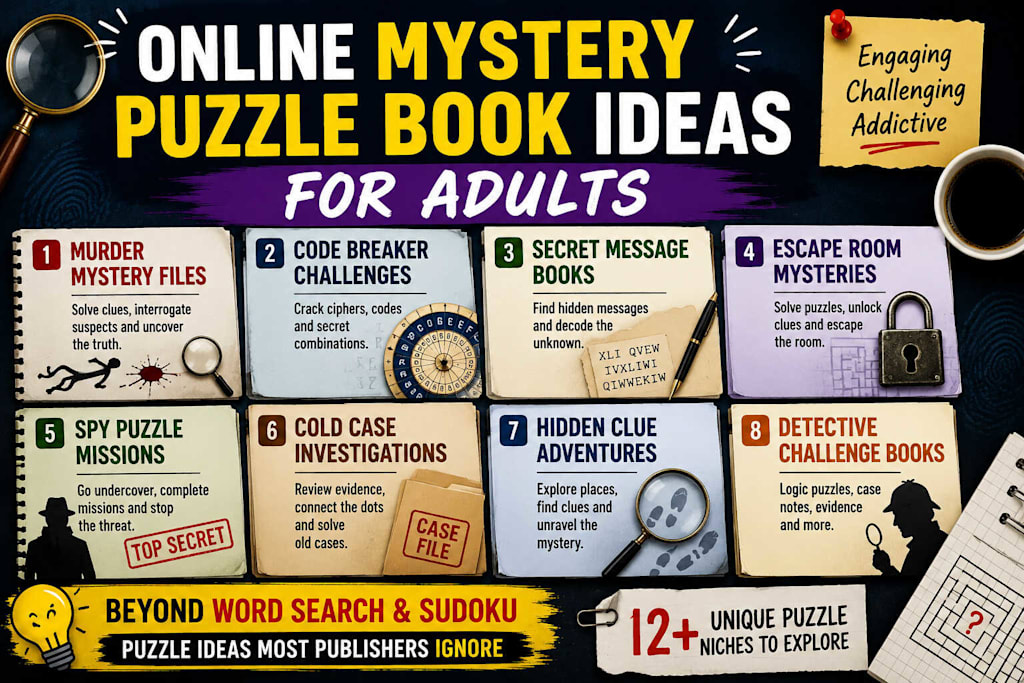
I have been spending more time than I care to admit browsing puzzle book categories on Amazon. Not solving them. Studying them. As someone who has followed the self-publishing space for a while, I wanted to understand what was actually selling, what was saturated, and where the gaps might be. What I found was a pattern that became impossible to unsee.
The traditional puzzle book market is enormous. Word search books alone represent a staggering number of listings. Sudoku collections, fill-in puzzle books, standard crosswords, and I Spy-style visual puzzles fill page after page of search results. Many of them are structurally identical. A grid of letters. A numbered list of words to find. A solutions page at the back. Different cover, same interior. Different author name, same experience.
This observation is not a criticism of the publishers creating them. Many of these books sell consistently. They meet a clear demand. Readers enjoy them, they are familiar, and they require no learning curve. But as I scrolled through what felt like the hundredth page of results, I started asking a different question. If I were entering this space today as a new publisher, as a puzzle creator looking for fresh territory, as an Etsy seller building a product line, would I want to compete here? And if not, where else could I look?
That question led me down a much more interesting path. One that eventually opened up into a category I now find genuinely fascinating: online mystery puzzle book ideas for adults. Not the traditional puzzle formats repackaged with darker covers, but something structurally different. Books that function less like collections of isolated puzzles and more like experiences. Books where the puzzles serve a narrative. Where the reader becomes a participant rather than just a solver.
The Crowded Landscape
To understand why this matters, it helps to look closely at what has happened to the traditional puzzle book market. Over the past several years, the barrier to entry for creating puzzle books has dropped dramatically. Accessible design tools, automated puzzle generators, and print-on-demand services have made it possible for virtually anyone to publish a word search collection or a sudoku book in an afternoon. That accessibility is genuinely empowering. It has also created an environment where certain categories feel overwhelmingly saturated.
Browse the word search book section and you will notice the pattern immediately. Hundreds of books with nearly identical interiors. The same grid sizes, the same word lists organized by theme, the same formatting. The differentiation happens almost entirely at the cover level. A floral pattern for gardeners. A dog photo for pet lovers. A vintage car for automotive enthusiasts. The puzzle itself never changes. The audience is segmented by interest, but the product is fundamentally the same.
Sudoku follows a similar trajectory. Fill-in puzzles, crossword collections, and I Spy books have all experienced the same phenomenon. Publishers identify a working format, and the market floods with variations. This is not inherently bad economics. If a format sells, rational publishers will create more of it. But from a creative standpoint, from the perspective of someone looking to build something that feels distinct, the traditional puzzle space can start to feel like a very crowded room where everyone is speaking at the same volume.
I have spoken with several self-publishers who entered this space with enthusiasm and gradually felt the pressure of that sameness. They would create a beautiful word search book, optimize their listing, price it competitively, and then watch it sink beneath dozens of nearly identical offerings released the same week. The platforms are not designed to surface novelty. They are designed to surface what is already selling. And what is already selling is usually what already exists in large quantities.
Why the Tools Keep Producing the Same Results
Part of what perpetuates this cycle is the software ecosystem surrounding puzzle publishing. Most of the popular puzzle generation tools available to independent publishers are optimized for exactly the categories that are already saturated. You can find excellent generators for word searches, sudoku puzzles, fill-in grids, and crosswords. These tools are fast, affordable, and produce clean, professional output. They are also, by their nature, designed to create more of what already exists.
A word search generator takes a list of words and embeds them in a letter grid. It can vary the size, the density, the direction of the words. But it cannot transform a word search into something that feels like an adventure. A sudoku generator can produce puzzles at different difficulty levels, but it cannot turn the solving experience into a narrative journey. The tools are built for efficiency and scale, and they achieve both brilliantly. What they generally do not do is help publishers create immersive, story-driven puzzle experiences.
This is not a flaw in the tools. It is simply a limitation of their design scope. They solve the problem of producing traditional puzzles quickly. They do not solve the problem of creating something that feels different from every other puzzle book on the virtual shelf. For publishers who want to explore outside the standard categories, the limitation becomes apparent very quickly. The software that helped them launch their first five word search books offers no pathway into anything more experiential.
I want to be careful not to overstate this. Traditional puzzles have enduring appeal. Millions of people enjoy them precisely because they are familiar and straightforward. There will always be a market for a well-made crossword collection. But as I researched deeper, I became increasingly interested in what exists just outside that familiar territory. Categories where the interior of the book matters as much as the cover. Where the experience of solving is woven into something larger.
The Pull of Mystery and Narrative
This is where my research started to get genuinely interesting. I began searching for puzzle books that did not fit the traditional mold. I was looking for formats where the puzzles served a larger purpose, where there was a reason to keep turning pages beyond the satisfaction of filling in a grid. What I found was a cluster of related categories that felt completely different from the saturated traditional market.
Mystery puzzle books represent one of the most compelling of these alternatives. Unlike a standard puzzle collection, a mystery puzzle book typically places the reader in a role. They are not just solving puzzles. They are solving a case. The puzzles become clues. The answers connect to a larger story. A cipher might reveal the name of a suspect. A logic grid might eliminate possible motives. The format demands more engagement because the puzzles are not isolated. They are connected.
Detective activity books extend this concept into a more interactive direction. These books often include case files, witness statements, evidence logs, and physical puzzles that the reader works through sequentially. They can feel remarkably immersive. A reader spending an hour with a detective activity book is having a qualitatively different experience from someone spending an hour completing sudoku puzzles. Both are valuable. But one creates a memory, a sense of having participated in something.
Spy puzzle books add another dimension entirely. These books lean into themes of espionage, secret missions, and coded communications. They often incorporate elements that feel like props from a thriller. Ciphers, dead drops, surveillance logs, intercepted messages. The reader becomes the agent. The book becomes the mission brief. This framing transforms even relatively simple puzzles into something that feels consequential.
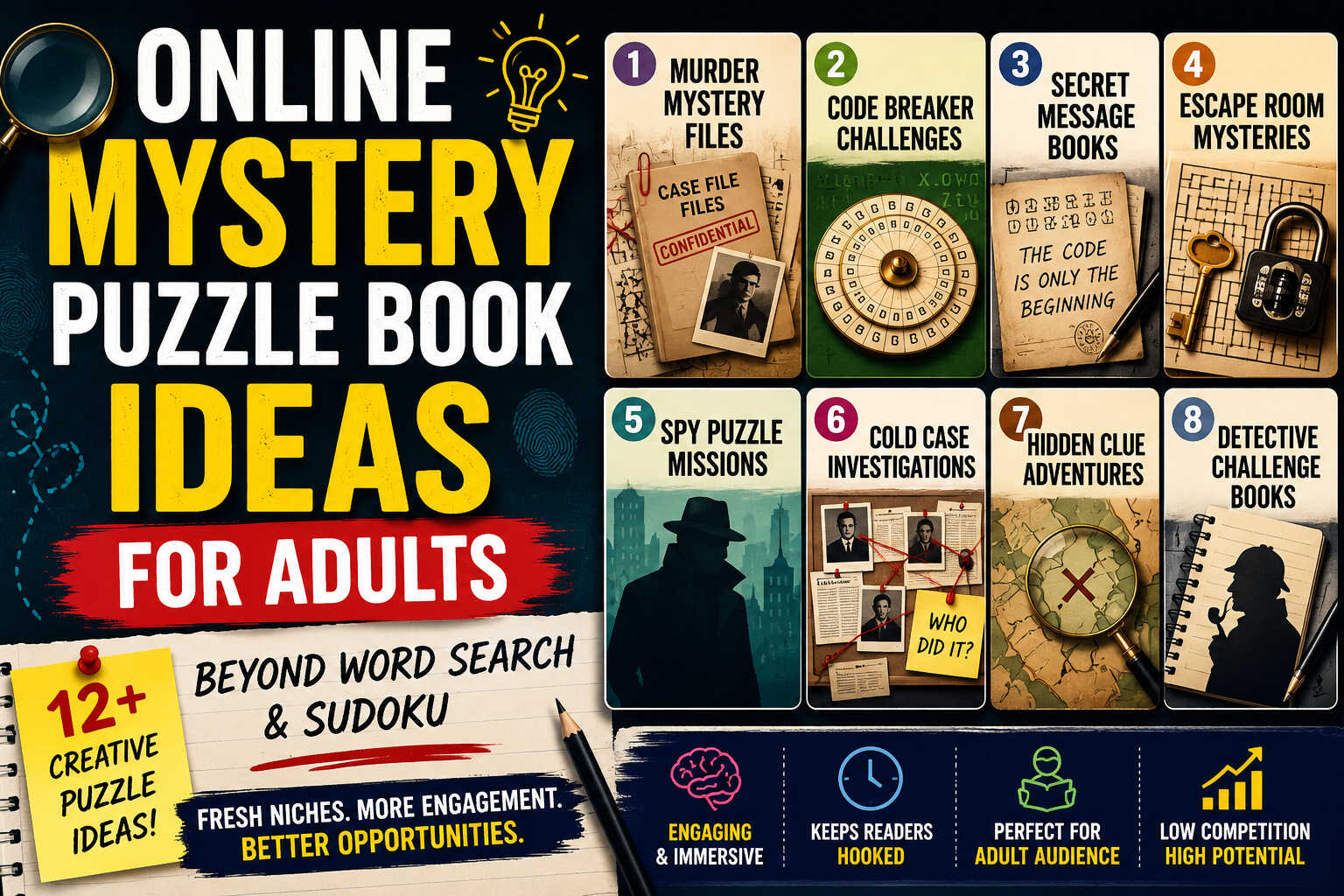
Code breaker books narrow the focus but deepen the expertise required. These collections center entirely on cryptographic challenges. Readers work through substitution ciphers, transposition puzzles, polyalphabetic systems, and increasingly complex encoding schemes. For adults who enjoy mental challenges that feel substantive, code breaker books offer something that a standard puzzle collection simply cannot match. The satisfaction comes not just from completion but from the gradual mastery of a skill.
Secret message books and mission-based puzzle books round out this landscape with formats that prioritize narrative continuity and reader agency. A secret message book might weave hidden communications throughout its pages, requiring the reader to extract and decode fragments that only make sense when assembled. A mission-style book might present a series of objectives, each unlocking the next, creating genuine forward momentum. These are books that readers stay up late to finish, not because they are addictive in the gamified sense, but because they want to know what happens next.
Narrative puzzle books, which blend fiction and interactive challenges, represent perhaps the most ambitious form of this alternative category. These are not puzzle collections with a loose theme. They are stories that cannot be fully experienced without solving the puzzles embedded within them. The narrative and the interactivity are inseparable. As I explored these various formats, I found myself thinking about online mystery puzzle book ideas for adults not as a niche, but as a genuinely different approach to what a puzzle book can be.
Why These Formats Feel Different
There are several reasons why mystery and detective-style puzzle books stand apart from traditional formats, and understanding these differences helps explain why they might represent meaningful opportunities for publishers willing to invest in something other than the standard template.
The first difference is time on page. A reader completing a word search might spend five minutes on a single puzzle and then move to the next. There is no narrative reason to linger. In a mystery puzzle book, however, the reader might spend twenty minutes studying a crime scene diagram, cross-referencing it with a witness statement, and working through a logic puzzle to determine what actually happened. The engagement is deeper because the context demands it. From a publishing perspective, books that hold reader attention longer often generate stronger reviews and more word-of-mouth recommendations.
The second difference is perceived value. Traditional puzzle books compete heavily on price and page count. Buyers compare thirty puzzles versus fifty puzzles versus a hundred puzzles. Mystery and detective formats compete on experience. A reader evaluating a spy puzzle book is not counting the number of individual puzzles. They are assessing whether the mission feels compelling, whether the codes feel authentic, whether the book delivers on its premise. This shifts the purchasing decision away from a commodity comparison toward an emotional one.
The third difference is repeat engagement. Someone who enjoys a well-crafted code breaker book is likely to seek out others in the same category. They are not just buying a puzzle book. They are buying into a genre. This creates opportunities for series, for branded lines, for building an audience that follows a publisher specifically because they trust that publisher's mystery and detective offerings. Traditional puzzle books can certainly be sold in series, but the attachment tends to be weaker. A reader who finishes a floral word search book does not necessarily need another one immediately. A reader who finishes a detective case file absolutely does.
The fourth difference, and perhaps the most significant for independent publishers, is the production barrier. Traditional puzzle books are easy to make, which is why so many people make them. Mystery and detective formats require more thought, more design work, and more narrative planning. That barrier is a feature, not a bug. It means the category will never be as flooded as the word search market. It means books that are well-executed have more room to breathe, more opportunity to be discovered, and more ability to command attention simply by virtue of being different.
Adult Readers and the Desire for Substance
One of the most interesting dimensions of this research has been understanding who is buying these alternative puzzle formats. Adult mystery puzzle books are not simply children's puzzle books with more difficult content. The adult audience brings different expectations and different motivations.
Adult readers of mystery activity books often describe their interest in terms that have nothing to do with traditional puzzling. They talk about the satisfaction of working through a complex case. They mention enjoying the feeling of being mentally challenged in a way that feels productive rather than repetitive. They appreciate the narrative elements, the sense that their effort leads somewhere meaningful. For many adult readers, these books serve as a form of active entertainment that feels more engaging than passive scrolling and more purposeful than casual gaming.
This audience also values aesthetics and production quality in ways that can be surprising. A sloppily designed mystery puzzle book, with typographical errors in the case files or inconsistent formatting in the evidence logs, will generate negative reviews faster than a sloppily designed word search book. The adult reader in this category notices details because the format asks them to notice details. The puzzles train them to be observant, and they apply that same observational standard to the book itself. Publishers who invest in quality design and careful proofreading are rewarded disproportionately in this space.
The adult audience also tends to purchase these books as gifts more frequently than traditional puzzle books. A detective activity book or a spy mission book feels like a more thoughtful present than a standard crossword collection. It suggests something about the recipient, that they are clever, that they appreciate a challenge, that they would enjoy stepping into a different role for a while. This gift-buying behavior creates additional market dynamics, including price flexibility and seasonal demand patterns that differ from the traditional puzzle market.
Discovering What Publishers Actually Use
After spending considerable time understanding these alternative categories, I started asking a practical question. If I wanted to create a mystery or detective-style puzzle book, what would I actually use? This turned out to be a more complicated question than I expected.
Most of the puzzle software I was already familiar with offered nothing in this direction. The popular generators focused on traditional formats. The design tools were built for covers and basic interiors, not for complex narrative structures. I began searching specifically for resources that supported the creation of code-breaking content, spy-themed activities, and mission-based puzzle books.
The search was revealing. There is a small but growing ecosystem of tools designed for this type of publishing, though they are much harder to find than traditional puzzle generators because they do not dominate the same marketing channels. Most are not advertised through the same affiliate networks or review sites. They spread more through word of mouth within specialized publishing communities.
While researching how publishers create mystery and code-breaking puzzle books, one of the resources I came across was because it focused on detective, spy, and mission-style puzzle creation rather than traditional grid-based formats. I spent some time exploring what it offered, not as a product review but as a window into how these more complex books are actually constructed.
What struck me was the specificity. The tool was not trying to be a general puzzle generator. It was designed around a particular publishing concept, creating books where readers engage with ciphers, secret messages, surveillance scenarios, and mission narratives. I looked at examples of what it could produce. Cipher Cracker challenges where readers decode layered encryption systems. Secret Message Decoder activities where hidden communications are embedded throughout a narrative context. Code Breaker Challenge books that escalate in complexity across chapters. Spy Mission Storybooks that blend prose and interactive puzzles into a continuous experience.
This was the first time in my research that I saw a software tool that seemed to understand what mystery and detective puzzle publishers were actually trying to build. It was not about generating content faster. It was about enabling a type of content that most existing tools simply could not produce. The publishers using this kind of resource were solving a different problem than the publishers cranking out word search books. They were not trying to optimize production speed. They were trying to create experiences that did not already exist.
I want to emphasize that this was one discovery in a much broader research process. I am not suggesting it represents the only option or even the best option for every publisher. What it represented to me was evidence that the tools for this alternative category do exist, that they are different from the traditional ecosystem, and that the publishers working in mystery and detective formats are drawing from a different well than the rest of the puzzle publishing world.
The Bigger Picture
As I step back from all of this research, the pattern that feels most significant is not about any single tool or any specific book format. It is about the divergence happening within puzzle publishing as a whole. The traditional categories, the word searches and sudoku collections and fill-in puzzles, are becoming a commodity market. Success in those categories increasingly depends on marketing skill, advertising budget, and the ability to optimize listings faster than competitors. There is nothing wrong with that approach. It is a valid business strategy. But it is not the only path.
The alternative categories, the mystery puzzle books and detective activity books and code breaker collections, represent a different approach. Success here depends more on design quality, narrative coherence, and the ability to create something that genuinely engages the reader for an extended period. These categories will never be as large as the traditional puzzle market. But they may offer more sustainable opportunities for publishers who are willing to invest in craft rather than scale.
I have come to think about it as the difference between manufacturing and storytelling. Traditional puzzle publishing often resembles manufacturing. You perfect a template, optimize the production process, and iterate on themes and covers. Mystery and detective puzzle publishing resembles storytelling. Each book requires unique planning. The interior matters as much as the exterior. The reader's emotional experience is part of the product.
Both models can work. Both have successful practitioners. But they attract different kinds of creators and reward different kinds of skills. The creator who loves designing a beautiful case file, who thinks carefully about pacing and difficulty curves across a narrative arc, who wants readers to remember their book as an experience rather than simply complete it and move on, will likely find the mystery and detective categories far more satisfying than the traditional puzzle market.
What I Am Watching Now
My research into online mystery puzzle book ideas for adults has changed how I look at the entire puzzle publishing landscape. I no longer see a single market with different themes. I see two fundamentally different approaches to what a puzzle book can be. One is familiar, efficient, and crowded. The other is emergent, complex, and still finding its audience.
I continue to pay attention to how these alternative categories evolve. I watch for new releases in the detective activity book space to see how publishers are structuring their case files. I look at reviews of spy puzzle books to understand what readers praise and what frustrates them. I study the code breaker books that gain traction to see how they balance accessibility with genuine challenge. I am particularly interested in whether narrative puzzle books, the most ambitious format in this cluster, will develop a substantial adult readership or remain a niche interest.
What I have learned most clearly is that the feeling of a crowded market is often just a signal to look adjacent. The traditional puzzle categories are crowded because the tools make them easy to enter and the demand is proven. The alternative categories feel less crowded not because there is no demand, but because the barrier to creating something worthwhile is higher. For publishers who are willing to climb that barrier, who are more interested in building something distinctive than in replicating a proven template, the mystery and detective puzzle space offers something genuinely worth exploring.
The books that stay with us are rarely the ones that were easiest to produce. They are the ones that required the most thought, the ones that respected the reader's intelligence, the ones that transformed passive consumption into active participation. As puzzle publishing continues to evolve, I suspect the categories that grow most meaningfully will be the ones that understand this distinction. The rest will continue to compete for the same virtual shelf space, each cover slightly different, each interior essentially the same.
About the Creator
Brooks Ghost Max
I'm just a running shoe geek with a serious addiction to foam. My current obsession? The Brooks Ghost Max. I spend my days analyzing stack heights and heel drops to help you decide if that $150 price tag is actually worth it.
Enjoyed the story? Support the Creator.
Subscribe for free to receive all their stories in your feed.
Comments
There are no comments for this story
Be the first to respond and start the conversation.