
One-Third
Prophet Muhammad's (peace be upon him) Timeless Formula for a Healthy Body

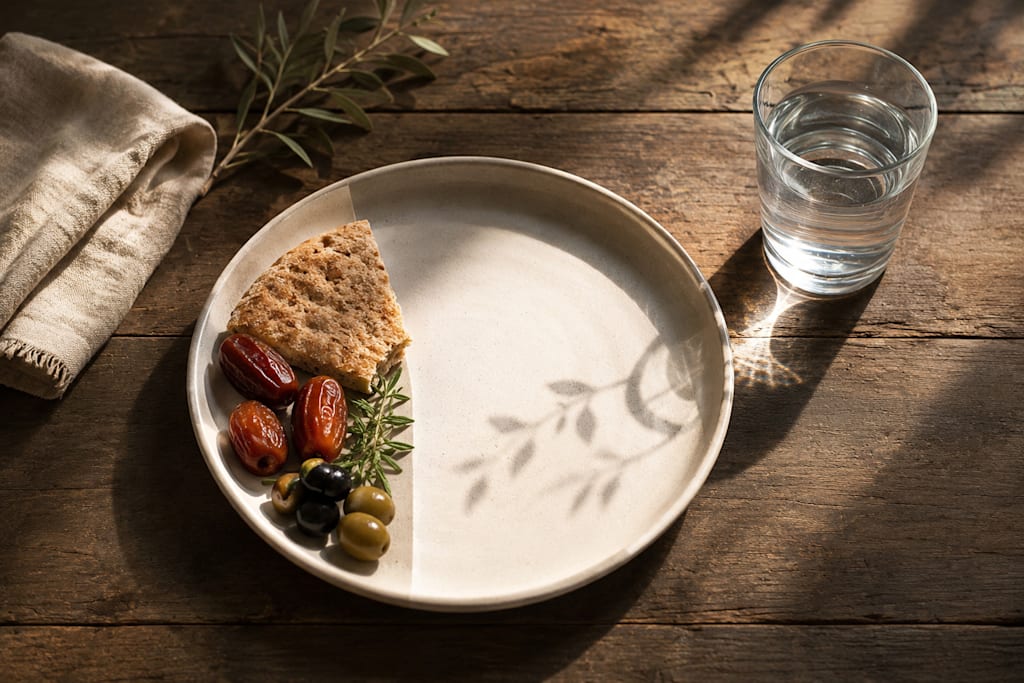
There is a moment, somewhere between the first bite and the last, where wisdom lives. Most of us never find it. We eat past it, rush through it, or ignore it entirely. But 1,400 years ago, in the deserts of Arabia, a man described it with breathtaking precision—and the world is only beginning to appreciate what he meant.
Prophet Muhammad (peace be upon him) said:
"The son of Adam fills no vessel worse than his stomach. It is sufficient for the son of Adam to eat a few mouthfuls to keep him going. But if he must fill it, then one-third for food, one-third for drink, and one-third for air." — Tirmidhi & Ibn Majah
Seven words. One-third. One-third. One-third.
Simple enough for a child. Deep enough for a lifetime.
The Body He Never Neglected
Prophet Muhammad (peace be upon him) was not a man who ignored the body in pursuit of the soul. He honored both—equally, deliberately, and wisely. His lifestyle was a masterclass in what we today call holistic health, practiced not as a trend but as a way of life guided by the Creator of the human body.
He ate, but he never overate.
He slept, but he never wasted sleep.
He moved, but he never exhausted himself needlessly.
He fasted, but he never harmed himself through excess.
In every habit, there was a middle path—and at the center of it all was the stomach, the vessel he warned us not to misuse.
Why the Stomach?
Modern gastroenterology tells us that the gut is often called "the second brain." It contains millions of nerve cells, produces a significant portion of the body's serotonin, and communicates directly with the brain through the vagus nerve. What we put into our stomach affects not only digestion but also mood, cognition, immunity, and overall well-being.
Prophet Muhammad (peace be upon him) identified the stomach as a vessel that should not be abused—long before the gut-brain connection, the microbiome, and metabolic disorders became subjects of scientific study.
He didn't need a laboratory.
He had revelation, keen observation, and a body he treated as a trust from God.
The Hidden Science of One-Third
Let us break it down—because every third carries a universe of wisdom.
The First Third — Food
Prophet Muhammad (peace be upon him) never filled his plate. He ate slowly, chewed thoroughly, and stopped before feeling completely full. Why? Because the body needs time to recognize fullness, making slow and mindful eating a healthy habit. He stopped early—not out of deprivation, but out of wisdom.
Modern research suggests that moderate eating and avoiding overeating can support long-term health. The Blue Zones—regions where many people live past 100—share one dietary habit above all others: they stop eating before they are completely full. The Okinawans call it Hara Hachi Bu—eat until 80% full. This principle closely reflects the timeless teaching of Prophet Muhammad (peace be upon him).
The Second Third — Drink
Water with meals. Not excess. Not absence. Balance.
He drank in three sips, pausing between each—a practice that encourages slow and mindful drinking. Moderation in eating and drinking has long been recognized as an important part of a healthy lifestyle.
He also encouraged mindful manners of drinking, emphasizing calmness and moderation in everyday life.
The Third Third — Air
This is perhaps the most overlooked and profound of the three. Leaving space in the stomach is not merely poetic language—it is a practical reminder to avoid overeating. An overfilled stomach can cause discomfort, make breathing feel heavier, and leave a person feeling sluggish.
By leaving one-third of the stomach empty, Prophet Muhammad (peace be upon him) taught a principle of balance and moderation that continues to inspire healthy eating habits today.
Beyond the Plate — His Full Lifestyle The one-third formula was not an isolated teaching. It was part of a balanced way of life whose principles continue to resonate with many modern approaches to health and well-being. He woke before dawn, beginning his day with purpose and discipline. He walked regularly—not simply as exercise, but as a natural part of daily life. Modern research suggests that regular walking, including after meals, can support healthy blood sugar levels and overall well-being. He used the miswak (tooth-stick) to clean his teeth—a practice that modern studies have shown possesses natural antibacterial properties and can contribute to good oral hygiene. He slept on his right side, a practice remembered and followed by millions as part of his balanced and mindful lifestyle. He encouraged calmness and moderation in all aspects of life, recognizing that emotional balance is closely connected to physical well-being. A Man Ahead of Every Era What makes the wisdom of Prophet Muhammad (peace be upon him) so extraordinary is not only its simplicity but also its completeness. Rather than offering isolated health tips, it presents a balanced way of living that brings together food, water, sleep, movement, hygiene, and emotional well-being. As scientific understanding continues to evolve, many modern findings highlight the value of balance, moderation, and healthy habits reflected in these timeless teachings. The Invitation You do not need a nutritionist, a wellness app, or a subscription meal plan. You need one habit, practiced at every meal, for the rest of your life: Stop at one-third. Leave space for water. Leave space for air. Leave space for life. Prophet Muhammad (peace be upon him) left us a principle so simple that it fits into a single sentence, yet so profound that it continues to inspire healthier living across generations.
The question was never whether this teaching was valuable. The question is whether we are willing to live by it.
“The son of Adam fills no vessel worse than his stomach.” — Prophet Muhammad (peace be upon him)
About the Creator
Muhammad Abbas
Sharing educational content, inspiring stories, and practical tips for learning, creativity, and personal growth.
Enjoyed the story? Support the Creator.
Subscribe for free to receive all their stories in your feed.
Comments
There are no comments for this story
Be the first to respond and start the conversation.